
Agentic AI in Accounts Payable: What It Means for Your Finance Team in 2026
What agentic AI actually means for accounts payable in 2026. Covers real deployments from Basware, Ramp, and Genpact, what changes for finance teams, and what you need in place first.

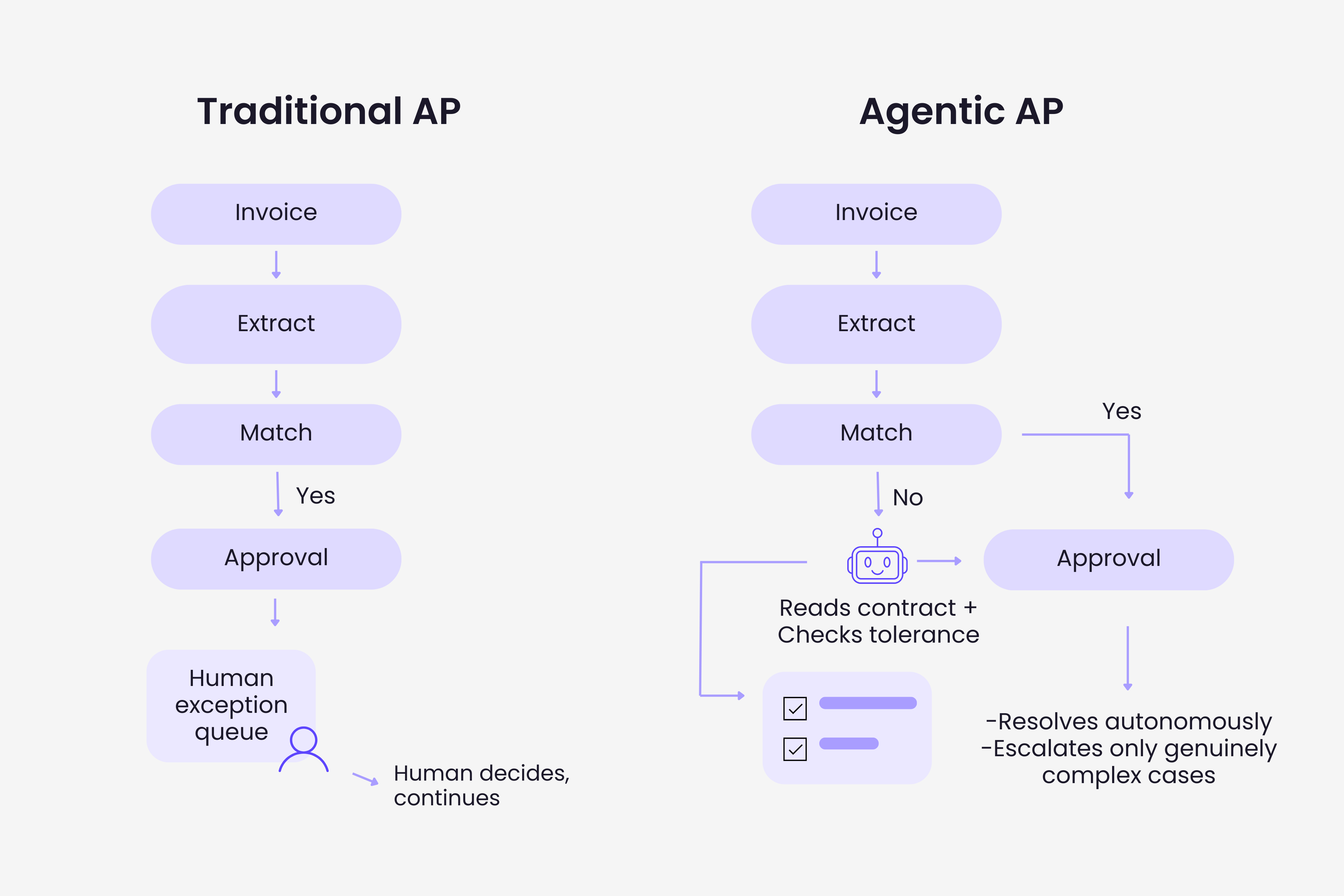
Most AP automation tools today are sophisticated rule followers. They extract data from invoices, match it against purchase orders, and route the result for approval. When something falls outside the expected pattern, they stop and wait for a human to decide what to do next. That handoff point, the exception queue, is where 30 to 40% of AP team time gets consumed.
Agentic AI changes the architecture of that handoff. Instead of stopping at an exception, an agentic system can examine the context, apply business logic, and resolve the issue autonomously within defined boundaries. It might compare a mismatched invoice against the contract terms, determine the discrepancy is within tolerance, and approve it. Or contact the vendor directly to request a corrected document. All without a human initiating the next step.
This is not a distant vision. Basware launched agentic AP capabilities in February 2026. Ramp, HighRadius, and Genpact have production agentic AP deployments running at scale. Forrester's 2026 predictions identified agentic AI as the new market differentiator in AP automation. Gartner estimates that only 15% of AP tools currently have true agentic capabilities, but expects that number to reach 60% by 2028.
What agentic AI actually means, and what it does not
The word agentic is being used loosely by vendors right now, which creates real confusion about what is actually available. A clear distinction helps.
| Traditional automation | Agentic AI | |
|---|---|---|
| Decision logic | Fixed rules set by humans in advance | Reasons from context, adapts to new situations |
| Exception handling | Stops and routes to human queue | Investigates, resolves within policy boundaries |
| Vendor communication | Human writes and sends the email | Agent drafts and sends clarification requests |
| Improvement over time | Requires manual rule updates | Learns from past decisions and corrections |
| Human role | Manages exceptions and approvals daily | Sets policy, reviews edge cases, supervises |
| Current availability | Widely deployed, mature | Early production, enterprise focus, expanding |
What agentic AP actually does in practice today
The clearest way to understand the difference is through specific tasks that agentic systems handle that rule-based systems cannot.
Exception resolution without human handoff
A traditional AP system flags a price discrepancy and routes it to an exception queue. An agentic system examines the original PO, the contract terms, and the vendor's billing history. If the discrepancy falls within the agreed tolerance, it approves the invoice and logs its reasoning. If it does not, it contacts the vendor with a specific clarification request and waits for a response before routing to a human.
Genpact reported a real example: a global food services company processing 8.5 million invoices annually cut invoice processing time from 9 minutes to 30 seconds after deploying agentic AP capture and routing, while raising auto-posting rates to 60%.
Context-aware GL coding
Traditional automation applies GL codes based on vendor rules you configure in advance. When a vendor changes their invoice format or a new vendor appears, the rule breaks and a human has to code it manually. Agentic systems learn from historical coding patterns and apply them to new situations without needing template updates. They also flag when their confidence is low rather than silently miscoding.
Fraud pattern detection beyond duplicates
Rule-based AP tools detect exact or near-exact duplicate invoices. Agentic systems can surface more subtle patterns: a vendor whose invoice amounts have crept upward over six months without a contract change, a new bank account on an invoice from a long-standing supplier, or an unusual concentration of invoices just below an approval threshold. These patterns are detectable by a human analyst who has the time and context to look for them. Agentic systems do it continuously, across all vendors, without anyone having to ask.
Autonomous vendor communication
When an invoice is missing a PO number or has an incorrect line item, someone has to contact the vendor and wait for a corrected document. In most AP teams today, that task sits in someone's inbox. Agentic systems can initiate that communication, track the response, and re-route the corrected invoice back into the processing pipeline automatically. The human only gets involved if the vendor does not respond or the correction introduces a new discrepancy.
Where agentic AP actually is in 2026. Forrester's 2026 Automation report is direct: fewer than 15% of firms have activated agentic features in their automation suites, and ROI and governance challenges are keeping most organizations on deterministic automation through the year. The technology is real and in production at enterprise scale, but widespread adoption among mid-market and smaller businesses is 2 to 3 years away. The firms building the foundation now will have better-trained models and smoother workflows when the market catches up.
What this actually changes for your finance team
The practical consequence of agentic AP is a shift in where human attention goes. This is different from saying it replaces people.
From processing to supervising. Instead of reviewing every invoice that hits an exception queue, your AP team reviews the decisions the agent made, spot-checks its reasoning, and adjusts the policy boundaries when it is wrong. This is a fundamentally different kind of work, more analytical, less repetitive.
From vendor follow-up to vendor strategy. When agents handle routine communication with vendors about invoice corrections and payment status, your team's vendor interactions shift toward payment terms negotiation, relationship management, and early payment discount optimization.
From reactive to proactive cash management. Agentic AP systems provide real-time visibility into outstanding liabilities, approval status, and payment timing. Forrester's 2026 predictions noted that by 2026, one-third of B2B transactions will involve autonomous agents managing invoicing, reconciliation, or spend control. That visibility enables strategic decisions about when to pay, when to capture discounts, and how to manage working capital, rather than just processing what arrives.
What you need in place before agentic AP makes sense
Agentic systems are only as good as the data they reason over. Organizations that have struggled to see ROI from agentic AI in finance share a common problem: fragmented data. When invoice fields, contract terms, and vendor records exist in multiple versions across different systems, agents cannot reason reliably. They replicate human errors at machine speed instead of eliminating them.
The practical prerequisites before agentic AP delivers value:
Clean, consistent invoice capture. Structured data arriving in your accounting platform from a reliable source. If invoices are still being manually entered from email attachments, fixing that is the first step, not exploring agentic AI.
Accurate vendor master data. An agent reasoning about a price discrepancy needs to know what the agreed price actually is. That requires clean vendor records, current contracts, and consistent PO data.
Defined approval policy. Agentic systems operate within policy boundaries that humans set. If your approval thresholds, tolerance limits, and escalation paths are not documented and consistent, there is nothing for the agent to enforce.
An audit trail for agent decisions. Every autonomous decision an agentic system makes needs to be logged and traceable. Basware's CEO put it plainly: autonomy without trust is just risk. Explainable, auditable decisions are not optional.
The foundation matters more than the agent. Despite 58% of finance functions using AI in some form, Gartner's 2024 research found that 86% reported no significant EBITDA impact. Auxis, analyzing early agentic AI deployments in finance, identified clean data and clear governance as the primary determinants of success. The companies getting meaningful ROI from agentic AP are the ones that solved their data and process fundamentals first.
Where the capture layer fits in an agentic finance stack
Agentic AP systems need clean, structured invoice data to reason over. They cannot agent their way around a data ingestion problem. If supplier invoices are still being manually downloaded from email and typed into accounting software, that manual step is the ceiling on how much automation is possible downstream.
Gennai sits at the ingestion layer: connecting directly to Gmail or Outlook, extracting structured invoice data automatically as emails arrive, and pushing it to Xero or QuickBooks in real time. That clean, consistent data feed is the foundation that makes more sophisticated downstream automation possible. The AI bookkeeping guide covers the full stack of how these layers connect.
The direction is clear, even if the timeline is not
Agentic AI in accounts payable is not speculative. It is in production at enterprise scale, delivering measurable results, and expanding rapidly into mid-market platforms. The question for most finance teams in 2026 is not whether this technology is real but whether their current AP process is ready to benefit from it.
The answer almost always starts the same way: get your invoice data clean, consistent, and flowing automatically into your accounting platform. Everything that comes after that, smarter matching, autonomous exception resolution, real-time cash visibility, is built on that foundation. If your capture layer is still manual, that is the right place to start.
References
- ChatFin. Agentic AI Accounts Payable 2026. chatfin.ai (February 2026)
- Basware. Basware Reveals Future of Intelligent Finance (press release). prnewswire.com (February 24, 2026)
- Forrester. Predictions 2026: The Shift From AI Hype to Hard Business Outcomes. forrester.com (December 2025)
- Forrester. Predictions 2026: Automation at the Crossroads. forrester.com (November 2025)
- Gartner (cited by ChatFin). Only 15% of AP tools currently offer true agentic capabilities; expected to reach 60% by 2028
- Genpact. From Automation to Advantage: Reinventing Accounts Payable with Agentic AI. genpact.com
- Ramp. What Is Agentic AI for Accounts Payable. ramp.com (January 2026)
- Auxis. Agentic AI for Finance and Accounting: Key Use Cases and Tips. auxis.com
- HighRadius. How Agentic AI Transforms Invoice Processing. highradius.com
- Medius. How Agentic AI Is Shaping the Next Wave of Intelligent AP Workflows. medius.com (July 2025)
- AWS (citing Forrester). Agentic AI in Financial Services. aws.amazon.com (September 2025)
- Infosys BPM. What Is Agentic AI Automation for Accounts Payable. infosysbpm.com
TL;DR
- Agentic AI in AP goes beyond rule-based automation — it reasons from context, resolves exceptions autonomously, and learns from corrections
- Basware, Ramp, HighRadius, and Genpact have production agentic AP deployments running in 2026
- A real-world example: 8.5M invoices/year processed at 30 seconds each (down from 9 minutes) with 60% auto-posting rate
- Only 15% of AP tools currently have true agentic capabilities — Gartner expects 60% by 2028
- Finance teams shift from processing to supervising: reviewing agent decisions, not handling every exception manually
- Prerequisites matter more than the AI: clean invoice capture, accurate vendor data, defined approval policies, and auditable decision trails
- 86% of finance AI deployments show no significant EBITDA impact — the gap is almost always data quality, not model capability
- The right starting point: automate your invoice capture layer first, then build toward agentic workflows on that foundation
Ready to automate your invoices?
Start extracting invoices from your email automatically with Gennai. Free plan available, no credit card required.
Start FreeRelated Articles
What to do when a supplier sends the wrong invoice
A supplier sent the wrong invoice? Here is what to do: identify the error, ask for a corrected invoice or credit note, and hold payment until it is right.
GuideABA Files Made Simple: How to Pay Australian Suppliers in Bulk Without Touching Your Bank
Generate ABA files for batch payments to Australian suppliers directly from your captured invoices. Skip the spreadsheet, skip the manual upload, pay everyone at once. Now live in Gennai.
GuideHow to Stop Chasing Invoices (And Automate the Whole Thing)
Practical guide to eliminating manual invoice chasing in 2026. Covers automated AR reminders, incoming invoice capture, approval routing, and the tools that make it work.