
Net 30 vs Net 60: What Payment Terms Really Mean for Your Cash
Net 30 vs net 60 explained for business owners: what each term means, when the clock really starts, and how the gap hits your cash on both sides.


TL;DR
- Net 30 and net 60 set a due date, not a payment date. In Western Europe about a quarter of B2B invoices are still paid after the due date (Atradius Payment Practices Barometer, Western Europe 2026).
- The clock has three possible starting points. Under EU rules the default is 30 calendar days from receipt of the invoice (Directive 2011/7/EU, article 3.3), so agree the anchor in writing.
- The same term has opposite signs. Net 60 finances you when you are buying and drains you when you are selling.
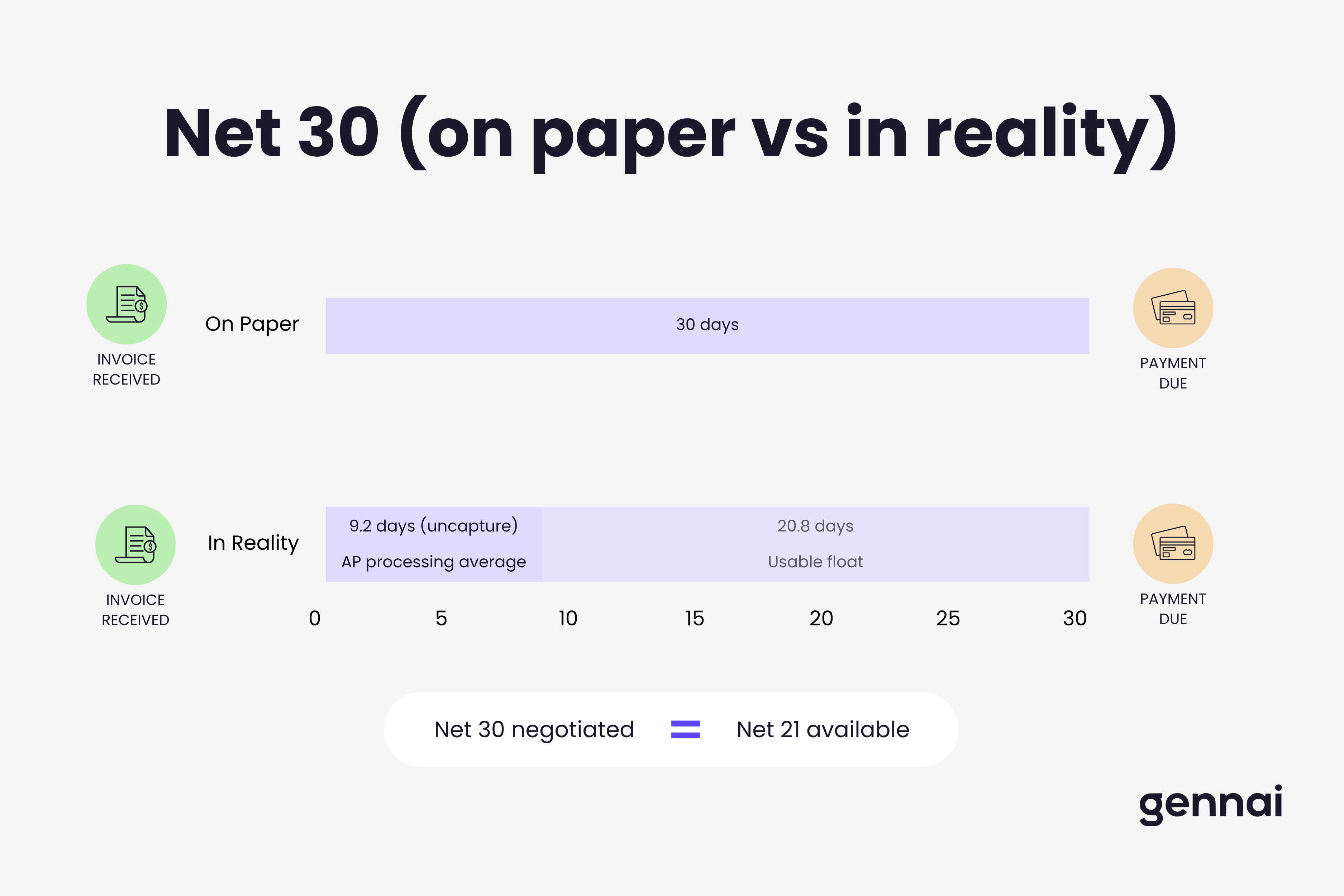
- Internal delay eats the term you negotiated. AP teams take 9.2 days on average to process one invoice (Ardent Partners 2025), which turns a net 30 bill into roughly net 21 of usable float.
- In the EU a term longer than 60 calendar days needs express agreement and must not be grossly unfair to the creditor (Directive 2011/7/EU, article 3.5).
Net 30 vs net 60 comes down to one thing: net 30 means the invoice is due 30 calendar days after the agreed starting point, and net 60 gives the payer twice as long. Neither is a discount, a penalty or a grace period. Each is a short-term loan, and the only question worth asking is which direction the loan runs. Accept a net 60 invoice and your supplier is financing you. Issue one and you are financing your customer. Most owners set their payment terms once, copy them into every contract, and never look again. That is how a healthy profit and loss statement ends up attached to an empty bank account.
What net 30 and net 60 actually mean
"Net" means the full invoiced amount with nothing deducted. The number after it counts calendar days, not business days, that the payer has before the invoice falls due. Net 30 is due 30 calendar days from the agreed starting point. Net 60 is due 60. That is the entire definition, and everything that matters happens around it rather than inside it.
The terms you will actually meet:
- Net 15. Common for freelancers and small service suppliers who cannot carry a month of float on their own balance sheet.
- Net 30. The working default across most B2B markets in the US, the UK and Europe.
- Net 45 and net 60. Standard once a large corporate, a retail group or a construction contractor is the buyer, because their working capital policy sets the terms, not yours.
- Net 30 EOM. Due 30 days after the end of the month of issue, so an invoice dated the 2nd quietly gets close to 60 days.
- 2/10 net 30. Pay in full within 30 days, or take 2% off by paying within 10.
Net 30 vs net 60, side by side
The same term reads in opposite directions depending on which side of the invoice you are standing on. This is the core of accounts payable vs accounts receivable: one is money you owe, the other is money owed to you, and a payment term moves both at once.
| Term | When you are paying | When you are being paid | Where you see it |
|---|---|---|---|
| Net 15 | Almost no float, near immediate cash out | Fastest cash in, best for thin reserves | Freelancers, small agencies, trades |
| Net 30 | One clean billing cycle of breathing room | Predictable, matches a monthly close | The default in most B2B contracts |
| Net 45 to net 60 | Two months of free supplier financing | Two months of your cash sitting in someone else's account | Large corporates, retail, construction |
| 2/10 net 30 | 2% saving if you can pay on day 10 | Faster cash, at a real cost per invoice | Wholesale and distribution |
When the clock actually starts
This is the part that costs owners money, and it almost never appears in the negotiation. "Net 30" is meaningless until you say net 30 from what. There are three common starting points, and they can sit a week or more apart:
- The invoice date. What most suppliers assume. Favours the supplier, because time spent in transit is time off your clock.
- Delivery of the goods or completion of the service. Common in supply contracts and usually the earliest of the three.
- Receipt of the invoice. The fairest anchor for the buyer, and the one European law defaults to.
Under EU rules the entitlement to late payment interest kicks in "30 calendar days following the date of receipt by the debtor of the invoice or an equivalent request for payment" when the contract is silent (Directive 2011/7/EU, article 3.3). In the US, federal agencies pay 30 days after receipt of a proper invoice under the Prompt Payment Act (5 CFR 1315.4).
Notice what both of those have in common. The clock starts when the invoice arrives, not when it was written. If you are the buyer, get that into the contract in one sentence. If you are the supplier, send the invoice the day you issue it, because a week in someone's outbox is a week of your own cash.
The 30 days you never actually get
Here is the gap between the term on paper and the cash in your account. Receiving an invoice is not the same as knowing you received it. Accounts payable teams take 9.2 days on average to process a single invoice from arrival to ready for payment (Ardent Partners, Accounts Payable Metrics That Matter in 2025), at an average cost of 9.40 USD each.
Apply that to a net 30 bill. If the invoice lands in a shared inbox on day 0 and reaches the person who approves it on day 9, you have roughly 21 days of usable float and about 20 days to query anything wrong with it. You negotiated net 30. You are operating on net 21. On net 60 the same delay hurts proportionally less, which is one of the quieter reasons finance teams push for longer terms rather than fixing the intake.
There is a pattern worth naming here, because it shows up again and again in accounts payable inboxes. The suppliers with the tightest terms are frequently the ones whose invoices arrive as an inline HTML email with no PDF attached, since they tend to be software, ads and cloud vendors billing monthly. Those are precisely the invoices a human eye skims past and a filter misses. The term says net 15. The outcome is a late fee on a bill nobody meant to be late on. Shortening your own terms will not touch that problem, and neither will the accounts payable process itself if the invoice never enters it.
What net 60 does when you are the one waiting
Flip sides and net 60 stops looking clever. In Western Europe roughly a quarter of B2B invoices are still paid after the due date, and days sales outstanding sits slightly above one month across the region (Atradius Payment Practices Barometer, Western Europe 2026). Net 60 plus that habit is a real collection cycle closer to 75 days.
The consequences land hardest on small businesses. In the US, 59% of small businesses report invoices overdue by 30 days or more, up from 47% a year earlier, and 39% of owners say a single late payment made it difficult to cover payroll or other bills in the past year (Intuit QuickBooks, 2026 Small Business Late Payments Report). A term is a promise about a date. It is not a promise about behaviour, and if you want to understand why invoices get paid late even when the money exists, the answer is usually process rather than intent.
How long a payment term is allowed to be
Terms are not unlimited, and most owners do not know they have leverage here.
In the EU, a contractual payment period above 60 calendar days requires express agreement in the contract and must not be grossly unfair to the creditor (Directive 2011/7/EU, article 3.5). When a payment is late, statutory interest runs at the reference rate plus at least 8 percentage points (article 2), and the creditor is entitled to a minimum fixed sum of 40 EUR in recovery costs without needing to send a reminder (article 6).
In the UK, statutory interest on a late commercial debt is 8% plus the Bank of England base rate under the Late Payment of Commercial Debts (Interest) Act 1998, and it can be claimed for up to 6 years from the end of the agreed payment period (Office of the Small Business Commissioner).
Most small suppliers never invoke any of this. Putting the clause in your terms is still worth doing, because it changes the conversation from a favour you are asking for into a right you are choosing not to enforce yet.
Picking your terms without guessing
A practical way to decide, whichever side you are on:
- If you are buying, treat net 30 as your floor and ask for it in writing anchored to invoice receipt. Ask for net 45 or net 60 only when your working capital genuinely needs it, and never as a workaround for invoices you found too late.
- If you are selling, shorter terms only work when you enforce them. Net 15 that everyone pays on day 40 is worse than net 30 that is respected, because it destroys your ability to forecast.
- On early payment discounts, do the arithmetic before you accept one. Skipping a 2/10 net 30 discount is equivalent to borrowing at roughly 36.72% a year (AccountingTools). If your cash costs you less than that, taking the discount is one of the cheapest returns available to a small business. If it costs more, keep the 20 days.
- Match your terms on both sides. Paying net 30 while collecting net 60 means you are funding a gap of 30 days out of your own reserves, every single cycle.
What changing your terms will not fix
Terms decide the due date. They do nothing about the four failures that actually cause late payments in a small business: the invoice that never got seen, the one that got entered twice, the one sitting in a personal mailbox while its owner is on holiday, and the one nobody could find at month end. None of those are negotiation problems.
That is the honest limit of this article. You can renegotiate every supplier to net 60 and still pay late, because the constraint was never the deadline. It was the 9 days before anyone knew the bill existed.
If your invoices arrive by email, which for most businesses is nearly all of them, the fix is upstream of the term. An automatic capture layer reads the inbox, pulls out every supplier invoice including the inline ones with no attachment, extracts the amount, the supplier and the due date, and pushes it into Xero, QuickBooks or Holded already organised. The term you negotiated then becomes the term you actually get to use, instead of chasing invoices one at a time at the end of every month.
Frequently asked questions
Is net 30 counted in business days or calendar days?
Calendar days, unless the contract explicitly says otherwise. A net 30 invoice issued on 1 September is due on 1 October, weekends and public holidays included. If you need business days, you have to write it into the contract, because no market convention gives them to you.
Can I charge interest when a customer pays a net 30 invoice late?
In the UK, yes. Statutory interest on a late commercial debt is 8% plus the Bank of England base rate under the Late Payment of Commercial Debts (Interest) Act 1998, and you can claim it for up to 6 years from the end of the agreed payment period. Across the EU, Directive 2011/7/EU sets statutory interest at the reference rate plus at least 8 percentage points, plus a minimum of 40 EUR in recovery costs, with no reminder required.
Is net 60 bad for a small business?
It depends which side of the invoice you are on. Receiving net 60 terms from your suppliers is free working capital. Offering net 60 to your customers means two months of your own cash sitting in their account, and that is before anyone pays late. The problem is running both at once, paying on net 30 while collecting on net 60.
What does 2/10 net 30 mean and is it worth taking?
It means you can deduct 2% from the invoice if you pay within 10 days, otherwise the full amount is due on day 30. Skipping that discount is roughly equivalent to borrowing at 36.72% a year, so if your own cost of cash is lower than that, taking it is one of the better returns available to a small business.
Payment terms are worth getting right, but they only pay off if the invoice reaches your books while the clock is still running. Gennai connects to Gmail or Outlook, finds every supplier invoice that arrives there including the inline ones with no attachment, organises them with the supplier, amount and due date already extracted, and exports them to Xero, QuickBooks or Holded. You keep the days you negotiated instead of losing them to an inbox. The free plan needs no credit card, and connecting a mailbox takes about a minute.
Ready to automate your invoices?
Start extracting invoices from your email automatically with Gennai. Free plan available, no credit card required.
Start FreeRelated Articles
Accounts Payable Turnover Ratio Explained
The accounts payable turnover ratio shows how fast you pay suppliers. Get the formula, a worked example, benchmarks and what your number really means.
GuideThe Accounts Payable Process, Step by Step (for Owners)
The accounts payable process has five steps: receive, verify, approve, pay, and record each invoice. Here is how each works and where owners lose money.
GuideInvoice vs receipt: which one your accountant actually wants
Invoice vs receipt explained: the invoice records the expense and supports a VAT or GST reclaim, the receipt only proves you paid. Here is which one to keep.