
Accounts Payable vs Accounts Receivable: A Business Owner's Plain-English Guide
Accounts payable vs accounts receivable, explained in plain English: what each one means, how they shape your cash flow, and why the difference matters.

TL;DR
- Accounts payable is money your business owes suppliers. Accounts receivable is money customers owe you. AP is cash out, AR is cash in.
- Both are promises, not cash in hand. A big receivables figure is not money in the bank, and payables can still squeeze you if they all come due at once.
- The gap between how fast customers pay you (DSO) and how fast you pay suppliers (DPO) is where your working capital lives.
- Owners chase the receivable side because it feels urgent, while the payable side leaks quietly through invoices lost in email. Intuit QuickBooks found 56% of US small businesses are owed money on unpaid invoices, over 17,000 USD each on average (2025).
- AP is a liability, AR is an asset. They are not the same as expenses or revenue, and one tool rarely handles both sides well.
Accounts payable vs accounts receivable in one line
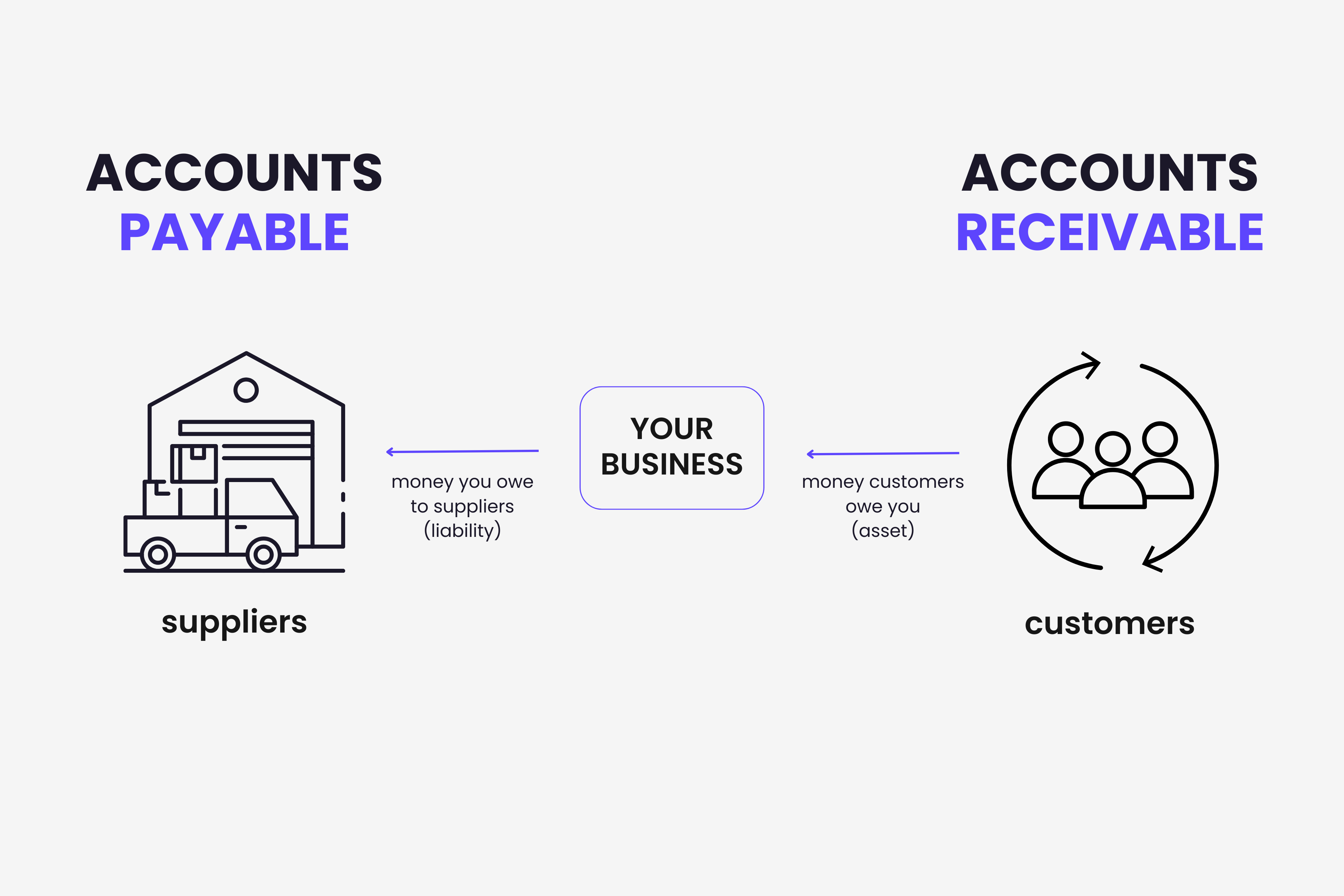
Accounts payable vs accounts receivable comes down to direction. Accounts payable is the money your business owes to suppliers for goods and services you have already received. Accounts receivable is the money your customers owe you for work you have already delivered. One is cash leaving, the other is cash arriving. Mix them up and your view of what you can actually spend this month is off.
Here is the part most owners miss: both are promises, not cash in hand. A healthy receivables number is not money in the bank, and a manageable payables number can still sink you if it all comes due the same week your customers decide to pay late.
What is accounts payable?
Accounts payable, usually shortened to AP, is what your business owes. Every supplier bill that lands in your inbox becomes a payable the moment you receive it and before the money leaves your account: the wholesaler, the SaaS subscription, the contractor you brought in for a project. On your balance sheet it sits as a short-term liability until it is paid.
A quick example. A cafe orders 800 EUR of coffee beans on 30-day terms. The invoice arrives today, the beans arrive today, but the cash does not move for a month. For those 30 days that 800 EUR is accounts payable: a real obligation you have taken on, even though nothing has left your bank yet.
The AP side is where quiet cash discipline lives, and it is slower than most owners think. Ardent Partners puts the average time to process a single supplier invoice at 9.2 days (Ardent Partners, AP Metrics That Matter 2025), and that is before the money even moves. For a small team, most of that delay is not decision-making, it is invoices sitting uncaptured in an inbox. If you want to go deeper on the operational side, our guide to automating accounts payable walks through it, and there is a version written specifically for AP in teams under 10 people.
What is accounts receivable?
Accounts receivable, or AR, is the mirror image: what other people owe you. You finish the work, send the invoice, and until the customer pays, that amount sits on your balance sheet as an asset. It is revenue you have earned but not yet collected.
This is the side owners feel most, because unpaid invoices hit cash flow directly. In the 2025 US Small Business Late Payments Report, Intuit QuickBooks found that 56% of small businesses are owed money from unpaid invoices, more than 17,000 USD each on average, and that businesses carrying a higher volume of overdue invoices were about 1.4 times more likely to report cash flow problems (Intuit QuickBooks, 2025). The waiting is real too: Xero Small Business Insights recorded US small businesses waiting on average 28.8 days to be paid in early 2026 (Xero Small Business Insights).
Because the pain is so visible, AR is usually the side owners chase hardest. That instinct is right, and there is a whole discipline around getting paid faster, from tighter terms to automated reminders, which we cover in why invoices get paid late.
The difference at a glance
| Question | Accounts payable (AP) | Accounts receivable (AR) |
|---|---|---|
| Who owes whom? | You owe a supplier | A customer owes you |
| Cash direction | Money going out | Money coming in |
| On the balance sheet | Liability | Asset |
| Triggered by | A bill you receive | An invoice you send |
| The job to be done | Capture, code, approve, pay | Issue, track, collect |
| What goes wrong | Invoices lost in email, paid late or twice | Customers pay slowly, cash gets stuck |
Why the gap between them decides your cash flow
There are two numbers that turn AP and AR into a cash flow story. Days sales outstanding (DSO) is how long, on average, your customers take to pay you. Days payable outstanding (DPO) is how long you take to pay your suppliers. The space between those two is where your working capital lives.
If your customers pay you in 45 days but your suppliers expect payment in 15, you are funding a 30-day gap out of your own pocket, every cycle. Widen your DPO or shorten your DSO and that gap narrows. This is why the difference between payable and receivable is not an accounting technicality. It is the reason a profitable business can still run out of cash: the profit is real, but it is trapped in receivables while the payables come due first.
Where business owners actually mix them up
After watching how invoices move through real inboxes, the pattern is consistent. Owners pour energy into the receivable side, because a customer who has not paid is a conversation you can feel, and chasing that money feels urgent. Meanwhile the payable side leaks quietly. A supplier invoice arrives as an inline email with no attachment, gets skimmed, and is never filed. Nobody is chasing you for it in the moment, so it disappears until month-end, or until the second copy arrives and gets paid twice.
That asymmetry is the real trap. AR problems announce themselves. AP problems hide, and the cost shows up later as missed tax deductions, duplicate payments, and a month-end close that drags because half the bills were never captured. The fix is to stop treating the inbox as your AP system and to separate the two jobs cleanly, which is exactly the point of splitting the AR chase from the AP capture and automating each. If you want the numbers behind the payable side specifically, the CFO view of AP automation ROI lays out where the money actually goes.
What AP and AR are not
A few clarifications that save owners from expensive confusion.
- Accounts payable is not the same as an expense. The expense is the cost of the coffee beans. The payable is the unpaid obligation to the supplier that exists until you settle the bill. The distinction between the document that records the cost and the one that just proves payment matters here too, which is what our guide on invoice vs receipt is about.
- Accounts receivable is not revenue you can spend. You can book the revenue when the invoice goes out, but the cash is not yours until it clears. Spending against uncollected AR is how solvent businesses get caught short.
- Neither is optional. Both are formal balance-sheet positions, not just admin. Your accountant needs both sides clean to close the books and to file correctly.
- One tool does not automatically handle both well. Software that is great at issuing and collecting your invoices (the AR side) usually does very little for capturing the supplier bills that hit your inbox (the AP side), and the reverse is just as true.
The one to fix first
If you only tighten one side this quarter, look at whichever one is quietly costing you. For most owners the receivable side is already getting attention. The payable side, the pile of supplier invoices scattered across Gmail and Outlook, is usually the one bleeding money without anyone noticing. Getting every incoming bill captured, coded, and ready for your accountant the moment it arrives is the unglamorous half of the equation, and it is where Gennai starts. You can connect an inbox and try it free, no card required, and see a month of missed invoices surface in one pass.
Frequently asked questions
Is accounts payable a debit or a credit?
Accounts payable is a liability, so it normally carries a credit balance. When a supplier bill is recorded you credit accounts payable and debit the relevant expense or asset account. When you pay the bill, you debit accounts payable to clear it and credit cash. If bookkeeping mechanics like this are new to you, a plain-English primer on the fundamentals will help more than memorizing the rule.
Can one system manage both accounts payable and accounts receivable?
Your accounting platform records both, but the day-to-day work is different. Receivables are about issuing invoices and collecting payment, while payables are about capturing supplier bills that arrive by email, coding them, and getting them approved. Most businesses end up using a dedicated tool for the side that hurts most, and for many that is the incoming supplier bills.
Is accounts receivable an asset or a liability?
Accounts receivable is an asset, because it represents money owed to you that you expect to collect. Accounts payable is a liability, because it represents money you owe others. They sit on opposite sides of the balance sheet, which is the clearest way to remember which is which.
Accounts payable and accounts receivable are two sides of the same cash position, and the payable side is usually the one quietly leaking money through invoices buried in email. Gennai captures every supplier bill from your inbox automatically, extracts the data, and exports to Xero, QuickBooks, or Holded, so your accountant gets clean payables without the chase. Connect an inbox and try it free, no card required.
Ready to automate your invoices?
Start extracting invoices from your email automatically with Gennai. Free plan available, no credit card required.
Start FreeRelated Articles
What Is Accounts Payable? A No-Jargon Guide for Owners Who Aren't Accountants
Accounts payable is every unpaid supplier bill your business owes. Learn what AP means, the 5 steps it involves, and where owners lose invoices.
GuideDSO vs DPO Explained: The Two Numbers Behind Your Cash Position
DSO vs DPO explained in plain English: what each number means, the formulas, healthy benchmarks, and how the gap between them decides your cash position.
GuideInvoice vs receipt: which one your accountant actually wants
Invoice vs receipt explained: the invoice records the expense and supports a VAT or GST reclaim, the receipt only proves you paid. Here is which one to keep.