
Accounts Receivable Explained: The Money Owed to You
Accounts receivable is the money your customers owe you for work already done. Learn what AR means, how it affects your cash, and how it differs from AP.

TL;DR
- Accounts receivable is the money customers owe you for goods or services already delivered but not yet paid. It is recorded as a current asset.
- AR is the mirror of accounts payable. AR is money coming in, AP is money going out. You need both under control to read your cash.
- Days sales outstanding (DSO) is how long you wait to get paid. US businesses average about 67 days despite roughly 28-day terms (Atradius).
- The older an unpaid invoice gets, the less you collect. Around 26% of receivables are uncollectible after 90 days and about 90% after a year (US Census Bureau data).
- Gennai does not chase receivables. It works on the accounts payable side, capturing the supplier invoices you receive.
Accounts receivable, in one sentence
What is accounts receivable? Accounts receivable, usually shortened to AR, is the money your customers owe you for goods or services you have already delivered but not yet been paid for. Every invoice you have sent that has not landed in your bank account yet is an account receivable. In accounting terms it is a current asset, something you own and expect to turn into cash soon, and it is the exact mirror of accounts payable, which is what you owe your own suppliers.
If you run a small business and you are not an accountant, here is the version that matters. Accounts receivable is money you have earned but do not have yet. It is real value sitting on your books, but you cannot spend a receivable. It only helps you once it becomes cash, and the gap between the two is where plenty of otherwise healthy businesses get into trouble.
Accounts receivable vs accounts payable
They are two halves of the same cash cycle, and owners mix them up constantly. Accounts receivable is money coming in, what customers owe you. Accounts payable is money going out, what you owe suppliers. One fills your bank account, the other drains it, and you need both under control to know whether your cash actually balances.
| Accounts receivable (AR) | Accounts payable (AP) | |
|---|---|---|
| Who owes whom | Customers owe you | You owe suppliers |
| On the balance sheet | Current asset | Current liability |
| Cash effect | Money arriving soon | Money leaving soon |
| The document | Invoices you send | Bills you receive |
| The risk if ignored | Cash you never collect | Late fees, strained suppliers |
What actually happens in accounts receivable: the cycle
Accounts receivable is not a single moment. It is a short cycle that every sale on credit runs through.
- Agree the terms. Before the work starts, you set when payment is due, for example within 30 days of the invoice, often written as Net 30.
- Deliver and invoice. You do the work or ship the goods, then send an invoice that states the amount, the due date, and how to pay.
- Track what is owed. The invoice becomes a receivable and sits on your books until it is paid. This is where an aging report, a simple list of who owes what and for how long, earns its keep.
- Follow up. If the due date passes, you remind the customer, politely at first and more firmly as the invoice ages.
- Record the payment. When the money arrives, you clear the receivable and match it to the invoice, so your books and your tax return stay correct.
Days sales outstanding: how long your money takes to arrive
The single most useful number in accounts receivable is days sales outstanding, or DSO. It is the average number of days it takes you to get paid after sending an invoice. The formula is simple: accounts receivable divided by total credit sales, multiplied by the number of days in the period.
Here is the uncomfortable part. Most businesses offer around 28-day payment terms, yet the average DSO in the US sits near 67 days (Atradius). That gap, more than a month of work already done and still unpaid, is money you have earned but cannot use. What counts as a normal DSO depends heavily on your industry.
| Industry | Typical DSO |
|---|---|
| Retail and e-commerce | 5 to 20 days |
| SaaS | 30 to 45 days |
| Professional services | 30 to 60 days |
| Manufacturing | 45 to 60 days |
| Construction | 60 to 90+ days |
Why accounts receivable is really about cash
Accounts receivable looks like an accounting entry, but it behaves like a cash problem. In the US, 39% of invoices are paid late (Atradius), and 56% of small businesses are carrying unpaid customer invoices at any given time, an average of 17,500 USD tied up per business (Intuit QuickBooks 2025).
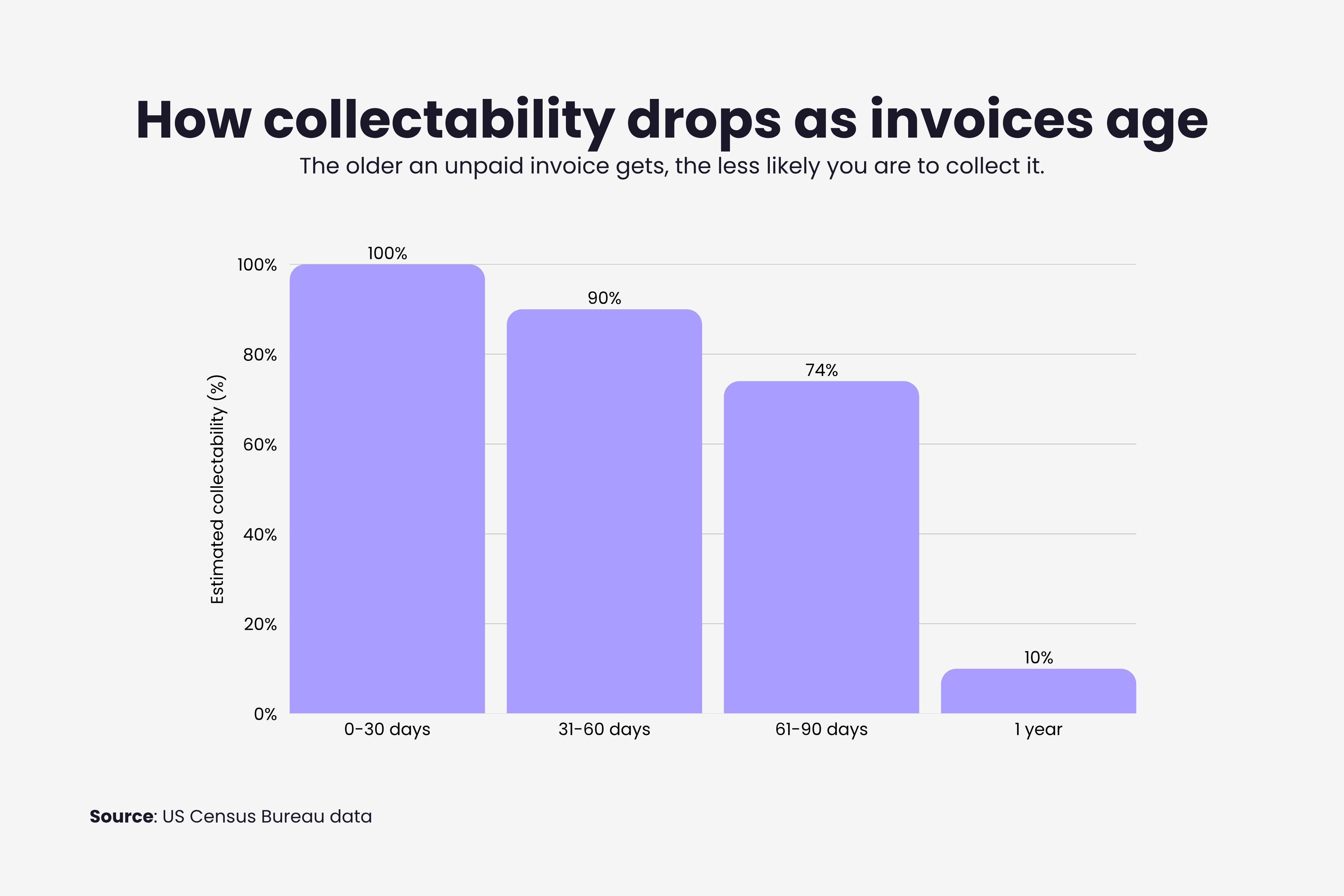
The longer an invoice goes unpaid, the less likely you are to ever see the money. On average, companies write off about 4% of their receivables as bad debt (Sage), and the odds worsen sharply with age: roughly 26% of receivables are uncollectible after 90 days, and about 90% after a year (US Census Bureau data). That is why chasing invoices you have already sent early and consistently matters more than almost anything else you do with AR.
Accounts receivable and accounts payable: the honest bit
A quick, honest note, because this is a Gennai guide and we would rather be useful than salesy. Plenty of tools help you chase and collect receivables. Gennai is not one of them. Gennai works on the other side of your cash, the supplier invoices you receive, capturing them automatically from your inbox so nothing you owe goes missing and your books stay complete. We explain accounts receivable here because you cannot understand your cash by looking at only one side, and because clean records on both sides are what let you close your books on time. If collecting faster is your main priority, a dedicated AR or invoicing tool is the right place to look.
How to keep accounts receivable under control
You do not need software to run AR well. A few habits do most of the work.
- Set terms in writing before you start. Agree the due date and payment method up front, so a late payment is a clear breach rather than a misunderstanding.
- Invoice the moment the work is done. Every day you wait to send the invoice is a day added to DSO before the clock even starts.
- Make paying easy. Put the amount, the due date, and a payment method where the customer cannot miss them.
- Follow up on a schedule. A friendly reminder a few days before the due date, and again the day after, collects more than an awkward call three months later.
- Watch the aging report. Sort what you are owed by how overdue it is, and chase the oldest invoices first.
Frequently asked questions
Is accounts receivable an asset or a liability?
Accounts receivable is an asset, specifically a current asset, because it is money owed to you that you expect to collect within a year. It sits on the balance sheet, not on the profit and loss statement.
Is accounts receivable a debit or a credit?
When you send an invoice, you debit accounts receivable, so the asset goes up, and you credit sales. When the customer pays, you credit accounts receivable to clear it and debit your bank account. In plain terms, AR rises when you invoice and falls when you get paid.
What is the difference between accounts receivable and accounts payable?
Accounts receivable is money your customers owe you. Accounts payable is money you owe your suppliers. AR is cash on its way in, AP is cash on its way out. Most businesses have both running at the same time.
What is a good DSO?
Lower is better, but a good DSO depends on your payment terms and your industry. A common rule of thumb is that healthy DSO stays within about 1.5 times your terms, so around 45 days on Net 30. Judge yourself against your own trend and your sector rather than a single universal number.
Accounts receivable is the money owed to you. Accounts payable is the money you owe, and that is the side Gennai takes off your plate. It connects to your inbox, pulls out every supplier invoice automatically, and sends it to Xero, QuickBooks, or Holded already organized, so the money-out side of your books is never the thing holding up your close. You can try it free, with no credit card, and point it at last year's inbox to see what slipped through. Get one side of your cash running itself, then tackle the other.