
Debits and Credits Explained Without the Jargon
Debits and credits explained without the jargon. What each one really means, the one rule that always holds, and how to read them without an accounting degree.

What debits and credits actually mean
Debits and credits are the two sides of every entry in double-entry bookkeeping: a debit records value going into one account, and a credit records the matching value leaving another. They are not good and bad, and they are not the same as the debit and credit on your bank statement. Every time your business records a transaction, one account is debited and another is credited by the same amount, so the books always balance.
This is the system nearly every business on earth runs on, and it has barely changed since a Franciscan friar named Luca Pacioli set it down in his 1494 book Summa de Arithmetica, which is why he is often called the father of accounting (ICAEW). You do not need an accounting degree to follow it. You need one rule and a couple of plain examples, and that is what the rest of this guide gives you.
TL;DR
- A debit is not a loss and a credit is not a gain. They are just the left and right side of an accounting entry.
- The rule that never breaks: in every transaction, total debits equal total credits, so the accounting equation stays balanced (ACCA).
- Debits increase assets and expenses. Credits increase liabilities, equity and income. That one table is most of what you need.
- Your bank statement uses the words the opposite way, because it is written from the bank's point of view, not yours.
- Modern accounting software applies double-entry for you, so understanding it is about reading your numbers, not posting them by hand.
Debits and credits are not good and bad
The single biggest source of confusion is the belief that a debit is negative and a credit is positive. In bookkeeping that is not what the words mean. Debit simply means the left side of an account, and credit means the right side. Nothing more.
Whether a debit is "more" or "less" depends entirely on the type of account it lands in. A debit adds to your cash but reduces what you owe. A credit reduces your cash but adds to your sales. So the same word points in different directions depending on where you write it. Once you stop reading debit as "bad" and credit as "good", the rest falls into place quickly.
The one rule that never changes
Double-entry bookkeeping rests on a single idea: every transaction has two sides, and the two sides are always equal. Buy something and money leaves one place and value arrives in another. Sell something and value leaves while money, or a promise of money, arrives.
That is why the totals always match. In any correct set of books, the sum of all debits equals the sum of all credits. ACCA describes this as the dual aspect of every transaction, and it is what keeps the accounting equation in balance: assets equal liabilities plus equity, or in plainer terms, what the business owns equals what it owes plus what the owners have put in (ACCA). If your debits and credits do not match, something is missing or miskeyed. That built-in check is the whole point of the system.
What a debit increases, and what a credit increases
Here is the part worth keeping. Every account in your books is one of five types, and the type decides whether a debit raises the balance or lowers it. This table is roughly 90% of debits and credits in practice.
| Account type | What it covers | A debit does | A credit does |
|---|---|---|---|
| Assets | Cash, equipment, stock, money owed to you | Increases | Decreases |
| Expenses | Rent, software, supplies, wages | Increases | Decreases |
| Liabilities | Loans, tax owed, unpaid supplier bills | Decreases | Increases |
| Equity | The owner's stake in the business | Decreases | Increases |
| Income | Sales and other revenue | Decreases | Increases |
A worked example in plain English
Take three things a business owner does in a normal week.
You pay 600 USD for a year of accounting software by bank transfer. The software is an expense, so you debit Software expense 600, which raises the expense. The money left your account, so you credit Bank 600, which lowers that asset. One debit, one credit, both 600.
A supplier sends a bill for 900 USD due in 30 days, and you have not paid it yet. You received the service, so you debit the expense 900. You now owe the supplier, so you credit Accounts payable 900, which raises a liability. When you pay it next month, you debit Accounts payable 900 to clear the debt and credit Bank 900 as the cash goes out. This is where the line between money you owe and money owed to you starts to matter, and it is worth understanding how accounts payable and accounts receivable differ before month-end.
You invoice a customer 1,500 USD. They now owe you, so you debit Accounts receivable 1,500, raising an asset. You earned the income, so you credit Sales 1,500. When they pay, you debit Bank 1,500 and credit Accounts receivable 1,500 to close it out.
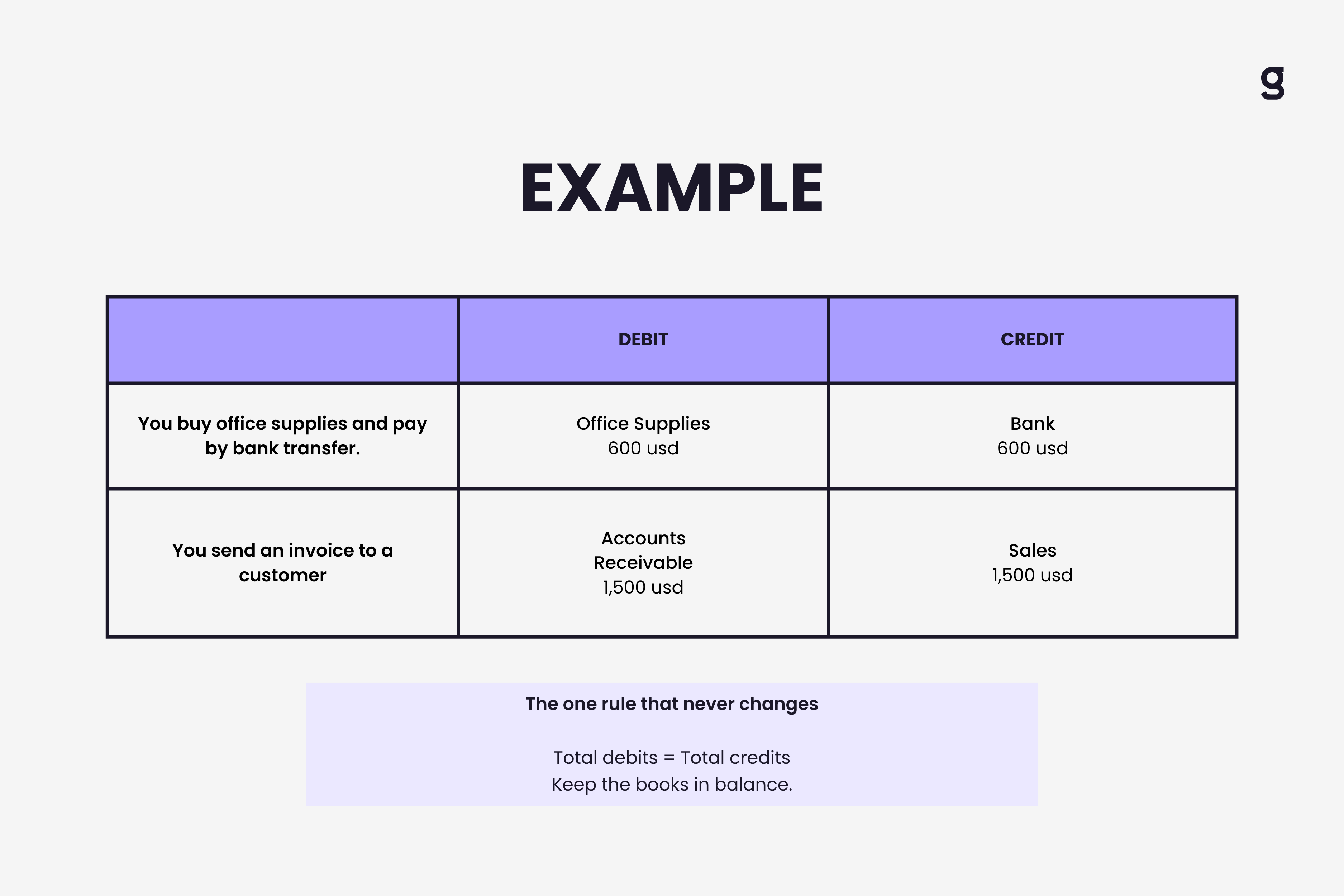
Notice the pattern. In every case the debit and the credit are equal, and each one lands in the account type the table above predicts. Nothing exotic happens. It is the same rule applied over and over.
Why your bank statement calls it the opposite
This is the confusion that trips up almost everyone. Your bank says it "credited" your account and your balance went up, so credit must mean more money, right? On your own books it is the reverse.
The reason is simple once you see it. A bank statement is written from the bank's point of view, not yours. To the bank, the money you deposit is money it owes back to you, which is a liability on its books, and a credit increases a liability. On your own books, that same cash arriving is an asset going up, which is a debit. Same event, opposite label, because you are looking at two different sets of books. Your accounting software always records from your business's side, so trust the table above, not the wording on your statement.
Where debits and credits show up for a business owner
Even if you never post an entry yourself, this is running underneath everything. Both HMRC and the IRS expect a business to keep a clear record of every sale and every expense. HMRC requires you to keep records of all sales and income and all business expenses, backed by receipts, bank statements and invoices (GOV.UK). The IRS puts it in bookkeeping terms directly, describing a summary of your business transactions kept in accounting journals and ledgers, with invoices and receipts as the supporting documents behind each entry (IRS).
Those journals and ledgers are exactly where debits and credits live. And the supporting document matters as much as the entry, because the right paperwork is what lets you claim the expense at all. If you are ever unsure whether you need an invoice or a receipt to back a purchase, that distinction decides what your accountant can actually book. In practice, most of those documents now arrive by email, which is where they tend to get lost before they ever reach the ledger. Getting them out of the inbox and into your books reliably is half the battle, and tools that pull invoices straight from your email exist precisely because that step breaks so often.
Do you actually need to memorize all this?
Honestly, no, not to run a business. You will almost never sit down and post a manual journal entry. Your accounting software applies double-entry automatically every time a transaction is recorded, and AI increasingly handles the categorization and coding before an invoice even reaches your books. If you want to see how far that has gone, the complete guide to AI bookkeeping walks through what is automated today and what still needs a human.
What understanding debits and credits does give you is the ability to read a report without guessing, to spot when a number looks wrong, and to hold a real conversation with your accountant instead of nodding along. That is worth the ten minutes it takes to learn. The mechanics can stay with the software.
Frequently asked questions
Is a debit positive or negative?
Neither. A debit just means the left side of an account. It increases assets and expenses and decreases liabilities, equity and income. Whether it means more or less money depends entirely on the account it lands in.
Do debits or credits increase an expense?
Debits increase an expense. When you record a cost such as rent or software, you debit the expense account and credit whatever you paid with, usually your bank or accounts payable.
What is the difference between a debit and a credit in simple terms?
A debit is the left side of an entry and a credit is the right side. Every transaction has both, and they are always equal, so the books stay balanced. The account type decides which one raises the balance.
Why must debits always equal credits?
Because every transaction has two sides of equal value: something comes in and something goes out. Recording both keeps the accounting equation in balance and gives the books a built-in error check, which is the whole purpose of double-entry.
Debits and credits are simpler than they look once you stop reading them as good and bad. The harder part is making sure every invoice and receipt actually reaches your books in the first place. Gennai finds the invoices sitting in your email, pulls out the data and organizes them, ready to export to Xero, QuickBooks or Holded. You can try it free, no card needed.
Ready to automate your invoices?
Start extracting invoices from your email automatically with Gennai. Free plan available, no credit card required.
Start FreeRelated Articles
Accounts Payable Turnover Ratio Explained
The accounts payable turnover ratio shows how fast you pay suppliers. Get the formula, a worked example, benchmarks and what your number really means.
GuideNet 30 vs Net 60: What Payment Terms Really Mean for Your Cash
Net 30 vs net 60 explained for business owners: what each term means, when the clock really starts, and how the gap hits your cash on both sides.
GuideThe Accounts Payable Process, Step by Step (for Owners)
The accounts payable process has five steps: receive, verify, approve, pay, and record each invoice. Here is how each works and where owners lose money.