
6 Industries That Benefit Most from Invoice AI
Discover which 6 industries see the biggest ROI from invoice AI automation. Analysis of volume, complexity, and automation impact by sector in 2026.

Not every industry sees the same return from invoice AI automation. The businesses gaining the most have specific characteristics: high invoice volumes, complex matching requirements, compliance mandates, or severe consequences for processing errors.
This analysis identifies the six industries experiencing the strongest impact from AI-powered invoice automation based on volume patterns, complexity factors, and measurable ROI. For comprehensive context on how different sectors approach automation, our complete guide to invoice automation by industry provides detailed implementation frameworks.
1. Healthcare: Compliance-Driven Automation
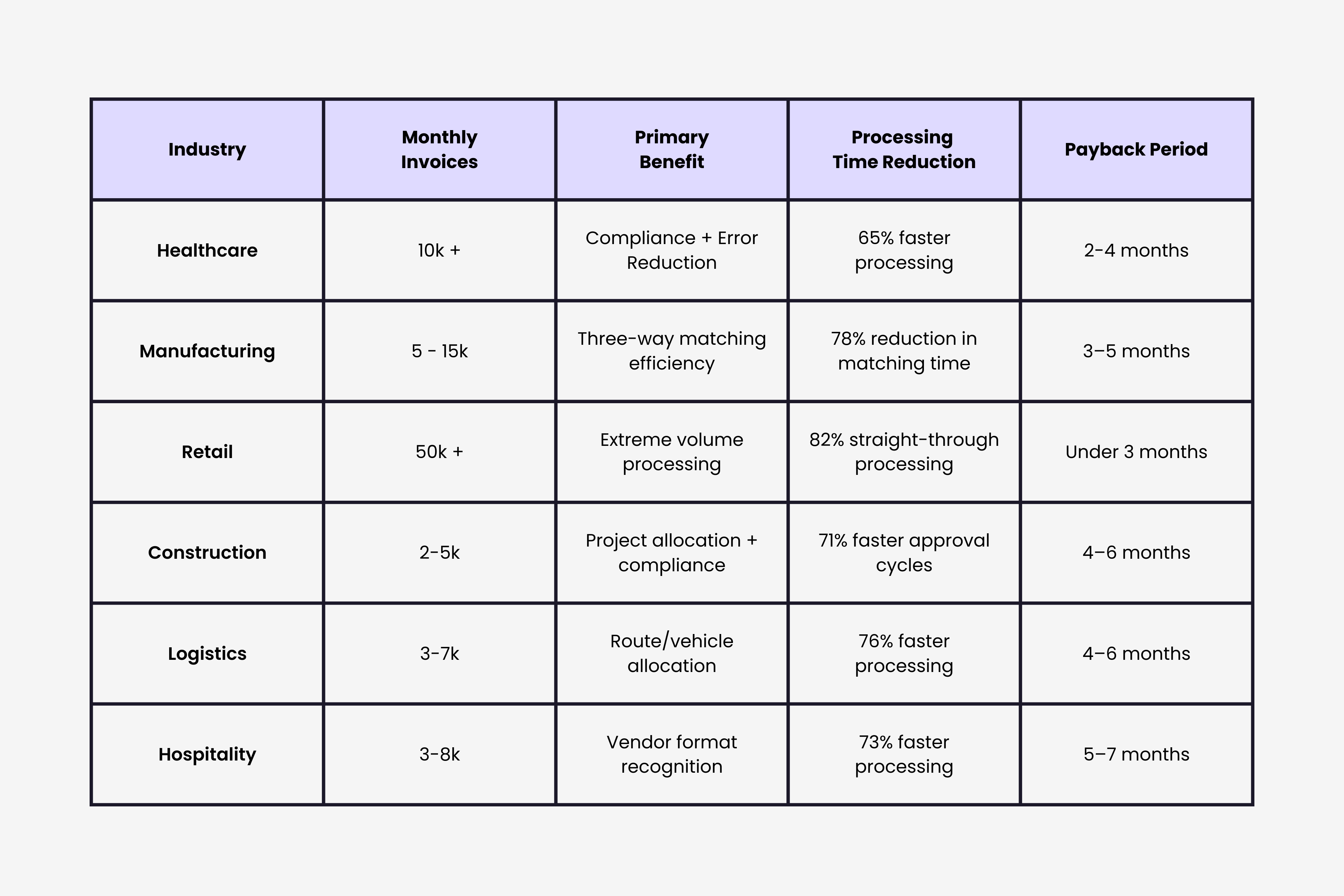
Mid-sized hospitals process 10,000+ monthly invoices with strict regulatory requirements. Every invoice must include proper medical coding, batch numbers for pharmaceuticals, FDA documentation, and insurance verification. Manual processing creates 15-20% error rates that trigger insurance rejections and compliance violations.
AI Impact: 89% reduction in coding errors, 65% faster processing, $47,000 average annual savings per 1,000 invoices. Valley Medical Center reduced per-invoice cost from $12.50 to $3.80.
Why it leads: Healthcare combines extreme volume with regulatory complexity, creating the highest ROI for invoice AI.
2. Manufacturing: Three-Way Matching at Scale
Manufacturers process 5,000-15,000 monthly invoices requiring three-way matching between purchase orders, goods receipts, and supplier invoices. Manual matching consumes 8-12 minutes per invoice. At 10,000 monthly invoices, reducing per-invoice time from 10 to 2 minutes saves 1,333 hours monthly.
AI Impact: 78% reduction in matching time, 91% decrease in payment discrepancies, $156,000 average annual savings. Global Parts Inc. processes 87,000 annual invoices with three AP staff (previously required nine).
Why it excels: Pure volume advantage. Even modest per-invoice improvements create massive aggregate savings.
3. Retail: Extreme Volume Processing
Large retail chains process 50,000+ monthly invoices with low average values. At $10 per invoice manual processing cost, that's $500,000 monthly or $6 million annually just for invoice processing. Seasonal volume spikes (3-5x during holidays) make manual processing economically impossible.
AI Impact: 82% straight-through processing, $0.85 average cost (down from $8.20), 94% reduction in late payment penalties. Fashion Forward Retail automated 94% of 28,000 monthly invoices, saving $203,000 annually.
Why it wins: Fastest payback periods (often under 3 months). Extreme volume magnifies small per-invoice savings.
4. Construction: Project-Based Complexity
Construction companies manage invoices from dozens of subcontractors while tracking costs against specific projects, managing retention payments, and ensuring lien waiver compliance. The complexity isn't volume (typically 2,000-5,000 monthly invoices) but rather project allocation, retention calculation, and legal compliance.
AI Impact: 71% faster approval cycles, 94% reduction in lien-related delays, $89,000 average annual savings. Anderson Construction reduced processing from 12 days to 2.5 days.
Why it benefits: Complexity reduction. AI handles project allocation, retention tracking, and compliance verification that manual processes struggle with.
5. Hospitality: Diverse Supplier Management
Hotels and restaurants process invoices from hundreds of diverse vendors: food/beverage suppliers, linen services, maintenance contractors, entertainment providers. Each vendor type has different invoice formats, delivery verification requirements, and payment terms. Volume is moderate (3,000-8,000 monthly) but diversity is high.
AI Impact: 73% faster processing through automated format recognition, 88% reduction in duplicate payments, $42,000 average annual savings. Grand Harbor Hotel reduced AP team from five to two people while improving payment accuracy from 91% to 99%.
Why it matters: AI handles format variations automatically. What required trained staff to recognize different invoice types now happens automatically.
6. Logistics and Transportation: Fleet Cost Tracking
Transportation companies must allocate invoice costs to specific vehicles, routes, or shipments while reconciling fuel cards and validating carrier rates. Volume is moderate (3,000-7,000 monthly) but allocation complexity is high. Manual allocation delays route profitability analysis.
AI Impact: 76% faster processing through automatic vehicle/route allocation, 89% reduction in carrier disputes, $94,000 average annual savings. Regional Transport Inc. reduced processing from 8 days to 1.5 days, enabling real-time route profitability analysis.
Why it succeeds: Speed enables operational decisions based on current cost data rather than week-old information.
What Determines ROI
Three factors determine invoice AI return:
Volume: More invoices mean bigger absolute savings. Retail's 50,000 monthly invoices create savings potential that 500-invoice companies can't achieve.
Complexity: Industries with matching requirements, compliance mandates, or allocation needs see disproportionate benefits. AI handles complexity that bogs down manual processes.
Error Cost: Healthcare and construction face severe consequences for errors (compliance violations, lien problems). AI error prevention creates value beyond time savings.
Industries ranking highest combine two or all three factors. Healthcare has all three. Manufacturing has volume + complexity. Retail has extreme volume.
Evaluating Your Position
Consider these questions:
Volume threshold: Do you process 1,000+ invoices monthly? Below this, ROI timeline extends significantly.
Complexity factors: Do invoices require matching, allocation, compliance verification, or approval workflows?
Current cost: Calculate cost per invoice (labor hours × hourly rate ÷ invoice count). Above $5/invoice indicates strong automation opportunity.
Error impact: What do processing errors cost? Compliance violations, payment disputes, or relationship damage justify automation even at moderate volumes.
For businesses processing vendor invoices while managing their own billing, understanding AI-powered invoice processing capabilities helps evaluate which side offers stronger automation opportunities.
Industries checking 3+ boxes see strongest ROI. Industries checking 1-2 boxes still benefit but expect longer payback periods.
Conclusion
Industries benefiting most from invoice AI share common characteristics: high volumes, complex processing requirements, or severe error consequences. Healthcare, manufacturing, and retail lead ROI rankings by combining multiple factors.
However, even industries with moderate volumes but extreme complexity (construction lien waivers, logistics fleet allocation) see transformational benefits from AI handling tasks manual processes struggle with.
The question isn't whether your industry benefits from invoice AI, but how strong the benefit is and how quickly you'll see returns. Understanding your industry's position on the volume-complexity-error spectrum helps set realistic expectations and prioritize automation investments.
Ready to automate your invoices?
Start extracting invoices from your email automatically with Gennai. Free plan available, no credit card required.
Start FreeRelated Articles
Accounts Payable Turnover Ratio Explained
The accounts payable turnover ratio shows how fast you pay suppliers. Get the formula, a worked example, benchmarks and what your number really means.
GuideNet 30 vs Net 60: What Payment Terms Really Mean for Your Cash
Net 30 vs net 60 explained for business owners: what each term means, when the clock really starts, and how the gap hits your cash on both sides.
GuideThe Accounts Payable Process, Step by Step (for Owners)
The accounts payable process has five steps: receive, verify, approve, pay, and record each invoice. Here is how each works and where owners lose money.