
Invoice Automation by Industry: Complete Guide 2026
Comprehensive guide to invoice automation across 15+ industries. Discover industry-specific solutions, ROI benchmarks, and implementation strategies for 2026.

The way businesses process invoices varies dramatically across industries. A construction company managing subcontractor payments faces completely different challenges than a healthcare provider processing insurance claims, yet both can benefit from automation. The key is understanding which solutions align with your industry's unique requirements.
This guide examines invoice automation across 15+ industries, providing specific implementation strategies, ROI benchmarks, and regulatory considerations that matter for your sector.
Why Industry-Specific Invoice Automation Matters
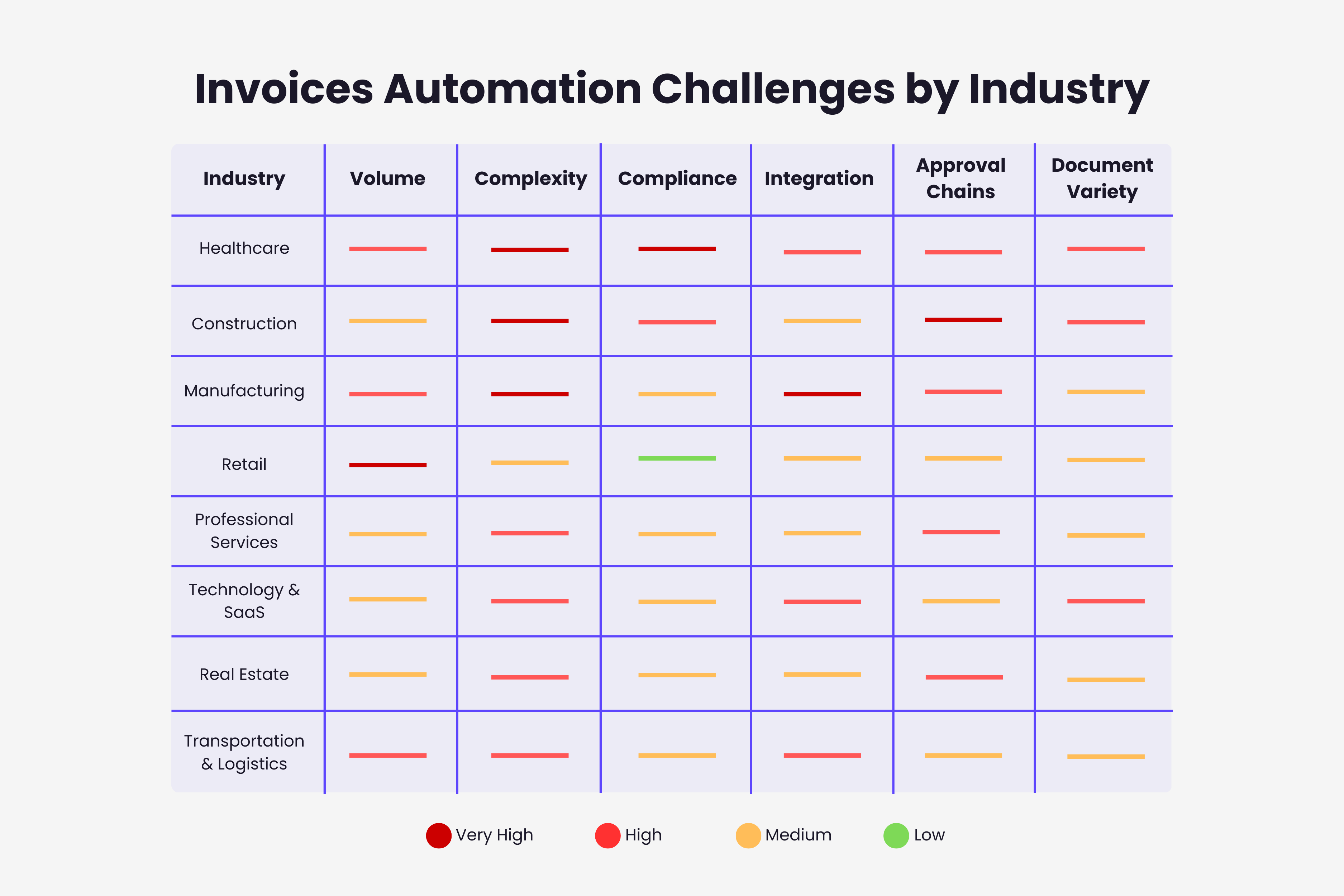
Generic invoice automation solutions often fail because they don't account for industry nuances. A retail business processing thousands of small-value invoices daily needs different functionality than a manufacturing company managing complex purchase orders with multiple approval chains.
Industry-specific considerations include:
- Regulatory compliance requirements that vary by sector
- Document formats and standards unique to each industry
- Approval workflows that reflect industry hierarchies
- Integration needs with industry-specific software
- Volume and complexity patterns that differ across sectors
The Cost of Generic Solutions
Companies using generic automation tools report 40% lower adoption rates compared to those implementing industry-tailored solutions. The difference stems from friction: when staff encounter processes that don't match their workflow, they revert to manual methods.
Before implementing any solution, understanding your accounts payable automation foundation becomes critical, as industry-specific features build on these core capabilities.
Healthcare: Managing Complex Medical Billing
Healthcare organizations process invoices from medical suppliers, equipment vendors, pharmaceutical companies, and service providers while maintaining HIPAA compliance and managing insurance reimbursements.
Unique Healthcare Challenges
Medical facilities deal with invoice volumes that can reach 10,000+ monthly documents for mid-sized hospitals. These invoices often contain:
- Product codes that must match healthcare classification systems
- Batch and lot numbers for pharmaceutical tracking
- Compliance documentation for regulated medical devices
- Insurance verification requirements
- Multiple cost centers and department allocations
Healthcare-Specific Automation Features
Effective healthcare invoice automation includes:
Medical coding integration that automatically validates product codes against standard classification systems. This prevents billing errors that could trigger audits or payment delays.
Regulatory documentation capture that extracts and stores compliance certificates, FDA documentation, and quality assurance records alongside financial data.
Insurance verification workflows that cross-reference supplier invoices with insurance pre-approvals and reimbursement schedules.
Controlled substance tracking for pharmaceutical invoices that require special handling and audit trails.
ROI in Healthcare Settings
Healthcare organizations implementing specialized invoice automation report:
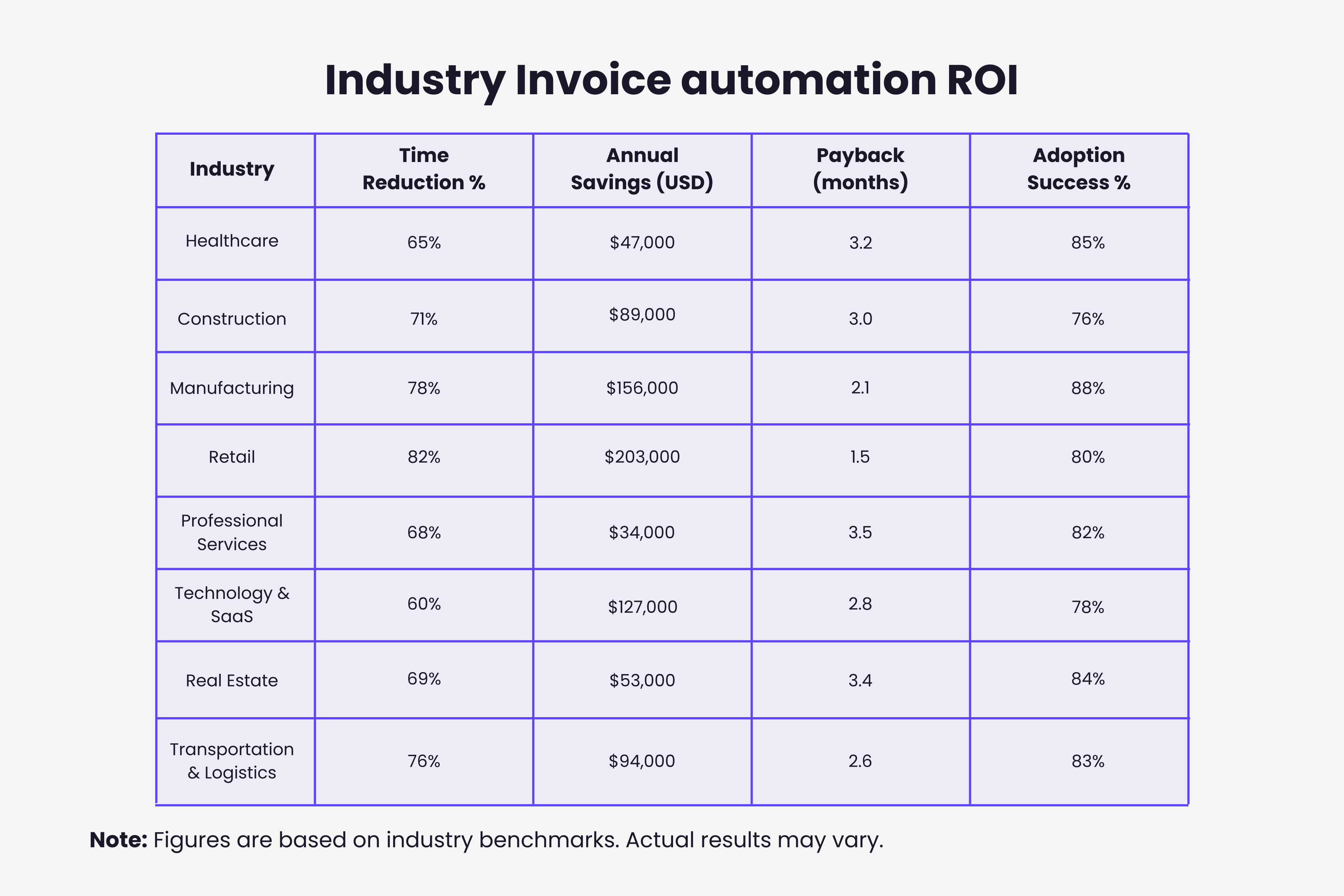
- 65% reduction in invoice processing time
- 89% decrease in coding errors
- $47,000 average annual savings per 1,000 invoices processed
- 3.2 month average payback period
Valley Medical Center reduced their invoice processing cost from $12.50 to $3.80 per invoice after implementing healthcare-specific automation, saving $340,000 annually.
Construction: Managing Subcontractor and Materials Invoicing
Construction companies juggle invoices from dozens of subcontractors, materials suppliers, and equipment rental companies while tracking costs against specific projects and maintaining lien waiver documentation.
Construction Industry Complexities
The construction sector faces unique invoicing challenges:
- Project-based cost allocation across multiple simultaneous builds
- Retention payments that hold back percentages until project milestones
- Lien waiver management requiring legal documentation before payment
- Progress billing that ties payments to completion percentages
- Union compliance for labor-related invoices
Construction-Specific Solutions
Specialized construction invoice automation provides:
Project cost coding that automatically routes invoices to the correct project, cost code, and budget line item. This integration with construction management software ensures real-time project cost tracking.
Lien waiver workflows that prevent payment processing until proper lien documentation is received and validated.
Retention tracking that automatically calculates and holds retention percentages, then releases them based on project milestone completion.
Compliance verification for certified payroll, prevailing wage requirements, and union documentation.
Construction ROI Metrics
Construction firms report these automation benefits:
- 71% faster invoice approval cycles
- 94% reduction in lien-related payment delays
- $89,000 average annual savings for companies processing 2,000+ invoices yearly
- Improved project profitability tracking with real-time cost data
Anderson Construction reduced their average invoice processing time from 12 days to 2.5 days, eliminating bottlenecks that previously delayed subcontractor payments and damaged relationships.
Manufacturing: Complex Purchase Order Matching
Manufacturing companies process high-volume invoices for raw materials, components, supplies, and services while maintaining precise inventory tracking and multi-way matching with purchase orders and receiving documents.
Manufacturing Invoice Challenges
Manufacturers face distinct processing requirements:
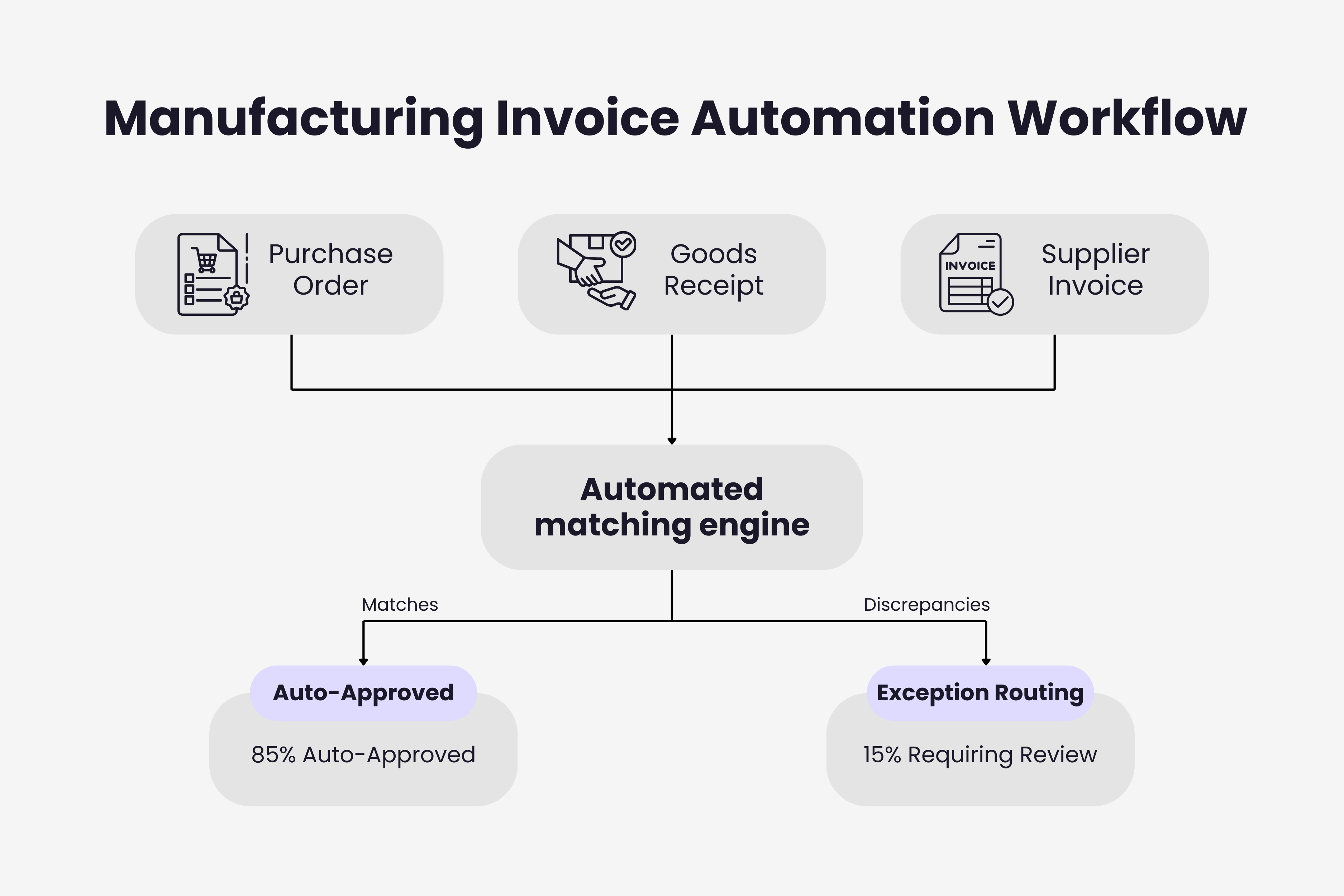
- Three-way matching between purchase orders, receiving documents, and invoices
- High invoice volumes often exceeding 5,000 monthly documents
- Multiple currencies for international suppliers
- Quality inspection holds that delay payment approval
- Just-in-time delivery coordination requiring rapid processing
Manufacturing Automation Capabilities
Effective manufacturing invoice automation includes:
Automated three-way matching that compares invoice line items against purchase orders and goods receipts, flagging discrepancies for review.
ERP integration with systems like SAP, Oracle, or Microsoft Dynamics that synchronizes invoice data with inventory, procurement, and accounting modules.
Variance threshold management that automatically approves invoices within acceptable tolerance ranges while routing exceptions for manual review.
Supplier performance tracking that captures on-time delivery, pricing accuracy, and quality metrics from invoice data.
Advanced AI invoice processing capabilities enable these complex matching scenarios that were previously impossible to automate.
Manufacturing Sector Results
Manufacturing companies implementing specialized automation achieve:
- 78% reduction in three-way matching time
- 91% decrease in payment discrepancies
- $156,000 average annual savings for mid-sized manufacturers
- 2.1 month payback period
Global Parts Inc. processed 87,000 invoices last year with just three AP staff members after implementing manufacturing-focused automation, a workload that previously required nine people.
Retail: High-Volume, Low-Value Transaction Processing
Retail businesses process enormous invoice volumes from suppliers, distributors, and service providers while managing tight profit margins that make processing efficiency critical.
Retail Processing Requirements
Retailers encounter specific challenges:
- Extreme invoice volumes reaching 50,000+ monthly for large chains
- Low average invoice values requiring minimal processing cost
- Seasonal fluctuations in volume and supplier mix
- Multiple location allocations for chain operations
- Promotional pricing verification against negotiated terms
Retail-Focused Automation
Specialized retail invoice automation provides:
High-throughput processing optimized for volume with straight-through processing rates exceeding 85% for standard invoices.
Promotional pricing validation that automatically checks invoice pricing against current promotional agreements and master vendor contracts.
Store-level allocation that routes and codes invoices to specific locations based on delivery documentation or predetermined rules.
Seasonal capacity scaling that handles 3-5x volume increases during peak periods without additional staff.
Retail Automation Benefits
Retail organizations report:
- 82% straight-through processing for routine invoices
- $0.85 average processing cost per invoice (down from $8.20)
- 94% reduction in late payment penalties
- 2.4 week implementation time for cloud-based solutions
Fashion Forward Retail automated 94% of their 28,000 monthly invoices, reducing processing costs by $203,000 annually while improving vendor relationships through faster payments.
Professional Services: Time and Materials Billing
Law firms, consulting companies, accounting practices, and other professional service providers process invoices based on billable hours, project milestones, and reimbursable expenses. Accounting firms face particularly complex scenarios when managing both their own invoices and client billing workflows simultaneously. For practices looking to streamline this dual responsibility, invoice management for accounting firms explores specific strategies for maintaining clean separation between firm expenses and client billables.
Professional Services Complexity
Service firms face unique invoicing scenarios:
- Time-based billing requiring hour validation and rate verification
- Client matter accounting that allocates costs to specific engagements
- Reimbursable expense management for travel, supplies, and services
- Retainer tracking that monitors prepayments and draws
- Multi-partner approval for large expenditures
Professional Services Automation
Specialized solutions for service firms include:
Matter-based coding that automatically routes invoices to client matters based on vendor, purchase order, or learned patterns.
Billable vs. non-billable classification that identifies which expenses can be passed to clients.
Time entry integration for staff expense reimbursements that sync with time tracking systems.
Client approval workflows for expenses that require client authorization before payment.
Services Sector ROI
Professional service firms implementing automation achieve:
- 68% reduction in invoice processing time
- 92% improvement in billable expense capture
- $34,000 average annual savings per 1,000 invoices
- Enhanced client billing accuracy
Carson Legal Partners reduced their invoice-to-client-billing cycle from 18 days to 4 days, improving cash flow and client satisfaction scores.
Creative agencies and marketing firms encounter similar challenges but with added complexity around project-based billing, retainer management, and client approval requirements. Managing hundreds of software subscriptions, variable contractor payments, and client-billable expenses requires systems that separate agency overhead from pass-through costs. Our detailed guide on how agencies handle vendor invoice chaos addresses the specific challenges of subscription tracking, contractor invoice standardization, and client expense allocation that agencies encounter.
Technology and SaaS: Subscription and License Management
Technology companies process invoices for software licenses, cloud services, professional services, and equipment while managing subscription renewals and usage-based billing.
Tech Industry Complexities
Technology companies face specific challenges:
- Subscription tracking across hundreds of SaaS tools
- Usage-based billing requiring consumption validation
- License compliance monitoring for software agreements
- Renewal management to prevent automatic renewals
- Multi-currency processing for global vendors
Tech-Focused Automation
Specialized technology invoice automation provides:
Subscription intelligence that tracks renewal dates, identifies redundant subscriptions, and flags unusual usage charges.
License optimization that compares invoiced licenses against actual usage data to identify cost reduction opportunities.
Department chargeback automation that allocates software costs to teams based on usage.
Contract term verification that validates invoice amounts against master service agreements.
SaaS companies themselves face the inverse challenge: managing their own recurring revenue streams and subscription billing to customers. The complexity of handling monthly recurring charges, usage-based billing, proration, and automated renewals requires specialized approaches. Companies in this position need to understand both sides of the subscription equation, which is why SaaS invoice management for recurring subscriptions has become critical for SaaS businesses scaling their operations.
Technology Sector Benefits
Tech companies implementing specialized automation achieve:
- 64% reduction in unnecessary subscription costs
- 91% improvement in license compliance
- $127,000 average annual savings through optimization
- 15% reduction in overall software spending
CloudTech Solutions identified $340,000 in redundant SaaS subscriptions within their first six months of implementing subscription-focused invoice automation.
Real Estate: Property Management and Development
Real estate companies process invoices for property maintenance, utilities, contractor services, and development costs while allocating expenses across multiple properties and ownership structures.
Real Estate Challenges
Property management and development firms encounter:
- Multi-property accounting requiring expense allocation
- Tenant billback calculations for recoverable expenses
- Capital vs. operating expense classification for tax purposes
- Draw request processing for construction financing
- CAM reconciliation for common area maintenance
Real Estate Automation Solutions
Specialized property management automation includes:
Property-level coding that automatically allocates invoices to specific properties and units based on vendor or service type.
Tenant recovery tracking that identifies billable expenses and automates tenant charge calculations.
Capital improvement classification using AI to distinguish between repairs (operating expense) and improvements (capital expense).
Draw management workflows that route construction invoices through the appropriate approval and funding channels.
Real Estate ROI
Real estate companies report:
- 69% reduction in property accounting time
- 94% improvement in tenant billback accuracy
- $53,000 average annual savings per 100 properties managed
- Enhanced financial visibility across portfolios
Summit Property Group manages 240 properties with automated invoice processing that correctly allocates 96% of expenses without manual intervention.
Transportation and Logistics: Freight and Operations
Transportation companies process invoices for fuel, maintenance, insurance, tolls, permits, and subcontractor services while tracking costs per vehicle, route, or shipment.
Transportation Industry Needs
Logistics providers face unique requirements:
- Per-vehicle cost tracking for fleet management
- Route-based allocation for operational analysis
- Fuel card reconciliation with purchase documentation
- Subcontractor carrier invoices requiring rate verification
- Accessorial charge validation for additional services
Transportation-Specific Features
Effective logistics automation includes:
Fleet integration that matches invoices to specific vehicles based on unit numbers, VINs, or license plates.
Rate verification for carrier invoices that compares charges against contracted rates and tariffs.
Fuel card matching that reconciles card transactions with invoice charges automatically.
Accessorial charge flagging that identifies questionable additional charges for review.
Transportation Sector Results
Logistics companies implementing automation achieve:
- 76% faster invoice processing
- 89% reduction in carrier payment disputes
- $94,000 average annual savings for mid-sized fleets
- Improved route profitability analysis
Regional Transport Inc. reduced their carrier invoice processing time from 8 days to 1.5 days, enabling faster carrier payments and better rate negotiations.
Education: Managing Academic Institution Spending
Educational institutions process invoices for supplies, equipment, services, and facilities while adhering to budget constraints, grant restrictions, and compliance requirements.
Education Sector Challenges
Schools and universities encounter:
- Grant funding restrictions requiring specific allocation tracking
- Budget period constraints tied to academic calendars
- Department-level autonomy with centralized oversight
- Tax-exempt purchasing requiring documentation
- Compliance reporting for government funding
Education-Focused Automation
Specialized education invoice automation provides:
Grant code tracking that ensures grant-funded purchases comply with allowable expense categories and funding periods.
Budget checking that prevents departments from overspending allocated budgets before invoice approval.
Tax exemption documentation that automatically attaches required certificates to qualifying purchases.
Compliance reporting that generates required reports for government agencies and oversight bodies.
Education Institution Benefits
Schools and universities report:
- 71% reduction in grant compliance issues
- 93% improvement in budget adherence
- $67,000 average annual savings for institutions processing 5,000+ invoices
- Enhanced transparency for stakeholder reporting
State University streamlined processing for 47,000 annual invoices across 200 departments while maintaining perfect compliance with federal grant requirements.
E-commerce: Managing Digital Supply Chains
Online retailers process invoices from suppliers, fulfillment partners, shipping carriers, platform fees, and marketing services while managing rapid growth and seasonal fluctuations.
E-commerce Challenges
Digital retailers encounter:
- Rapid volume growth requiring scalable solutions
- Multi-channel complexity across various selling platforms
- Fulfillment network invoices from third-party logistics providers
- Platform fee reconciliation for marketplace charges
- International supplier management with currency conversion
E-commerce Automation Features
Specialized e-commerce solutions include:
Platform integration that automatically reconciles marketplace fees and charges.
Fulfillment invoice matching that validates 3PL charges against shipment volumes and service agreements.
Shipping carrier reconciliation that catches billing errors and applies earned discounts.
Multi-currency handling with automatic conversion and foreign exchange tracking.
E-commerce ROI
Online retailers report:
- 84% straight-through processing for routine invoices
- $1.20 average processing cost (down from $9.50)
- $178,000 average annual savings for businesses processing 10,000+ monthly invoices
- Scalability supporting 500% growth without proportional staff increases
BrightGoods scaled from 4,000 to 23,000 monthly invoices over 18 months with automated processing that required zero additional AP headcount.
Remote-First Organizations: Distributed Team Challenges
Companies with distributed teams face unique invoice management challenges that cross traditional industry boundaries. The shift to remote work has created new considerations around approval workflows, policy enforcement, and spending visibility that affect organizations regardless of their sector.
What makes remote invoice management particularly challenging isn't just the distance between team members. It's the fundamental shift from synchronous, location-based processes to asynchronous, distributed workflows that requires rethinking traditional approaches. Organizations transitioning to or scaling remote operations discover that invoice management systems designed for centralized offices simply don't work. The approval bottlenecks, policy inconsistencies, and visibility gaps multiply across time zones and locations. Understanding how remote-first companies successfully handle invoice management reveals strategies that go beyond simply digitizing paper processes.
Remote Work Invoice Complexities
Remote-first companies encounter:
- Decentralized purchasing across multiple locations and time zones
- Varied vendor relationships without centralized negotiation
- Digital approval workflows replacing in-person sign-offs
- Expense reimbursement complexity across different jurisdictions
- Compliance variations based on employee locations
Remote-Optimized Solutions
Effective automation for distributed teams includes:
Asynchronous approval workflows that don't require real-time collaboration or same-timezone coordination.
Mobile-first interfaces enabling approvals from anywhere, on any device.
Automated policy enforcement that applies rules consistently across all locations without manual oversight.
Multi-currency and multi-tax handling for international team expenses.
For comprehensive strategies on managing invoices across distributed teams, see our detailed guide on how remote-first companies handle invoice management.
Remote Team Results
Distributed organizations implementing specialized automation report:
- 83% reduction in approval delays due to timezone differences
- 76% improvement in policy compliance across locations
- $42,000 average annual savings for companies with 50+ remote employees
- Enhanced visibility into distributed spending patterns
Choosing the Right Industry Solution
Selecting effective invoice automation requires understanding your industry's specific requirements and evaluating solutions against those needs.
Essential Evaluation Criteria
Industry expertise: Does the vendor demonstrate deep understanding of your sector's unique challenges? Review their case studies, client list, and feature set for industry-specific capabilities.
Regulatory compliance: For regulated industries, verify that solutions meet your specific compliance requirements. Request documentation of certifications, validation capabilities, and audit trail features.
Integration capabilities: Ensure the solution integrates with your industry-standard software. A healthcare solution should connect with your EHR, while a manufacturing tool needs ERP integration. For small to mid-sized businesses, the choice often comes down to which accounting platform you're already using. The capabilities and limitations of your core accounting system significantly impact which automation features you can leverage. Many businesses evaluating automation discover they first need to choose between the two dominant platforms, which is why understanding the differences between QuickBooks and Xero for invoice management becomes a prerequisite decision that shapes your entire automation strategy.
Scalability: Evaluate whether the solution handles your volume patterns, including seasonal fluctuations or growth trajectories typical in your industry.
Implementation approach: Industry-specific solutions should include pre-configured workflows, templates, and rules that reflect best practices in your sector.
Red Flags to Avoid
Watch for these warning signs when evaluating solutions:
- Generic positioning: Vendors claiming to serve all industries equally well often lack depth in any specific sector.
- Missing integrations: Solutions that don't connect with industry-standard software create data silos.
- Compliance gaps: For regulated industries, vague compliance claims without specific certifications indicate inadequate capabilities.
- Inflexible workflows: Solutions that can't adapt to your industry's unique approval processes will face adoption resistance.
Implementation Best Practices by Industry
Successful implementation requires industry-specific approaches. While our comprehensive accounts payable automation implementation guide covers the general framework, here are industry-specific considerations:
Phase 1: Foundation (Weeks 1-2)
Configure industry-specific features and integrations. For healthcare, this includes medical coding systems. For construction, it means lien waiver workflows. For manufacturing, it's three-way matching rules.
Phase 2: Workflow Customization (Weeks 3-4)
Adapt approval chains and routing rules to match your industry's organizational structure and compliance requirements. Involve department leaders who understand sector-specific needs.
Phase 3: Integration Testing (Weeks 5-6)
Validate connections with industry-standard software. Test end-to-end workflows including data flow to ERP, project management, or specialized systems.
Understanding common OCR errors becomes especially important during this phase, as different industries deal with different document formats and quality levels.
Phase 4: User Training (Weeks 7-8)
Provide training that uses industry-specific examples and terminology. Healthcare staff need different training than construction teams.
Phase 5: Pilot Launch (Weeks 9-10)
Start with a representative subset of your invoice volume. Include the full range of invoice types common in your industry.
Measuring Success: Industry-Specific KPIs
Different industries prioritize different success metrics based on their unique operational challenges and business models. While some sectors focus heavily on compliance and accuracy, others optimize primarily for speed and cost reduction. The metrics that matter most in healthcare differ dramatically from those in retail or manufacturing.
Understanding which industries see the strongest returns from automation helps set realistic expectations and identify whether your sector is positioned for significant gains. Research into which industries benefit most from invoice AI reveals patterns around document complexity, regulatory requirements, and volume characteristics that determine automation ROI.
Universal Metrics
All industries should track:
- Processing cost per invoice
- Approval cycle time
- Error and exception rates
- Straight-through processing percentage
Industry-Specific Metrics
Healthcare: Coding accuracy, compliance documentation completeness, insurance verification speed
Construction: Lien waiver compliance, retention tracking accuracy, project cost allocation speed
Manufacturing: Three-way match success rate, PO compliance, variance resolution time
Retail: Promotional pricing accuracy, high-volume processing capacity, seasonal scalability
Professional Services: Matter allocation accuracy, billable expense capture, client approval speed
Technology: Subscription optimization savings, license compliance, renewal management effectiveness
Real Estate: Tenant recovery accuracy, capital vs. operating classification, multi-property allocation
Transportation: Fleet cost tracking accuracy, rate verification success, fuel reconciliation
Education: Grant compliance, budget adherence, tax exemption documentation
E-commerce: Platform reconciliation accuracy, 3PL validation, shipping carrier optimization
Future Trends in Industry-Specific Automation
Invoice automation continues evolving with industry-focused innovations:
AI-Powered Industry Intelligence
Advanced systems learn industry-specific patterns, automatically recognizing invoice types common to your sector and applying appropriate workflows without manual configuration. The evolution from basic OCR to AI-powered processing has enabled these intelligent, context-aware systems.
Modern invoice automation platforms now use machine learning to understand industry context without explicit programming. They detect whether an invoice comes from a medical supplier, construction subcontractor, or software vendor, then apply appropriate extraction rules and validation logic automatically. Solutions like Gennai's AI-powered extraction demonstrate how contemporary systems adapt to different industries without requiring manual configuration or industry-specific setup.
Predictive Compliance
Machine learning identifies potential compliance issues before they occur, flagging invoices that may violate industry regulations based on historical patterns.
Industry Benchmark Integration
Modern platforms incorporate industry benchmark data, alerting you when costs exceed typical ranges for your sector or identifying optimization opportunities based on peer performance.
Vertical-Specific Ecosystems
Automation platforms increasingly integrate with broader industry ecosystems, connecting with specialized software, industry databases, and sector-specific services.
Automated Regulatory Updates
Systems automatically adapt to changing industry regulations, updating compliance rules and documentation requirements without manual intervention.
Conclusion: The Industry Advantage
Generic invoice automation delivers basic efficiency gains. Industry-specific solutions transform how your organization handles financial operations by aligning with your sector's unique workflows, compliance requirements, and business processes.
The organizations achieving the highest ROI share common characteristics: they prioritize industry fit over feature counts, involve sector experts in vendor selection, and implement solutions that integrate deeply with their existing industry-specific systems.
Whether you're processing medical invoices, construction payments, manufacturing materials, or any other industry-specific document type, the right automation platform should feel like it was built specifically for your sector. Modern AI-powered solutions like Gennai adapt to different industry contexts automatically, learning from your invoice patterns to provide intelligent extraction and routing regardless of your sector.
Start your evaluation by identifying your three most critical industry-specific requirements. Then find vendors who address those needs natively rather than through workarounds or customization. The difference in adoption, efficiency, and ROI will be substantial.
Ready to automate your invoices?
Start extracting invoices from your email automatically with Gennai. Free plan available, no credit card required.
Start FreeRelated Articles
How Agencies Handle Vendor Invoice Chaos
Stop vendor invoice chaos at your agency. Practical systems for processing contractor payments, software subscriptions, client billbacks, and project expense allocation in 2026.
GuideInvoice Management for Accounting Firms: Complete Workflow
Complete workflow guide for accounting firms managing client and internal invoices. Practical systems for separation, automation, and billable expense tracking in 2026.
GuideE-commerce Invoice Extraction: Automate Email Capture
How e-commerce businesses auto-extract invoices from supplier emails, marketplace notifications, and shipping providers. Save hours on bookkeeping.