
Future-Proofing Invoice Compliance: 2026 Regulations
Navigate 2026 invoice compliance requirements including EU AI Act, intensified GDPR enforcement, US state privacy laws, and data localization. Practical steps for regulation-ready workflows.

Invoice compliance requirements evolve continuously as regulators address emerging technologies and data protection concerns. Organizations processing invoice data in 2026 face new obligations from EU AI Act implementation, expanded state privacy laws, and stricter enforcement of existing GDPR standards. For the broader security framework, see our complete guide to invoice data security and compliance.
Reactive compliance approaches responding to violations after they occur prove expensive and operationally disruptive. Proactive strategies incorporating upcoming requirements into current systems prepare organizations for regulatory changes before enforcement begins.
This guide examines key invoice compliance developments taking effect in 2026, specific obligations affecting invoice processing, implementation timelines, and practical steps for building regulation-ready invoice workflows.
EU AI Act: August 2026 Implementation
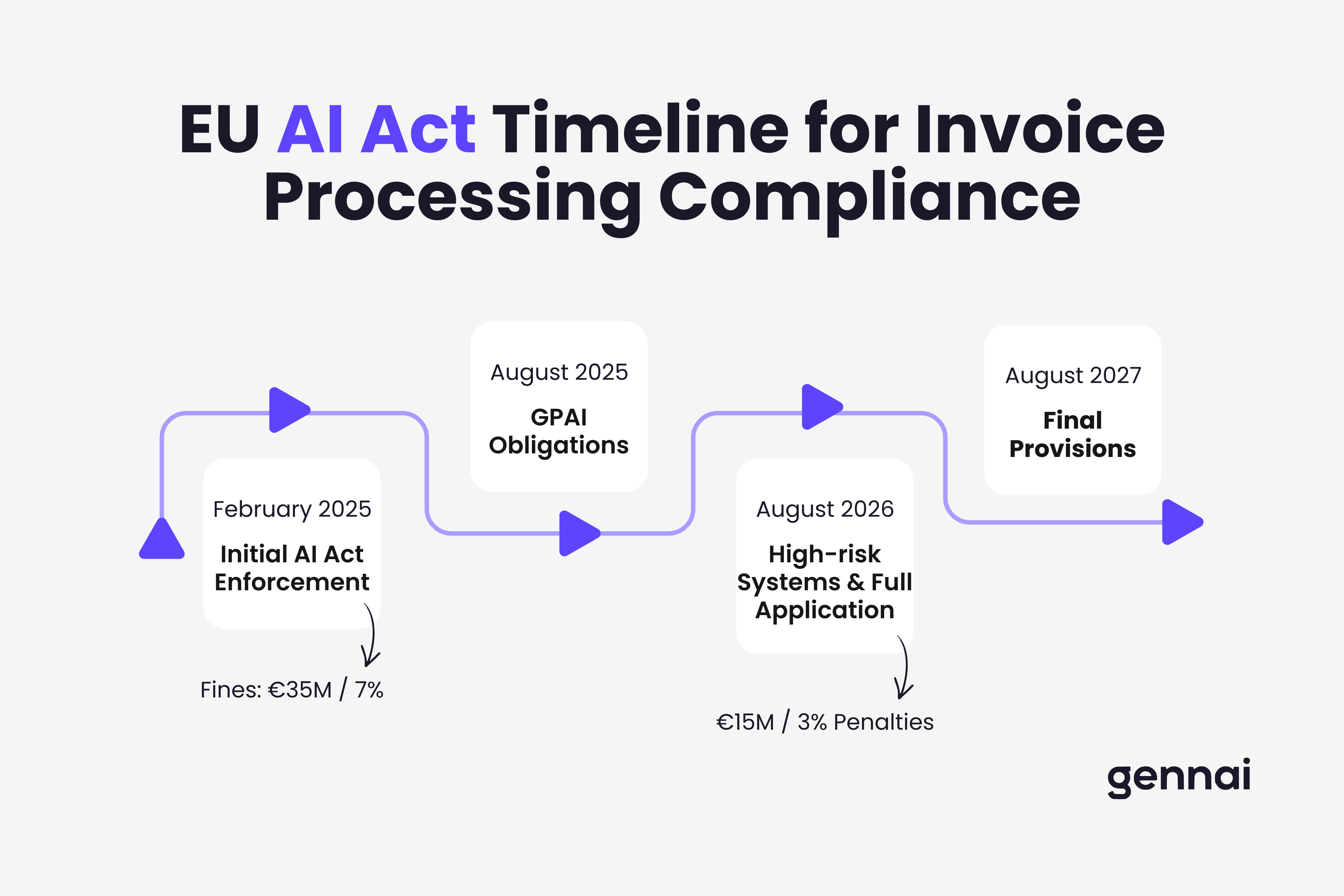
The European Union's Artificial Intelligence Act becomes fully applicable August 2, 2026, creating the first comprehensive AI regulatory framework worldwide.
AI-powered invoice processing falls under EU AI Act scope when systems use AI for data extraction, fraud detection, payment routing, or automated approval decisions. Organizations deploying these capabilities must assess whether invoice AI qualifies as high-risk systems requiring strict compliance.
High-risk classification applies to AI systems significantly impacting rights, safety, or access to services. Invoice processing rarely reaches high-risk thresholds, but automated payment decisions affecting vendor relationships or AI determining invoice legitimacy warrant careful evaluation.
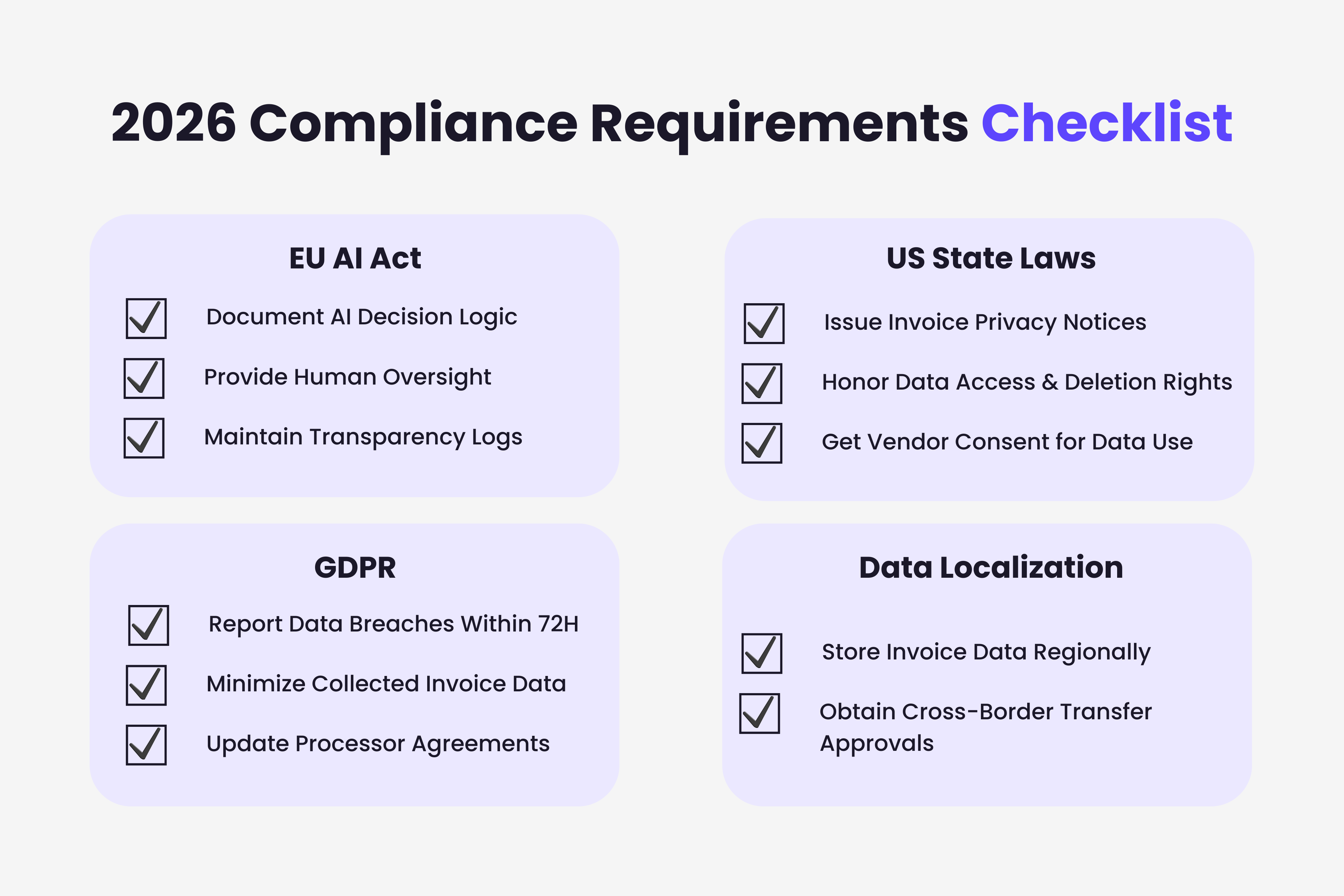
Organizations using AI invoice tools must verify technical documentation demonstrating how AI processes data, transparency logs tracking AI decisions, human oversight for high-value determinations, and ongoing monitoring for accuracy and bias.
The Act's extra-territorial scope means non-EU organizations processing invoices for EU entities must comply. Geographic location doesn't exempt organizations from AI Act obligations when their systems impact EU operations.
Penalties reach €35 million or 7% of global annual turnover for prohibited practices, €15 million or 3% for high-risk violations. These sanctions exceed GDPR maximum penalties.
Organizations should inventory all AI systems touching invoice workflows, classify risk levels following AI Act criteria, document AI decision logic and oversight procedures, and establish incident monitoring for AI failures.
GDPR Enforcement Intensification
GDPR requirements for invoice processing enter their seventh year of enforcement with regulators demonstrating increased willingness to impose substantial penalties for invoice data violations.
Cumulative GDPR fines reached €5.88 billion since 2018. Recent enforcement actions include €530 million for unauthorized data transfers and €479 million for manipulative consent practices.
Dark patterns receive heightened scrutiny. Regulators investigate organizations making data acceptance easy while complicating rejection or deletion requests.
Data minimization audits examine whether organizations collect invoice information actually needed for stated purposes. Fields captured but never used create violations.
Breach notification timelines remain strict. Organizations discovering invoice data incidents must notify authorities within 72 hours. Automated breach detection enables meeting deadlines.
Processor accountability increases. Data processing agreements must specify concrete security measures, not generic commitments.
Organizations should update data processing agreements with specific security commitments, implement automated breach detection, audit collected invoice fields, and document processor security verification procedures.
US State Privacy Law Expansion
Nineteen US states now enforce comprehensive privacy legislation as of January 2026, with additional states considering similar frameworks.
Maryland's Online Data Privacy Act represents the most stringent state law, significantly limiting sensitive data collection. Organizations processing Maryland resident invoice data face enhanced consent requirements.
State law variation creates compliance complexity. California, Virginia, and other state frameworks impose different requirements for data handling and consumer rights.
Business-to-business data receives mixed treatment across states. Invoice data containing individual names or contact details may fall under various state protections.
Vendor contact information requires analysis. Email addresses like john@company.com identify specific individuals, triggering privacy protections.
Indiana, Kentucky, and Rhode Island enforcement began January 1, 2026.
Organizations should map which state laws apply, harmonize privacy notices, implement universal data subject rights procedures, and monitor new legislation proposals.
Data Localization Requirements
Global data residency requirements increase, affecting where organizations may store and process invoice information.
Saudi Arabia requires prior approval for cross-border data transfers. Organizations processing Saudi resident invoice data must maintain in-country storage or obtain explicit authorization.
India's Digital Personal Data Protection Act phases extend through 2027. Invoice data from Indian entities falls under evolving DPDP requirements.
Data localization complicates cloud invoice solutions using global server distribution. Organizations must configure region selection carefully and verify where data physically resides. For a detailed comparison, see our guide on cloud versus on-premise invoice storage security.
Alternatives include regional processing hubs maintaining data within required jurisdictions or hybrid architectures combining local storage with limited international transfers.
Building Compliance-Ready Invoice Systems
Future-proof invoice workflows incorporate flexibility for regulatory adaptation.
Design with privacy by default. Configure invoice systems to collect minimum necessary data, enable easy data deletion, maintain comprehensive audit trails, and support data subject rights exercises. Learn how to audit your invoice data access to establish proper access controls from the start.
Implement modular compliance controls. Rather than hardcoding compliance into workflows, use configurable rules enabling rapid adjustment as requirements change. Following invoice system integration best practices helps ensure compliance controls work across connected systems.
Maintain detailed compliance documentation. Document legal basis for invoice processing, data processing agreements, security measures, retention schedules, and rights exercise procedures.
Establish regulatory monitoring processes. Subscribe to updates from relevant regulators, participate in industry associations, and schedule quarterly compliance reviews.
Partner with regulation-aware vendors. Invoice management platforms designed for compliance incorporate privacy controls, regional deployment options, and audit trail capabilities. Learn how to evaluate invoice management software for compliance before committing to a platform.
Invoice compliance in 2026 demands attention to EU AI Act governance, intensified GDPR enforcement, expanding state privacy laws, and data localization requirements. Organizations building compliance into invoice workflows rather than retrofitting controls reactively position themselves for sustained regulatory success across evolving requirements.
TL;DR
- EU AI Act becomes fully applicable August 2, 2026—inventory AI systems in invoice workflows and classify risk levels
- GDPR enforcement intensifies with €5.88 billion cumulative fines—update data processing agreements and implement breach detection
- 19 US states now enforce privacy laws—map applicable requirements and harmonize compliance across jurisdictions
- Data localization requirements expand globally—verify where invoice data physically resides and configure regional storage
- Privacy by default and modular compliance controls future-proof invoice systems against evolving regulations
Ready to automate your invoices?
Start extracting invoices from your email automatically with Gennai. Free plan available, no credit card required.
Start FreeRelated Articles
Accounts Payable Turnover Ratio Explained
The accounts payable turnover ratio shows how fast you pay suppliers. Get the formula, a worked example, benchmarks and what your number really means.
GuideNet 30 vs Net 60: What Payment Terms Really Mean for Your Cash
Net 30 vs net 60 explained for business owners: what each term means, when the clock really starts, and how the gap hits your cash on both sides.
GuideThe Accounts Payable Process, Step by Step (for Owners)
The accounts payable process has five steps: receive, verify, approve, pay, and record each invoice. Here is how each works and where owners lose money.