
GDPR and Invoice Processing: What You Must Know
Learn which GDPR obligations apply to invoice data, what Article 28 processing agreements require, and how to handle breach notification for invoice systems.

Invoice data contains personal information subject to GDPR protection. Every invoice listing a contact name, email address, or business owner details triggers data protection obligations. Organizations processing invoice data from EU residents must understand exactly what GDPR requires and how violations create regulatory exposure.
Recent GDPR enforcement demonstrates regulators' willingness to impose substantial penalties for invoice data mishandling. The cumulative €5.88 billion in fines since 2018 includes multiple cases involving financial transaction data similar to invoice records.
This guide explains which GDPR obligations apply to invoice data, what Article 28 processing agreements must contain, how to respond to data subject requests, and when breach notification becomes mandatory. For the full security framework spanning GDPR, SOC 2, and ISO 27001, see our complete guide to invoice data security and compliance.
When Invoice Data Qualifies as Personal Data
Not all invoice information triggers GDPR protection, but most business invoices contain at least some personal data requiring compliance.
Personal data under GDPR means any information relating to an identified or identifiable natural person. Invoice data qualifies when it includes names of individual contacts, email addresses for vendor communication, phone numbers listed on invoice documents, or business addresses identifying sole proprietors.
Business-to-business invoices frequently contain personal data despite appearing purely commercial. The vendor contact listed on an invoice identifying the specific person handling billing creates GDPR obligations. Email addresses like john@company.com link invoices to identifiable individuals.
Sole proprietors and individual consultants present clear cases. When an invoice bills services from a freelancer operating under their own name, every detail constitutes personal data. The business name, contact information, bank account details, and service descriptions all relate to an identifiable person.
Small business invoices blur business and personal identity. A local vendor operating as 'Jane's Consulting' processes payments through personal accounts and lists home office addresses. GDPR protections apply throughout invoice processing for such entities.
The practical reality: assume invoice data contains personal information unless you've specifically designed processes to eliminate all individual identifiers.
Article 28 Processing Agreements for Invoice Tools
Using third-party services for invoice management creates data processor relationships requiring specific contractual protections under GDPR Article 28.
You act as the data controller when invoice data belongs to your business relationships. The invoice management software, extraction tool, or accounts payable platform processes this data on your behalf, making them data processors. Article 28 mandates written agreements governing these relationships.
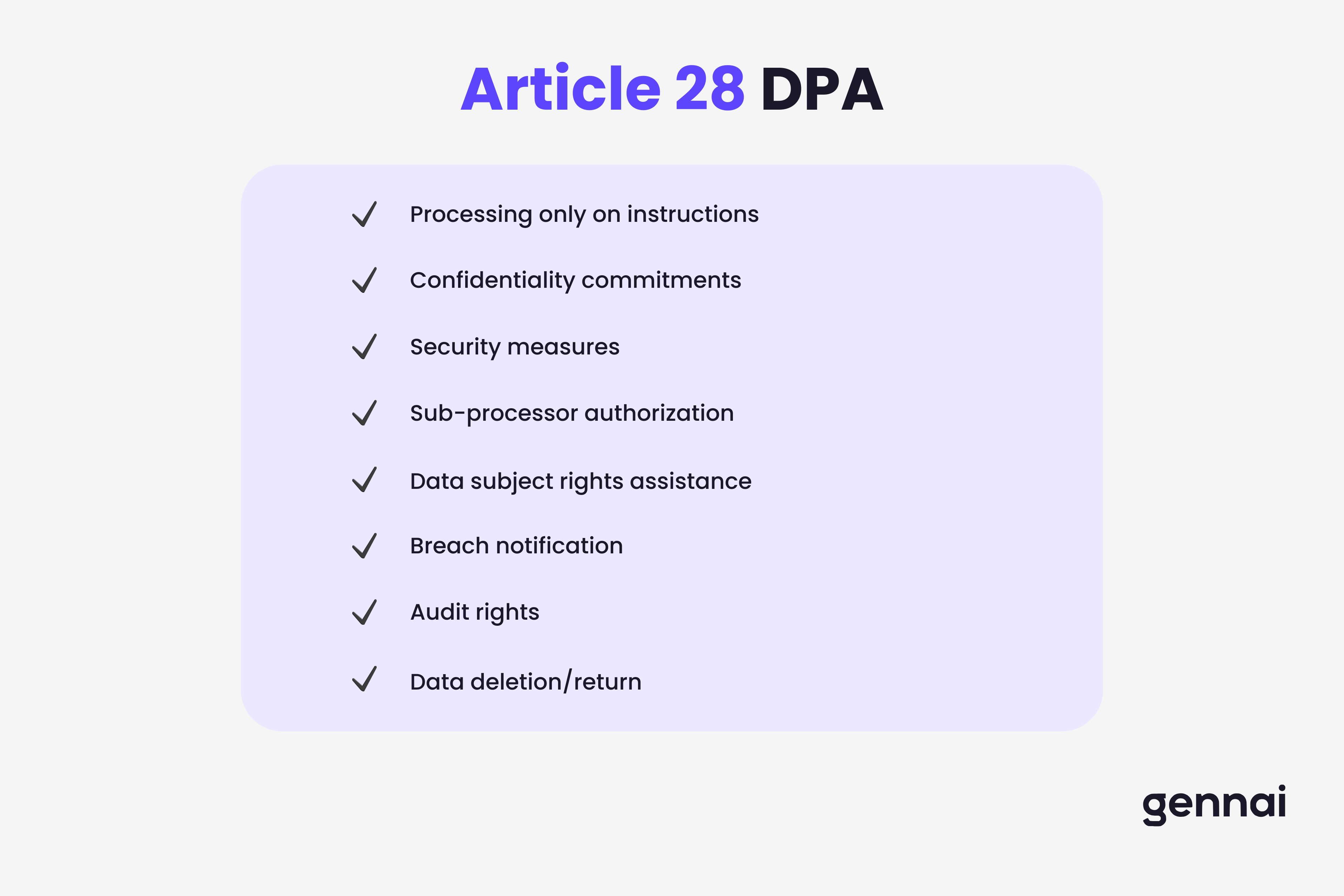
Processing agreements must specify the subject matter and duration of processing, describing which invoice data the processor handles and for how long. Agreements should explicitly list data fields: vendor names, contact emails, invoice amounts, payment terms, bank account details, and any other personal information the processor accesses.
Processors must commit to processing data only on documented instructions from you as controller. The agreement should state that processors cannot use invoice data for their own purposes, cannot share it with third parties without authorization, and must delete or return all data when processing relationships end.
Security obligations under Article 32 transfer to processors. Agreements must require appropriate technical and organizational measures protecting invoice data. This includes encryption for data in transit and at rest, access controls limiting who views invoice information, audit logging tracking all data access, and regular security assessments.
Audit rights allow verification of processor compliance. Agreements should grant you the right to audit processor security practices, either directly or through independent auditors. Many organizations satisfy this through reviewing processor SOC 2 reports or ISO 27001 certificates.
Responding to Data Subject Rights Requests
Individuals whose information appears in invoice data can exercise GDPR rights requiring specific organizational responses.
Right of access allows data subjects to request copies of their invoice-related personal data. Access requests require responses within one month, extendable to three months for complex requests.
Right to rectification means correcting inaccurate invoice personal data when requested. However, maintaining accurate historical financial records often justifies refusing rectification of old invoices while updating current contact information.
Right to erasure presents particular challenges for invoice data. Tax regulations mandating 3-7 year invoice retention override deletion requests for data within retention periods.
Managing rights requests for invoice data requires balancing compliance with operational necessity. Document your legal basis for invoice retention clearly, respond to requests within required timeframes while explaining applicable exceptions, and maintain records showing how you handled each request.
Breach Notification Requirements for Invoice Data
Invoice security incidents trigger specific GDPR notification obligations when personal data is compromised.
The 72-hour notification deadline applies to controller notification of supervisory authorities. When you discover an invoice data breach, you have 72 hours from awareness to notify your relevant data protection authority unless the breach is unlikely to result in risk to individuals' rights and freedoms.
Notification content must include the nature of the breach describing what invoice data was compromised, the approximate number of affected data subjects and records involved, likely consequences of the breach, and measures taken to address the breach.
Data subject notification becomes mandatory when breaches create high risk to individuals. Invoice breaches exposing bank account details, extensive personal information, or data enabling identity theft typically require notifying affected individuals without undue delay.
Implementing GDPR Compliance for Invoice Processing
Practical implementation requires systematic approaches addressing data protection requirements throughout invoice workflows.
Conduct a data inventory identifying where invoice personal data exists throughout your systems. Map email accounts receiving invoice attachments, accounting software storing invoice records following invoice system integration best practices, approval workflow applications, and backup systems. Understanding cloud versus on-premise invoice storage security helps determine where data resides and which protections apply.
Establish lawful basis for invoice processing and document your reasoning. Most organizations rely on legitimate interests for processing vendor invoice data necessary for accounts payable operations.
Configure appropriate security measures throughout invoice lifecycles. Enable encryption for invoice data transmission, require multi-factor authentication for invoice system access, implement role-based access controls, maintain comprehensive audit logging following a systematic approach to how to audit your invoice data access, and conduct regular security assessments.
Execute Article 28 processing agreements with all third parties handling invoice data. Review vendor-provided templates carefully to evaluate invoice management software for compliance, negotiate terms ensuring full GDPR compliance, and monitor processor security practices through annual SOC 2 or ISO 27001 certificate reviews.
Systematic GDPR implementation for invoice processing creates defensible compliance postures. Understanding when invoice data qualifies as personal information, executing proper processor agreements, responding appropriately to data subject rights, and maintaining breach notification readiness protects organizations from regulatory penalties while respecting vendor and customer privacy.
TL;DR
- Invoice data is personal data — contact names, email addresses, and sole proprietor details on invoices trigger full GDPR protection obligations
- Article 28 agreements are mandatory for any third-party invoice tool, specifying data fields, processing purposes, security requirements, and audit rights
- Data subject rights apply to invoice records, including access, rectification, and erasure — though tax retention rules (3-7 years) override deletion requests
- 72-hour breach notification is required when invoice data containing personal information is compromised, with mandatory individual notification for high-risk breaches
- €5.88 billion in GDPR fines since 2018 demonstrates active enforcement, including cases involving financial transaction data
- Practical compliance starts with data inventory, lawful basis documentation, encryption, access controls, audit logging, and processor agreement execution
Ready to automate your invoices?
Start extracting invoices from your email automatically with Gennai. Free plan available, no credit card required.
Start FreeRelated Articles
Accounts Payable Turnover Ratio Explained
The accounts payable turnover ratio shows how fast you pay suppliers. Get the formula, a worked example, benchmarks and what your number really means.
GuideNet 30 vs Net 60: What Payment Terms Really Mean for Your Cash
Net 30 vs net 60 explained for business owners: what each term means, when the clock really starts, and how the gap hits your cash on both sides.
GuideThe Accounts Payable Process, Step by Step (for Owners)
The accounts payable process has five steps: receive, verify, approve, pay, and record each invoice. Here is how each works and where owners lose money.