
Cloud vs On-Premise Invoice Storage: Security Comparison
Compare cloud and on-premise invoice storage security including shared responsibility models, compliance requirements, disaster recovery, and cost analysis.

Invoice storage decisions directly impact security posture, compliance capabilities, and operational costs. Organizations face a fundamental choice: cloud-based invoice management leveraging provider infrastructure or on-premise systems requiring direct operational control.
This choice determines who manages security controls, how quickly you can scale capacity, what compliance frameworks apply, and which costs appear as capital versus operational expenses.
Understanding the security implications of each approach enables informed decisions aligning storage strategy with organizational requirements and risk tolerance. For the comprehensive security framework covering all aspects of invoice data protection, see our complete guide to invoice data security and compliance.
The Shared Responsibility Model in Cloud Invoice Storage
Cloud security operates under a shared responsibility framework dividing security obligations between cloud service providers and customers.
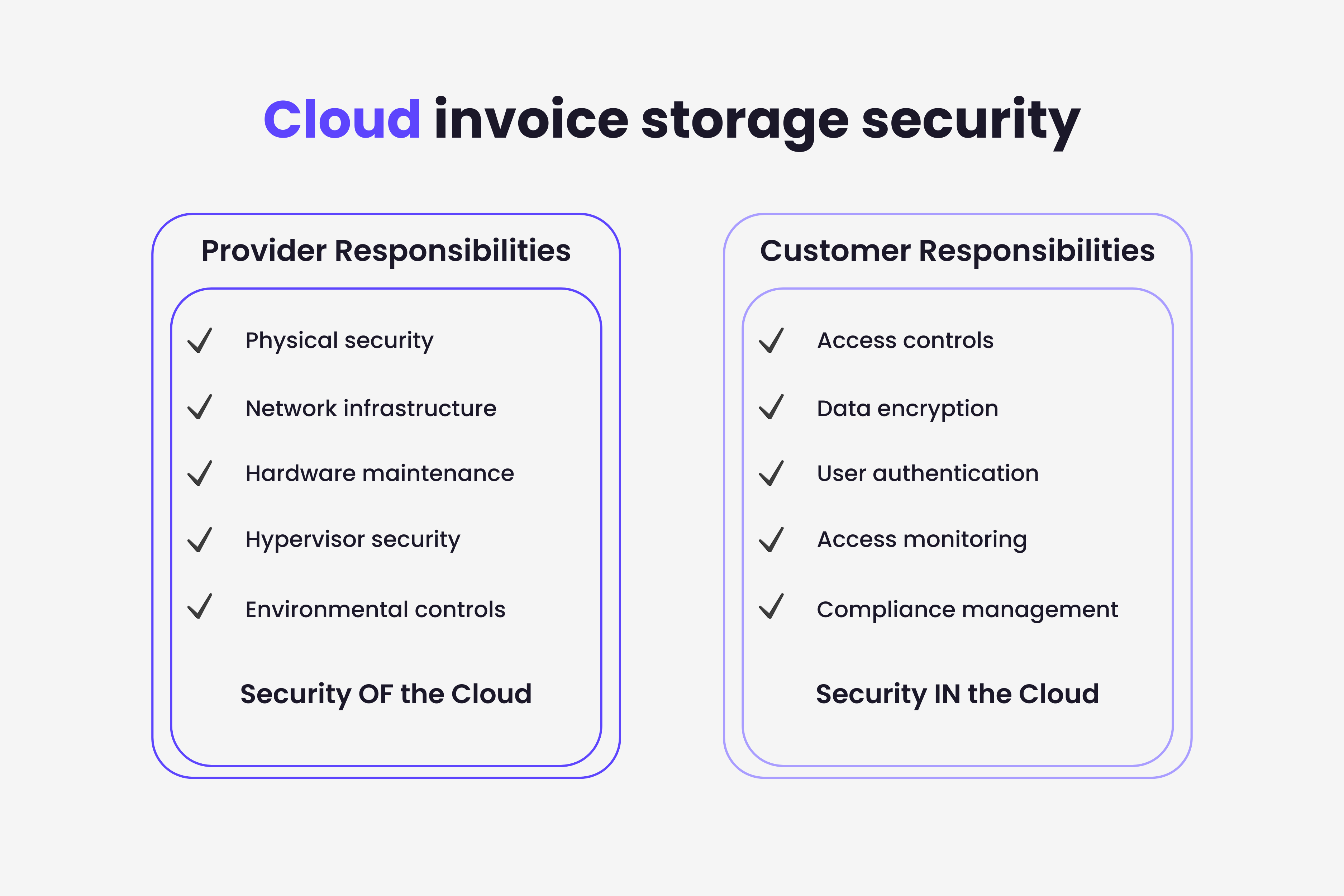
Providers secure the cloud infrastructure itself. This includes physical data center security with 24/7 monitoring and biometric access controls, network infrastructure protection against DDoS attacks, hardware maintenance and patch management, hypervisor security enabling virtual machine isolation, and environmental controls for power and cooling.
Major cloud providers invest billions annually in security capabilities exceeding what most organizations achieve independently. According to industry data, approximately 99% of cloud security failures stem from customer misconfigurations rather than provider infrastructure vulnerabilities.
Customers secure data and applications within the cloud. Your organization remains responsible for configuring access controls determining who views invoice data, enabling encryption protecting information in transit and at rest, managing user authentication and authorization, monitoring access logs for suspicious activity, and ensuring compliance with applicable regulations.
This division creates a common misconception. Many organizations assume migrating to cloud storage automatically secures invoice data. The reality: cloud providers deliver secure infrastructure, but securing invoice information requires proper configuration and ongoing management.
Cloud Invoice Storage Security Advantages
Cloud platforms implement security controls most organizations cannot replicate independently.
Physical security in cloud data centers exceeds typical enterprise capabilities. Providers maintain multiple geographically distributed facilities with redundant power and cooling, biometric access requiring multiple authentication factors, 24/7 security personnel and surveillance, mantrap entrances preventing tailgating, and visitor logging with escort requirements.
Network security benefits from provider scale and expertise. Cloud networks include automated DDoS mitigation absorbing large-scale attacks, intrusion detection systems monitoring traffic patterns, network segmentation isolating tenant environments, and threat intelligence feeding real-time protection updates.
Compliance certifications reduce audit burden. Major providers maintain SOC 2 Type II attestations, ISO 27001 certification for information security management, regional compliance including GDPR for EU operations, and industry-specific certifications.
Automated security updates eliminate patching delays. Cloud providers continuously update infrastructure security without requiring customer intervention.
Disaster recovery capabilities exceed most on-premise implementations. Cloud storage automatically replicates invoice data across multiple availability zones, enables geo-replication to distant locations, and provides point-in-time recovery.
Cloud Invoice Storage Security Considerations
Cloud storage introduces specific security challenges requiring attention.
Data residency and sovereignty create compliance complexity. Invoice data stored in cloud may physically reside across multiple countries. European GDPR requirements for invoice processing, data localization mandates, and sector-specific regulations about data location all require careful configuration.
Misconfigurations represent the primary cloud security risk. Common mistakes include publicly accessible storage buckets, overly permissive access policies, disabled encryption, inadequate logging, and weak authentication.
Research consistently shows misconfiguration as the leading cause of cloud data breaches. Unlike provider infrastructure vulnerabilities, misconfigurations lie entirely within customer responsibility.
Third-party access raises additional concerns. Cloud storage means invoice data resides on provider infrastructure. Reputable providers implement strict controls limiting employee access, but provider access remains technically possible.
On-Premise Invoice Storage Security Advantages
On-premise deployments provide direct control over entire security stack.
Complete infrastructure control enables customization for specific requirements. Organizations maintain full authority over hardware selection, network architecture, security tool deployment, access control implementation, and data location guarantees.
No third-party access to infrastructure eliminates provider risk. On-premise storage means your employees exclusively access physical systems.
Air-gapped networks provide maximum isolation. Organizations can completely disconnect invoice storage from internet access, preventing remote attacks entirely.
On-Premise Invoice Storage Security Challenges
On-premise deployment transfers all security responsibilities to your organization.
Physical security requires substantial investment. Construction costs for enterprise data centers typically range from $600 to $1,100 per square foot, with operational costs consuming 40-60% of budgets annually.
Security expertise becomes critical bottleneck. On-premise security requires specialized personnel for network security management, vulnerability assessment, security tool deployment, incident response, and regulatory compliance.
Patch management creates operational burden and risk. Delayed patching represents a leading cause of breaches.
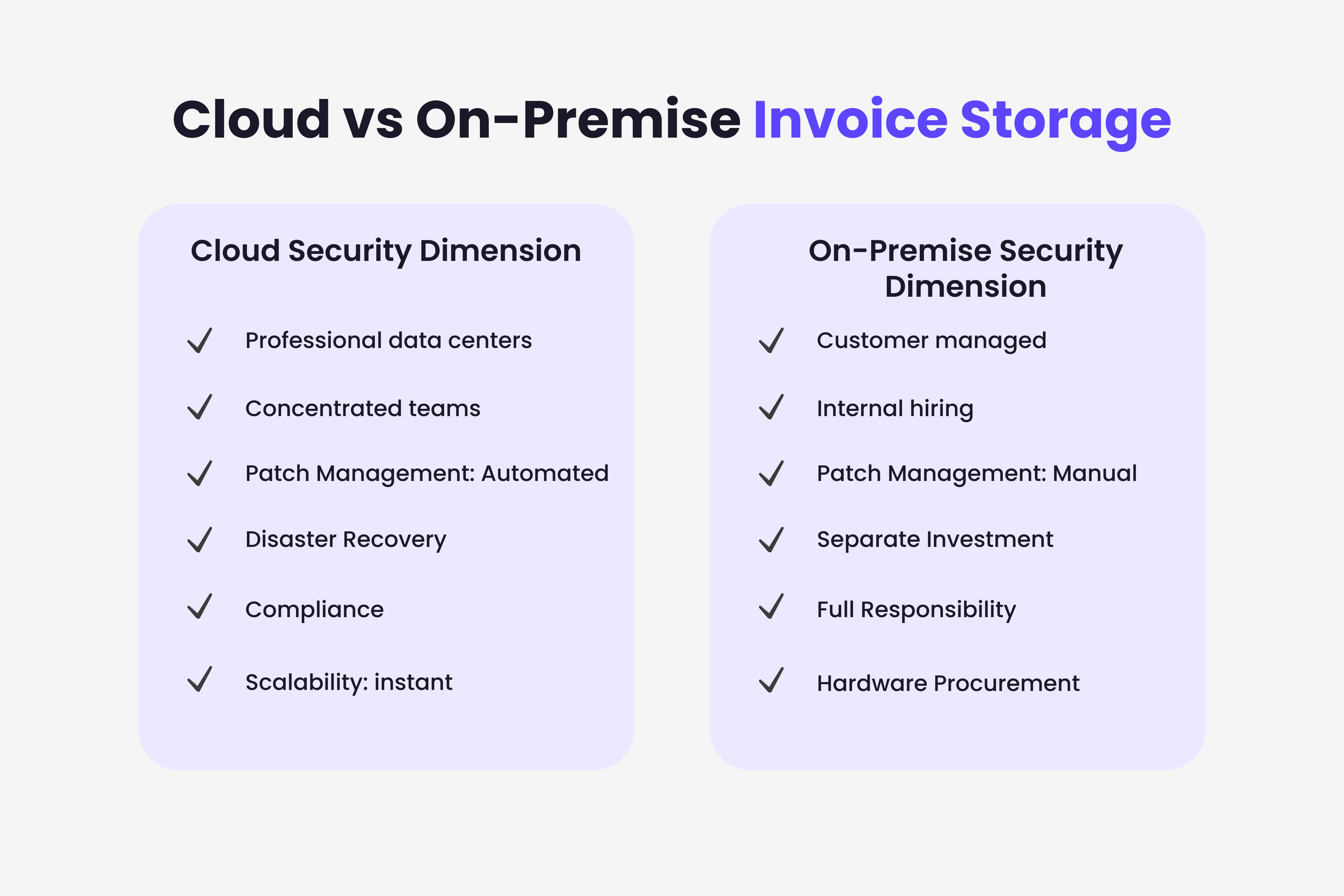
Scalability demands significant planning and investment. Cloud storage scales instantly through configuration changes, a key advantage when implementing accounts payable automation. On-premise scaling requires months of planning and capital expenditure.
Cost Implications and Hybrid Approaches
Security capabilities directly correlate with costs across models.
Cloud storage converts capital expenditure to operational expense. Organizations pay subscription fees scaling with usage, avoid hardware purchases, and reduce personnel dedicated to infrastructure management.
On-premise storage requires substantial upfront investment. Hardware purchases, facility modifications, and staffing all demand capital allocation. Data center operational costs typically range from $10 million to $25 million annually for enterprise facilities.
Many organizations adopt hybrid models balancing cloud and on-premise storage. Hybrid invoice storage might process current invoices in cloud for accessibility while maintaining historical archives on-premise for compliance.
Effective hybrid implementations require clear data classification policies following invoice system integration best practices, consistent security controls across both environments, unified access management, and comprehensive monitoring spanning all storage. Learn how to audit your invoice data access across both cloud and on-premise environments.
The optimal storage approach depends on specific organizational circumstances. Small businesses typically benefit from cloud storage when they evaluate invoice management software for compliance. Large enterprises may prefer on-premise for sensitive data.
Storage decisions made today shape invoice security, compliance readiness, and operational flexibility for years ahead. Careful evaluation enables choices supporting both immediate requirements and long-term business objectives.
TL;DR
- Shared responsibility model divides security: cloud providers secure infrastructure, you secure data configuration, access controls, and compliance
- 99% of cloud security failures stem from customer misconfigurations, not provider infrastructure vulnerabilities
- Cloud advantages include professional physical security, automated patching, built-in disaster recovery, and inherited compliance certifications (SOC 2, ISO 27001)
- On-premise advantages offer complete infrastructure control, no third-party access, and air-gapped network isolation
- On-premise challenges include $600-$1,100/sqft construction costs, 40-60% annual operational overhead, and critical security staffing requirements
- Hybrid approaches process current invoices in cloud for accessibility while maintaining on-premise archives for compliance
- Small businesses typically benefit from cloud; large enterprises may prefer on-premise for sensitive data
Ready to automate your invoices?
Start extracting invoices from your email automatically with Gennai. Free plan available, no credit card required.
Start FreeRelated Articles
Accounts Payable Turnover Ratio Explained
The accounts payable turnover ratio shows how fast you pay suppliers. Get the formula, a worked example, benchmarks and what your number really means.
GuideNet 30 vs Net 60: What Payment Terms Really Mean for Your Cash
Net 30 vs net 60 explained for business owners: what each term means, when the clock really starts, and how the gap hits your cash on both sides.
GuideThe Accounts Payable Process, Step by Step (for Owners)
The accounts payable process has five steps: receive, verify, approve, pay, and record each invoice. Here is how each works and where owners lose money.