
Cash vs Accrual Accounting: Which One Are You Actually Using?
Cash vs accrual accounting is all about timing. Learn the difference, which method you are probably using, and when you are required to switch.

TL;DR
- Cash basis is money in, money out. You record income when it lands in your account and an expense when you actually pay it. It mirrors your bank balance.
- Accrual is earned and incurred. You record a sale when you invoice it and a cost when the bill arrives, before any cash moves (IRS Publication 538).
- In the US, most small businesses can choose cash basis if their average annual gross receipts stay at or below 32 million USD for 2026 (IRS Revenue Procedure 2025-32).
- In the UK, cash basis is the default for sole traders and partnerships from the 2024/25 tax year, with the option to switch to traditional accrual accounting (gov.uk).
- Neither method tells the truth if a bill never made it into your books. Missing invoices break both.
Cash vs accrual accounting comes down to one thing: timing. Cash basis records income when the money actually reaches your account and expenses when you actually pay them. Accrual records income when you earn it and expenses when you incur them, no matter when the cash moves. Most freelancers and small businesses run on cash basis without ever deciding to, because it matches what they see in the bank. Larger businesses use accrual, and above a certain size the tax authorities require it. The quiet problem is that plenty of owners manage the business in their head on one method and file taxes on the other, and the gap between the two is exactly where cash-flow surprises live.
The difference in one sentence: timing
Both methods look at the same sales and the same bills. They disagree only on when those land in your books.
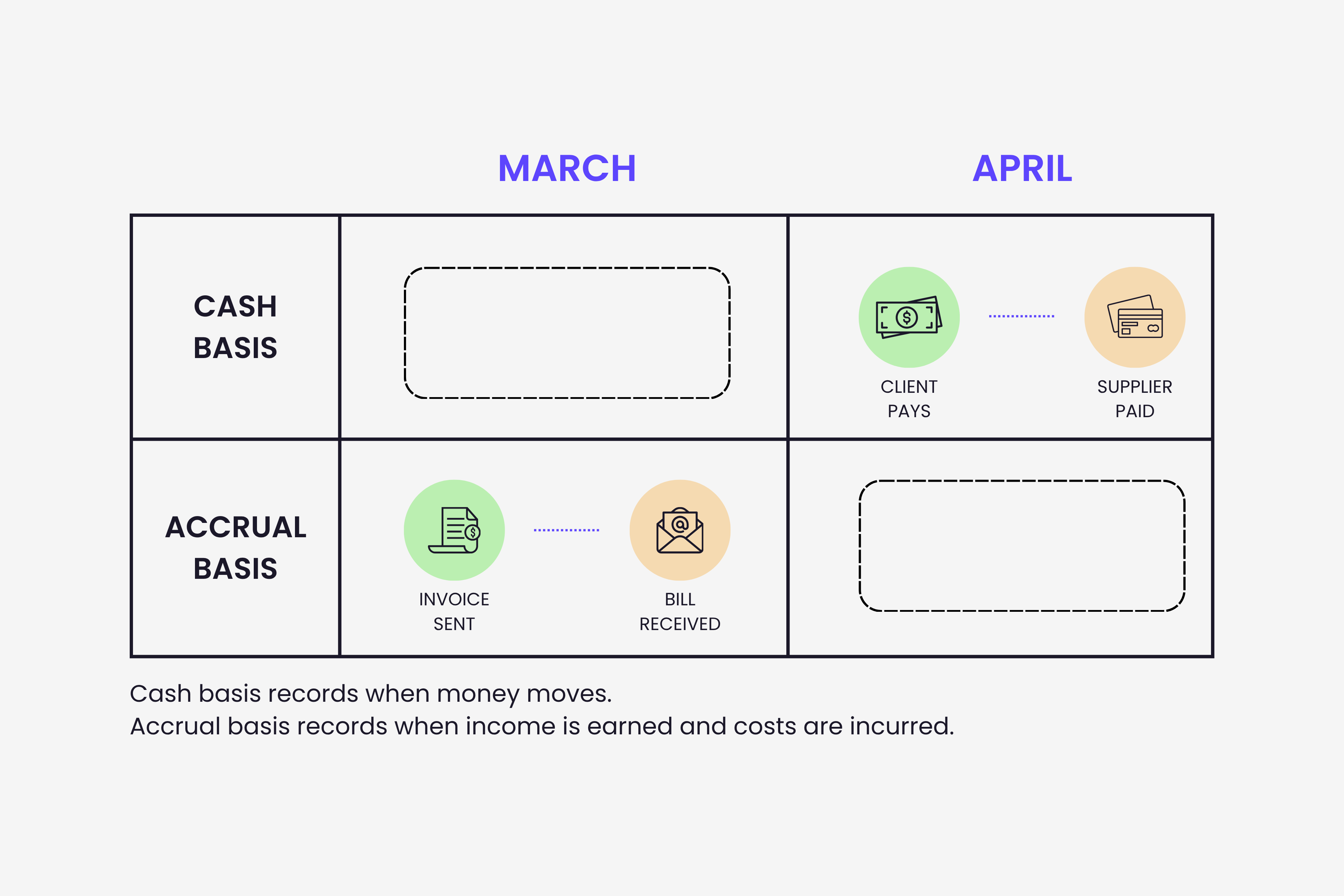
Say you invoice a client in March and get paid in May. Cash basis books that income in May, when the money arrives. Accrual books it in March, when you did the work and sent the invoice. Now flip it: a supplier sends you a bill in March that you pay in April. Cash basis records the expense in April. Accrual records it in March, when you received the bill. Same four events, different months, and that shift is the entire debate.
Cash basis accounting, explained
Under the cash method you include income in the year you actually or constructively receive it, and you deduct an expense in the year you actually pay it (IRS Publication 538). If the cash has not moved, nothing hits the books.
The appeal is simplicity. Your accounts track your bank account, so you always know what you can spend. There are no receivables or payables to manage, and the bookkeeping is light enough for one person to keep on top of. This is why sole traders, freelancers, and small service businesses tend to live here.
The weakness is that it can distort how the business is really doing. A large sale you invoice in December but collect in January shows up as January income, so a strong month can look weak and a quiet month can look rich. Cash basis also hides what you are owed and what you owe, because money still in transit simply is not there yet.
Accrual accounting, explained
Under the accrual method you report income in the year it is earned, once the all-events test is met, and you deduct expenses when they are incurred and economic performance has occurred (IRS Publication 538). Cash timing is irrelevant.
The payoff is a truer picture of profit. Because revenue is matched to the costs that produced it, each period reflects the real activity of that period rather than the accident of when payments cleared. Accrual is the basis behind GAAP financial statements, so it is what most investors, lenders, and larger companies expect to see.
The cost is complexity. You have to track accounts receivable and accounts payable, and your profit on paper will often not match the cash sitting in the bank. A month can be profitable on an accrual income statement while your account is nearly empty because customers have not paid yet.
The same month, booked two ways
Here is one small business quarter, recorded both ways, so you can see the same events land in different months.
| Event | Date | Cash basis records it | Accrual records it |
|---|---|---|---|
| You invoice a client 1,200 USD | Mar 3 | when paid (Apr 20) | Mar 3 (earned) |
| The client pays | Apr 20 | Apr 20 | already booked, no new entry |
| A supplier bills you 400 USD | Mar 10 | when you pay (Apr 5) | Mar 10 (incurred) |
| You pay the supplier | Apr 5 | Apr 5 | already booked, no new entry |
So which one are you actually using?
In the US, you choose an accounting method on your first tax return and generally stick with it. Most small businesses can use cash basis, and many do because it is allowed and simpler. You can use it as long as you meet the small-business gross receipts test, which for 2026 means average annual gross receipts of 32 million USD or less over the prior three years (IRS Revenue Procedure 2025-32).
Some businesses are barred from cash basis unless they clear that same test: C corporations, partnerships that have a C corporation as a partner, tax shelters, and businesses that have to keep inventory to work out their income (IRS Publication 538).
In the UK the default flipped. From the 2024/25 tax year, cash basis is the automatic method for most sole traders and partnerships, and you now have to actively opt in to traditional accrual accounting if you want it (gov.uk).
Here is the part that trips owners up. Many people believe they are on accrual because their accountant hands them accrual accounts at year end, while they run the business day to day on whatever is in the bank. Both things can be true at once. The method on your return and the mental model you use to manage cash do not have to match. Knowing which is which is what stops the ugly moment when a profitable month somehow has no money in it.
When you have to switch to accrual
You can outgrow cash basis. In the US the usual triggers are crossing the gross receipts threshold on a three-year average, becoming a C corporation, or taking on inventory in a way that forces accrual (IRS Publication 538). Changing method is not a silent switch either. It generally needs IRS consent through a formal change-of-accounting-method request, so it is a decision to plan with your accountant, not something to do quietly on a return.
In the UK the move runs the other way now that cash basis is the default: you leave it by electing traditional accounting when accrual suits the business better, for example once you carry stock or want financials a lender will accept.
This guide stays at the level of understanding the two methods. The actual decision, and the timing of any switch, is a conversation worth having with whoever files your accounts.
Both methods need one thing: complete records
Choosing the method is the easy part. The part that actually wrecks owners' numbers is not cash versus accrual at all, it is incomplete records. Whichever method you are on, the books can only be right if every bill and every sale is actually in them.
Picture an invoice sitting unread in an inbox, or a software receipt that arrived as an HTML email and never got saved. On cash basis you miss that expense in the period you paid it. On accrual you miss the liability in the period you incurred it. Either way the numbers lie, and you usually find out at month-end or at tax time, which is the worst moment to discover a gap. It also helps to know which document your accountant actually needs so the right paperwork lands in the file in the first place.
This is why the boring discipline of capturing every supplier invoice the moment it arrives matters more than the label on your method. Gennai works on exactly that layer: it reads invoices straight out of your inbox and pushes clean, structured records into Xero, QuickBooks, or Holded, so whichever method you file on has complete data underneath it. If you are also trying to automate the bookkeeping behind both methods, that captured data is the foundation everything else is built on.
Frequently asked questions
Can I switch from cash to accrual accounting?
Yes. In the US a change of accounting method generally needs IRS approval through a formal request, so you plan it with your accountant rather than flipping it on a return (IRS Publication 538). In the UK, where cash basis is now the default, you move the other way by electing traditional accounting.
Which method is better for a small business?
Cash basis is usually simpler and mirrors your bank, which is why most freelancers and small businesses start there. Accrual gives a truer picture of profit and is required once you pass a size threshold or need GAAP financials. Many businesses begin on cash and move to accrual as they grow.
Do I have to use the same method for tax and for running the business?
No. Your tax return uses one chosen method, but you can still watch cash in the bank day to day. The trouble starts when you confuse the two and read an accrual profit figure as money you can spend.
What happens if my records are incomplete?
Both methods produce wrong numbers. A missing supplier bill is a missed deduction on cash basis and a missing liability on accrual. Complete capture of every invoice is what makes either method trustworthy.
Cash or accrual, the method only works when the data underneath it is complete. Gennai captures every supplier invoice from your inbox and files it as a clean record in Xero, QuickBooks, or Holded, so your books match reality whichever method you report on. Start free, no card needed, and see a month of invoices captured for you.
Ready to automate your invoices?
Start extracting invoices from your email automatically with Gennai. Free plan available, no credit card required.
Start FreeRelated Articles
Net 30 vs Net 60: What Payment Terms Really Mean for Your Cash
Net 30 vs net 60 explained for business owners: what each term means, when the clock really starts, and how the gap hits your cash on both sides.
GuideThe Accounts Payable Process, Step by Step (for Owners)
The accounts payable process has five steps: receive, verify, approve, pay, and record each invoice. Here is how each works and where owners lose money.
GuideWhat Is a Chart of Accounts? A Guide for Business Owners
A chart of accounts is the list of accounts your business uses to record every transaction. Learn the five account types, numbering, and how to set one up.