
8 Reasons Your Invoice Approval Gets Stuck
Stuck invoice approvals are structural and fixable. Here are the eight most common reasons your invoice approval gets stuck and what to do about each one.

The invoice arrived on time. The vendor is legitimate. The amount is correct. And it has been sitting in an approval queue for eleven days.
Stuck invoice approvals are one of those problems that finance teams accept as normal because it has always been this way. But the causes are almost always structural and fixable. Here are the eight that come up most often.
01. The approver is out and there is no backup
An invoice routed to someone on holiday or medical leave sits until they return or someone manually re-routes it. Approval workflows that do not include a delegation rule or an escalation timer will stall every time a key approver is unavailable. This is the most common cause of stuck approvals and the easiest to fix: every approver needs a designated backup, and the workflow needs to trigger that backup automatically after a defined number of days with no action.
02. The threshold rule routes to the wrong person
Approval thresholds that made sense two years ago may no longer match how the business actually spends. An invoice for $8,500 gets routed to a department head who no longer manages that cost center. A $50,000 vendor contract goes to a manager whose authority level was changed after a reorg. These mismatches do not generate errors; they just create confusion and slow everything down while people figure out who should actually approve it.
03. The invoice data is incomplete or wrong
If the extracted data is missing the cost center, the GL code, or the purchase order reference, the routing logic cannot determine where to send the invoice for approval. It lands in an exceptions queue instead. From there, it waits for someone to manually complete the record before routing can proceed. This is where the quality of your extraction layer directly affects approval cycle time. As covered in the guide on what happens to invoice data after extraction, incomplete structured data at the extraction step creates downstream delays that compound at every stage.
04. The approval email got buried
Email-based approval workflows depend on the approver noticing, opening, and acting on a notification that arrived between forty other messages. If your approval process is a link in an email, the bottleneck is inbox management, not finance operations. Teams that move approval actions into a dedicated system, where invoices are visible as a task list rather than email threads, see faster cycle times simply because the work is more visible.
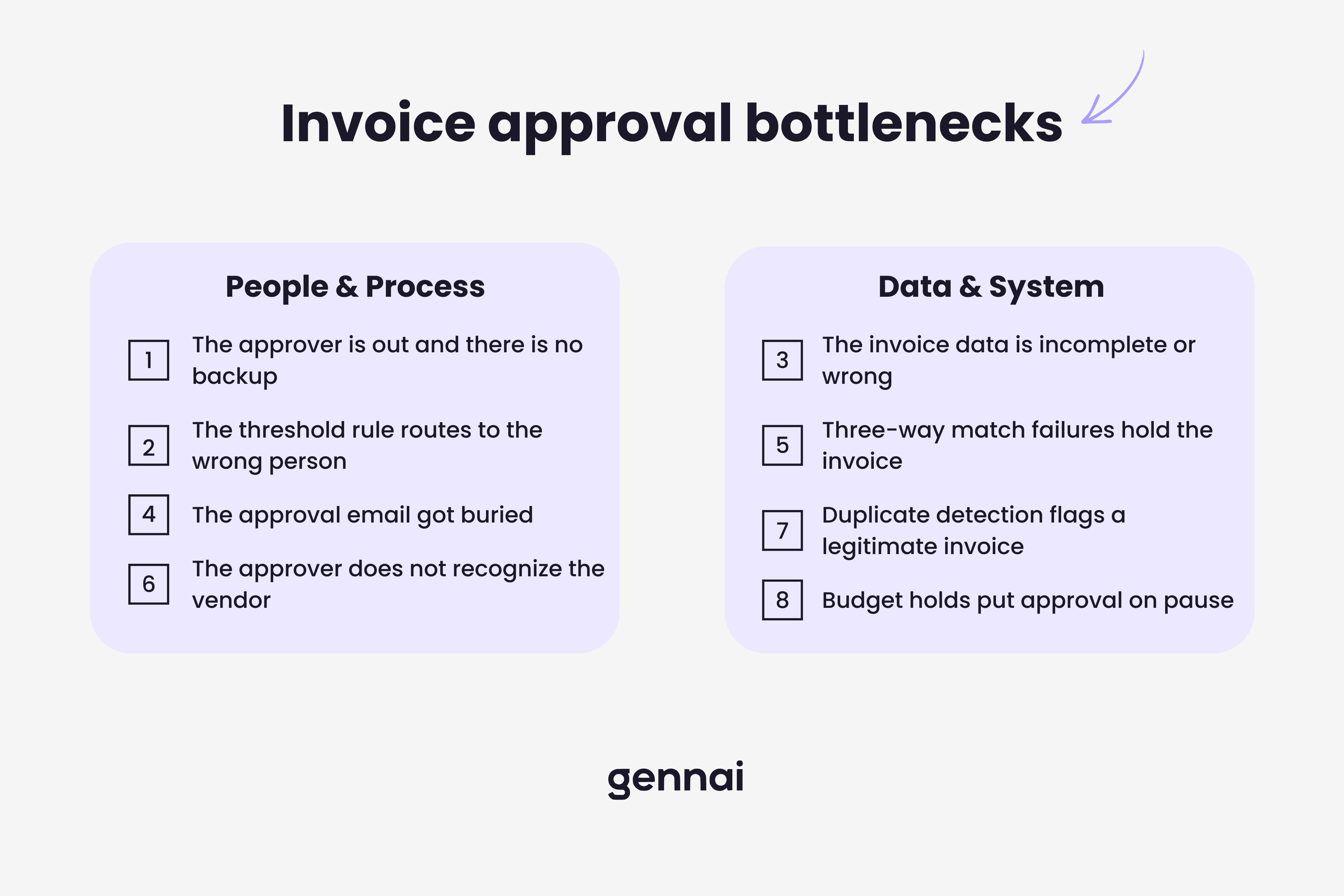
05. Three-way match failures hold the invoice
When your AP process requires matching an invoice to a purchase order and a goods receipt, any discrepancy stops the approval automatically. The invoice total does not match the PO amount. The quantity received differs from what was invoiced. These are legitimate holds, but they become stuck approvals when no one owns the resolution. The invoice sits waiting for procurement or receiving to confirm the correct figures, and there is no defined process for how fast that needs to happen.
06. The approver does not recognize the vendor
A new vendor, a vendor name that changed after an acquisition, or a subsidiary billing under a different entity than the one in your system: any of these can cause an approver to hold an invoice pending verification. This is not always avoidable, but it is manageable. New vendors should be added to your vendor master before they submit invoices, not after. A vendor onboarding step that captures entity names, payment details, and approval routing rules prevents this category of delay entirely.
07. Duplicate detection flags a legitimate invoice
Automated duplicate detection occasionally catches a false positive: a legitimate invoice that shares enough fields with a previous one to trigger a hold. When this happens, the invoice sits in a review queue until someone manually clears the flag. The mechanics of duplicate invoice detection matter here: fuzzy matching logic that is tuned too aggressively will create more false positives; logic tuned too loosely will let real duplicates through. Both require human resolution time.
08. Budget holds put approval on pause
Some approval workflows include a budget availability check before routing to the approver. If the relevant cost center is over budget for the period, the invoice is held automatically. This is a policy decision, not a workflow failure, but it becomes a problem when no one notifies the vendor, no one communicates an expected resolution date, and the invoice sits silently. The AP automation guide covers how to structure exception handling so holds do not become invisible backlogs.
The Pattern Underneath
Most stuck approvals share a common root: the workflow was designed for a specific set of conditions, and something outside those conditions happened. The approver is unavailable. The data is wrong. The vendor is new. The budget ran out.
A well-designed approval workflow handles exceptions as predictably as it handles clean invoices. That means escalation rules, backup approvers, defined resolution owners for each exception type, and visibility into where every invoice is at any given moment. Without those elements, every edge case becomes a stuck invoice.
The data side of this problem connects directly to how invoices are captured and structured before they enter your workflow. The five-step guide to automating invoice processing covers how to build a pipeline where complete, validated data reaches your approval workflow consistently, rather than landing in an exceptions queue because of missing fields.