
What Is Accounts Payable? A No-Jargon Guide for Owners Who Aren't Accountants
Accounts payable is every unpaid supplier bill your business owes. Learn what AP means, the 5 steps it involves, and where owners lose invoices.

TL;DR
- Accounts payable is what your business owes suppliers for goods and services already delivered but not yet paid. It is recorded as a current liability.
- AP is the mirror image of accounts receivable. AP is money you owe, AR is money owed to you.
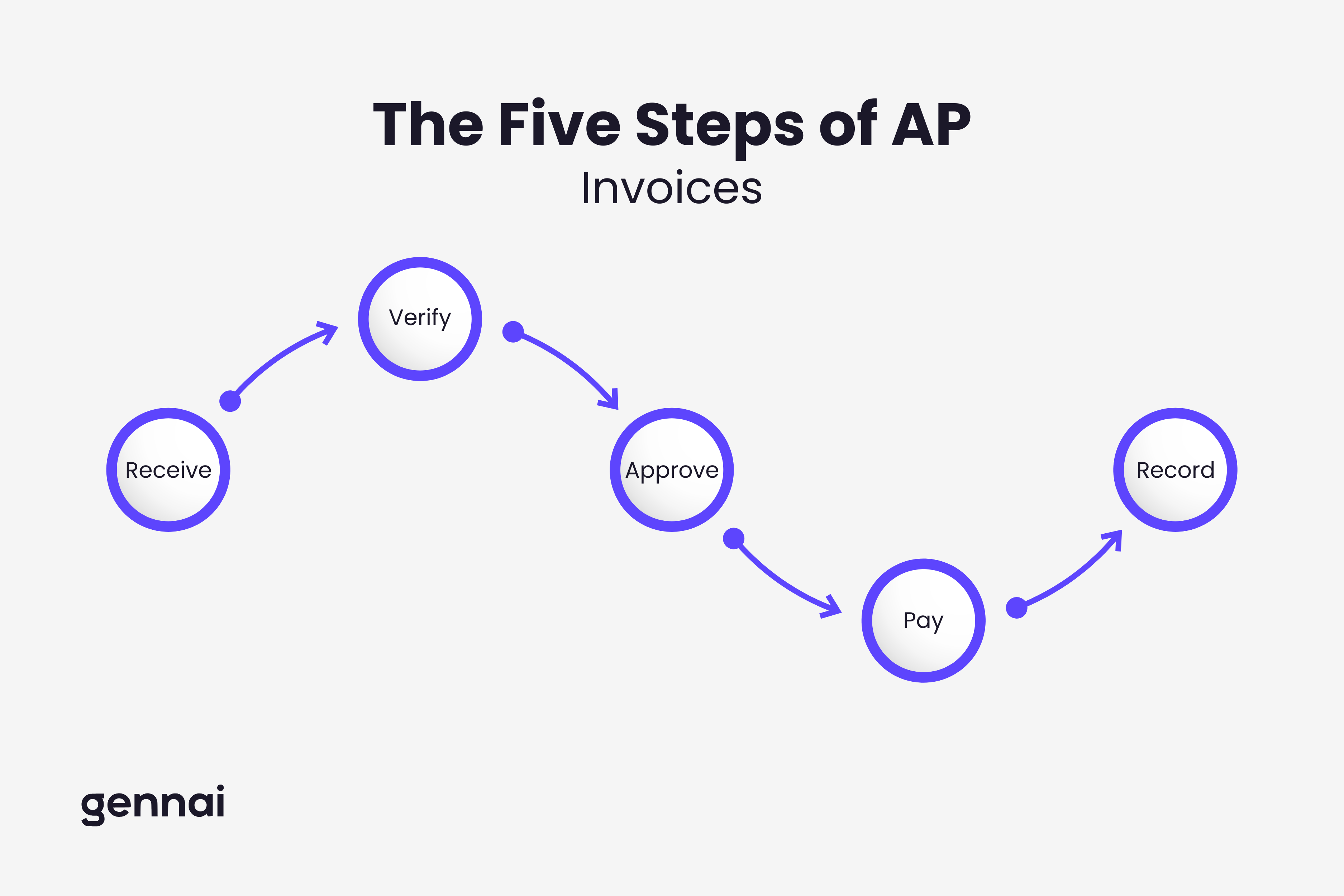
- The AP cycle has five steps: receive the invoice, verify it, approve it, pay it, and record it.
- The step that breaks most often is the first one. Invoices arrive by email and get lost before anyone records them, and the average invoice still takes 9.2 days to process (Ardent Partners 2025).
- You do not need an accounting degree to run AP well. You need every invoice captured and a simple, repeatable path from inbox to paid.
Accounts payable, in one sentence
What is accounts payable? Accounts payable, usually shortened to AP, is the money your business owes to suppliers for goods and services you have already received but have not paid for yet. Every unpaid bill sitting in your inbox is an account payable. In accounting terms it is a current liability, a short-term debt you expect to settle within days or weeks, and it is one of the two numbers that decide how cash actually moves through your business.
If you run a small company and you are not an accountant, that plain version is the whole idea. Your electricity bill, the invoice from your web developer, the wholesaler you buy stock from, the monthly software subscription. Until the money leaves your account, each one is an account payable. This guide explains what that means in practice, the five steps AP really involves, and the one place where it quietly falls apart for most owners: the email inbox.
Accounts payable vs accounts receivable
The fastest way to lock in the meaning is to put AP next to its mirror image. Accounts payable is money you owe. Accounts receivable, or AR, is money owed to you by your customers. Owners flip the two constantly, so keep the direction straight: payable is cash on its way out, receivable is cash on its way in.
| Accounts payable (AP) | Accounts receivable (AR) | |
|---|---|---|
| Who owes whom | You owe your suppliers | Your customers owe you |
| On the balance sheet | Current liability | Current asset |
| Cash effect | Money leaving soon | Money arriving soon |
| The document | Bills you receive | Invoices you send |
| The risk if ignored | Late fees, lost discounts, strained suppliers | Cash you never collect |
What actually happens in accounts payable: the five steps
Accounts payable is not a single action. It is a short cycle that every supplier bill runs through, whether you do it in your head or in software.
- Receive the invoice. The bill arrives, usually by email, sometimes on paper or inside a supplier portal. This is the moment the payable exists.
- Verify it. Check the invoice is genuine, the amounts match what you ordered or received, and it is not a duplicate you already paid. Accountants call the thorough version a three-way match (invoice, purchase order, delivery note). For a small business it is often just, did we actually get this, and is the price right?
- Approve it. Someone with the authority to spend confirms the bill should be paid.
- Pay it. You settle it by bank transfer, card, or direct debit, on or before the due date.
- Record it. The invoice is entered into your accounting software, whether that is Xero, QuickBooks, Holded, or a spreadsheet, so your books and your tax return reflect it.
Where accounts payable breaks for owners: the inbox
On paper the five steps look simple. In practice the first one is where the money leaks. Invoices do not arrive in a tidy queue. They land in different inboxes, under vague subject lines, as PDF attachments or as plain text buried inside an email that reads like marketing. The average invoice still takes 9.2 days to move from arrival to processed, and only 32.6% are handled with no manual touch at all, according to Ardent Partners' 2025 accounts payable benchmarks. Everything else depends on someone remembering to forward, download, and type it in. Across small and mid-sized businesses, 86% still enter invoice data by hand, and roughly 39% of invoices carry an error that has to be caught and corrected (DocuClipper).
This is why the invoices that quietly disappear in an inbox cost far more than the few minutes of tidying they seem to represent. A missed invoice is a missed expense on your tax return and a supplier chasing you for a payment you never saw. The fix is not a bigger folder system. It is capturing every invoice the moment it arrives, straight from your inbox, before a person has to touch it.
Why accounts payable matters for your cash
You can run a profitable business and still run out of cash, and accounts payable is half of the reason. What you owe suppliers, and when you choose to pay it, sets the timing of money leaving your account. Accountants track this with days payable outstanding, or DPO, which is simply the average number of days you take to pay a bill. Pay too fast and you strain your own cash. Pay too slow and you lose early-payment discounts, collect late fees, and wear down the suppliers you rely on.
Cash gets squeezed from both directions. On the money-owed-to-you side, 56% of small businesses are carrying unpaid customer invoices at any given time, an average of 17,500 USD tied up per business (Intuit QuickBooks 2025). The discipline you would want on collecting what you are owed is the same discipline you need on what you owe, so nothing slips past its due date just because it was lost in an inbox.
Do you need an accounts payable process if you are tiny?
Yes, and it is smaller than you fear. If you handle a handful of bills a month, one clear rule and a single place to keep them is enough. The pain usually shows up around 50 to 80 invoices a month, when forwarding, downloading, and typing stops being a five-minute job and starts eating a morning. That is the moment to move from a manual routine to AP automation for small teams, which is built for businesses of fewer than ten people rather than large finance departments. If you want the full picture of how the cycle can run with far less manual work, the guide to automating the accounts payable process end to end walks through the steps in order.
What accounts payable is not
A few things get mixed up with accounts payable, so it helps to name them plainly.
- It is not the same as your expenses. An expense is the cost itself. Accounts payable is the unpaid obligation to settle that cost. They line up eventually, but they are separate entries.
- It is not accounts receivable. AP is money leaving, AR is money arriving. If you remember nothing else, remember the direction.
- It is not just data entry. The typing is the visible part, but the real value of AP is control: paying the right amount, once, on time, with a record you can defend when taxes are due.
Frequently asked questions
Is accounts payable an asset or a liability?
Accounts payable is a liability, specifically a current liability, because it is money your business owes and expects to pay within a short period, usually under a year. It appears on the balance sheet, not on the profit and loss statement.
Is accounts payable a debit or a credit?
When you record a new supplier bill, accounts payable is credited, so the liability goes up, and the matching expense or asset is debited. When you pay the bill, you debit accounts payable to reduce it and credit your bank account. In plain terms, AP rises when bills come in and falls when you pay them.
What is the difference between accounts payable and expenses?
An expense is the cost of something your business has used, such as electricity or software. Accounts payable is the unpaid bill for that cost. You can have an expense and a payable for the same item at the same time. The payable clears once you actually pay.
What is the difference between accounts payable and accounts receivable?
Accounts payable is money you owe to suppliers. Accounts receivable is money your customers owe you. AP is cash on its way out, AR is cash on its way in. Most businesses have both running at the same time.
Accounts payable is not complicated, but it is unforgiving when invoices go missing. Get the capture right and the rest of the cycle, approving, paying, and recording, becomes far calmer. Gennai connects to your inbox and pulls out every supplier invoice automatically, then sends it to Xero, QuickBooks, or Holded already organized. You can try it free, with no credit card, and point it at last year's inbox to see what slipped through. Start with the invoices you already have, then let the new ones take care of themselves.