
Claude AI vs ChatGPT for Invoice Processing: Which Wins?
Claude vs ChatGPT for invoice processing: Compare accuracy (90% vs 91%), speed, costs, and real-world performance. Which AI model wins for your invoices?

Both Claude and ChatGPT have become leading names in AI-powered invoice processing. Companies evaluating automation solutions inevitably face this question: which AI model actually performs better for extracting and processing invoice data? The answer isn't as straightforward as you might expect.
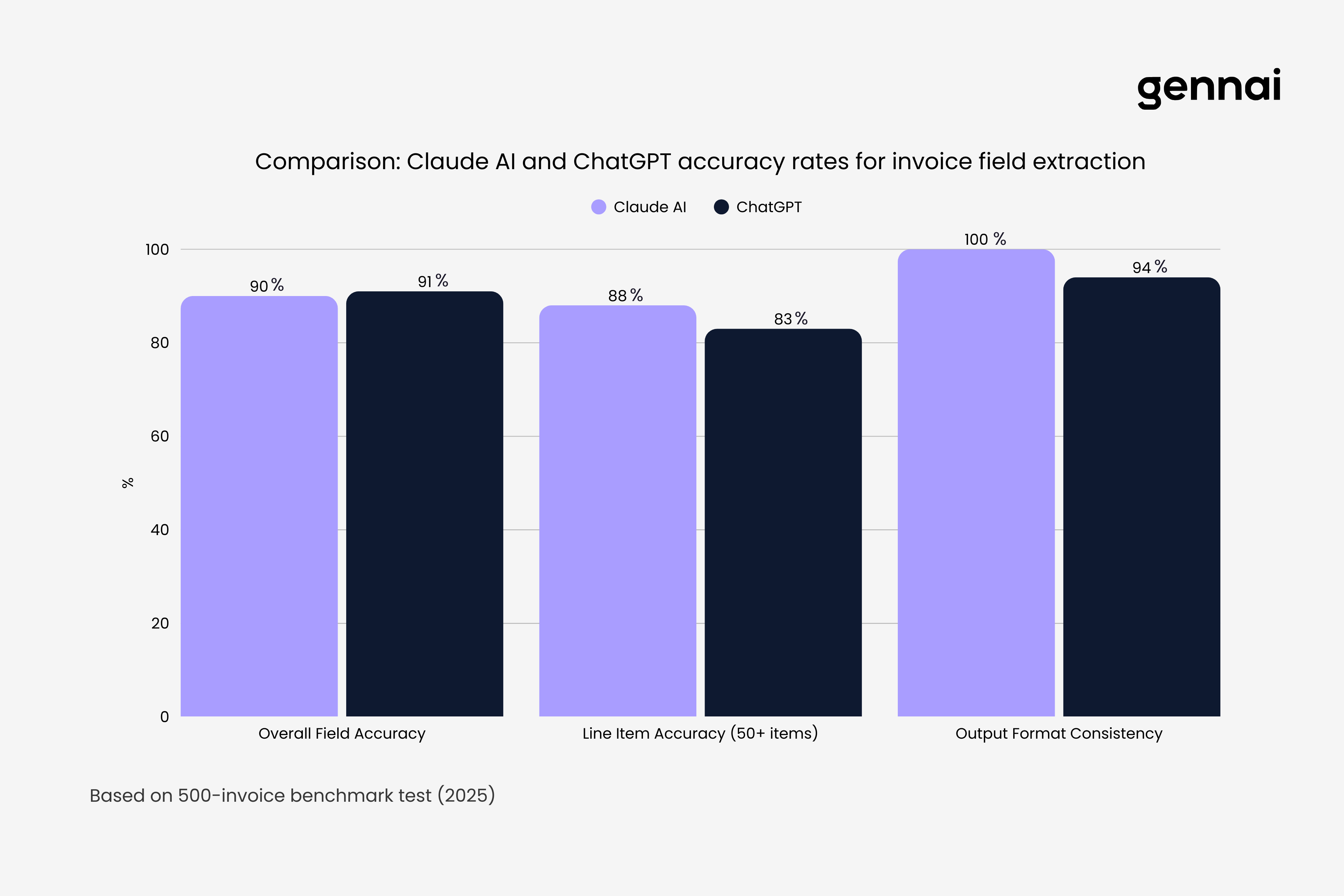
Recent benchmarks testing invoice extraction accuracy found Claude Sonnet 3.5 achieving 90% accuracy, while GPT-4 with advanced OCR reached 91%. A third leading model led with 94% thanks to integrated vision capabilities. But accuracy numbers alone don't tell the complete story. Processing speed, cost, integration complexity, and output consistency all factor into which AI works best for your specific invoice processing needs.
This comparison digs into real-world performance differences between Claude and ChatGPT specifically for invoice processing tasks. We'll examine extraction accuracy, processing approaches, cost considerations, and practical recommendations based on actual deployment scenarios. If you're evaluating AI invoice processing solutions, understanding these distinctions helps you make an informed decision.
The Fundamental Architectural Differences
Before comparing performance metrics, you need to understand how Claude and ChatGPT approach invoice processing differently. These architectural choices significantly impact their effectiveness for document extraction tasks.
Claude was built with Constitutional AI principles prioritizing safety, consistency, and contextual understanding. Anthropic designed Claude specifically for long-context reasoning, giving it the ability to process up to 200,000 tokens in a single conversation. This massive context window means Claude can handle entire invoice batches, complex multi-page documents, and detailed processing instructions without losing track of earlier information.
ChatGPT takes a different approach. OpenAI optimized GPT models for versatility and speed across diverse tasks. GPT-4's context window reaches 128,000 tokens, which suffices for most invoice processing scenarios but falls short of Claude's capacity. Where ChatGPT gains ground is multimodal capability. GPT-4o can process images directly without requiring separate OCR preprocessing, streamlining the extraction workflow.
These architectural differences manifest in practical ways during invoice processing. Claude excels when you need to maintain context across hundreds of invoices, apply complex validation rules, or ensure output formatting remains absolutely consistent. ChatGPT shines when processing speed matters most, when you're handling diverse invoice formats, or when you want to process image files without separate OCR steps.
Understanding how AI actually reads invoices helps clarify why these architectural choices matter. For a deeper look at the ML mechanics underpinning both models, see our guide to machine learning for invoice data. The multi-layer processing approach works differently depending on the underlying model's strengths.
Extraction Accuracy: The Real Performance Data
Independent benchmarks provide the clearest picture of how Claude and ChatGPT actually perform on invoice extraction tasks. A comprehensive study testing 500 invoices with varying formats and quality levels revealed important accuracy differences.
Claude Sonnet 3.5 achieved 90% field-level extraction accuracy across the test set. The model demonstrated particular strength with complex, multi-page invoices and documents containing intricate table structures. Claude's accuracy remained more consistent across different invoice qualities, maintaining high performance even with lower-resolution scans or partially obscured text.
GPT-4 coupled with advanced OCR reached 91% accuracy on the same test set. ChatGPT performed slightly better on simple, single-page invoices and showed faster processing times for straightforward extraction tasks. However, accuracy dropped more noticeably when encountering poor-quality scans or unusual document layouts.
The more telling metric is output consistency. Claude produced valid JSON in 100% of test cases, with clean, properly formatted data that required no post-processing. ChatGPT occasionally generated syntax errors in JSON output at very high volumes, requiring additional validation steps before the data could be used reliably.
For line-item extraction specifically, both models performed comparably on invoices with fewer than 20 line items. Claude pulled ahead on complex invoices with 50+ line items, maintaining accuracy in associating descriptions, quantities, prices, and totals even when table formatting became irregular.
Error types differed between the models. Claude's errors typically involved conservative extraction, where low-confidence fields were flagged for review rather than guessed incorrectly. ChatGPT showed more overconfidence, occasionally extracting incorrect values without appropriately low confidence scores.
Processing Speed and Cost Considerations
Speed and cost represent crucial factors when choosing an AI model for invoice processing at scale. Processing thousands of invoices monthly means small differences in per-document costs and processing times compound significantly.
Claude processes a typical single-page invoice in approximately 1.2-1.5 seconds. Multi-page invoices with extensive line items take 2-3 seconds. These times assume text-based PDFs where OCR happens separately. The total processing time increases when factoring in external OCR preprocessing required for scanned invoices.
ChatGPT processes invoices slightly faster, averaging 0.9-1.3 seconds for single-page documents. GPT-4o's integrated vision capabilities eliminate separate OCR steps for image-based invoices, potentially reducing total processing time by 40-50% compared to Claude's OCR-then-extraction workflow.
Cost calculations based on processing 1,000 invoices monthly with average 2,000 input tokens and 500 output tokens per invoice show interesting differences. Claude API pricing results in approximately $1.50-$2.00 per 1,000 invoices. GPT-4 costs range from $1.80-$2.50 for the same volume, though the higher end includes multimodal processing that eliminates separate OCR costs.
At enterprise scale processing 100,000+ invoices monthly, these per-document differences become material. Claude's slightly lower API costs and more consistent output formatting reducing post-processing needs can generate meaningful savings. However, ChatGPT's faster processing and elimination of separate OCR infrastructure might offset higher API costs depending on your specific workflow.
Processing cost represents only part of the total cost equation. Implementation complexity, maintenance overhead, and error correction costs all factor into true cost of ownership. Claude's more consistent output typically requires less validation logic and error handling code, reducing development and maintenance costs. ChatGPT's broader ecosystem and more extensive documentation can reduce initial implementation time.
Integration and Implementation Complexity
How easily each AI model integrates into existing invoice processing workflows significantly impacts real-world usability. Both Claude and ChatGPT offer robust APIs, but integration experiences differ meaningfully.
Claude's API provides straightforward REST endpoints with clear documentation. The model accepts plain text input, making it necessary to perform OCR separately before sending data to Claude. This two-step process adds complexity but also provides flexibility. You can choose the OCR engine that works best for your invoice types and quality levels, then send the extracted text to Claude for intelligent field extraction.
ChatGPT offers more implementation options through OpenAI's API. For text-based invoices, the workflow resembles Claude's approach. Where ChatGPT differentiates is handling image inputs directly through GPT-4o's vision capabilities. You can send invoice images without preprocessing, and the model performs both character recognition and field extraction in a single API call.
This integrated approach simplifies implementation for businesses processing primarily scanned or photographed invoices. Companies using automated invoice extraction from Gmail particularly benefit from eliminating the OCR preprocessing step when dealing with email attachments.
Both platforms offer SDKs for popular programming languages including Python, JavaScript, and Node.js. Claude's SDK emphasizes safety and structured outputs, with built-in features for handling rate limits and managing conversation context. ChatGPT's SDK provides broader functionality including function calling, embeddings, and access to the entire OpenAI ecosystem.
Error handling differs between the platforms. Claude returns more informative error messages and confidence scores for each extracted field, making it easier to implement robust exception handling. ChatGPT's errors can be less specific, occasionally requiring additional logic to determine whether processing failed due to API issues, content problems, or model limitations.
For businesses already using comprehensive invoice management software, API integration becomes crucial. Both Claude and ChatGPT can integrate with major platforms, but implementation complexity varies based on your specific tech stack and processing requirements.
When Claude Is the Better Choice
Specific invoice processing scenarios favor Claude's architecture and capabilities. Understanding these situations helps you determine if Claude aligns with your needs.
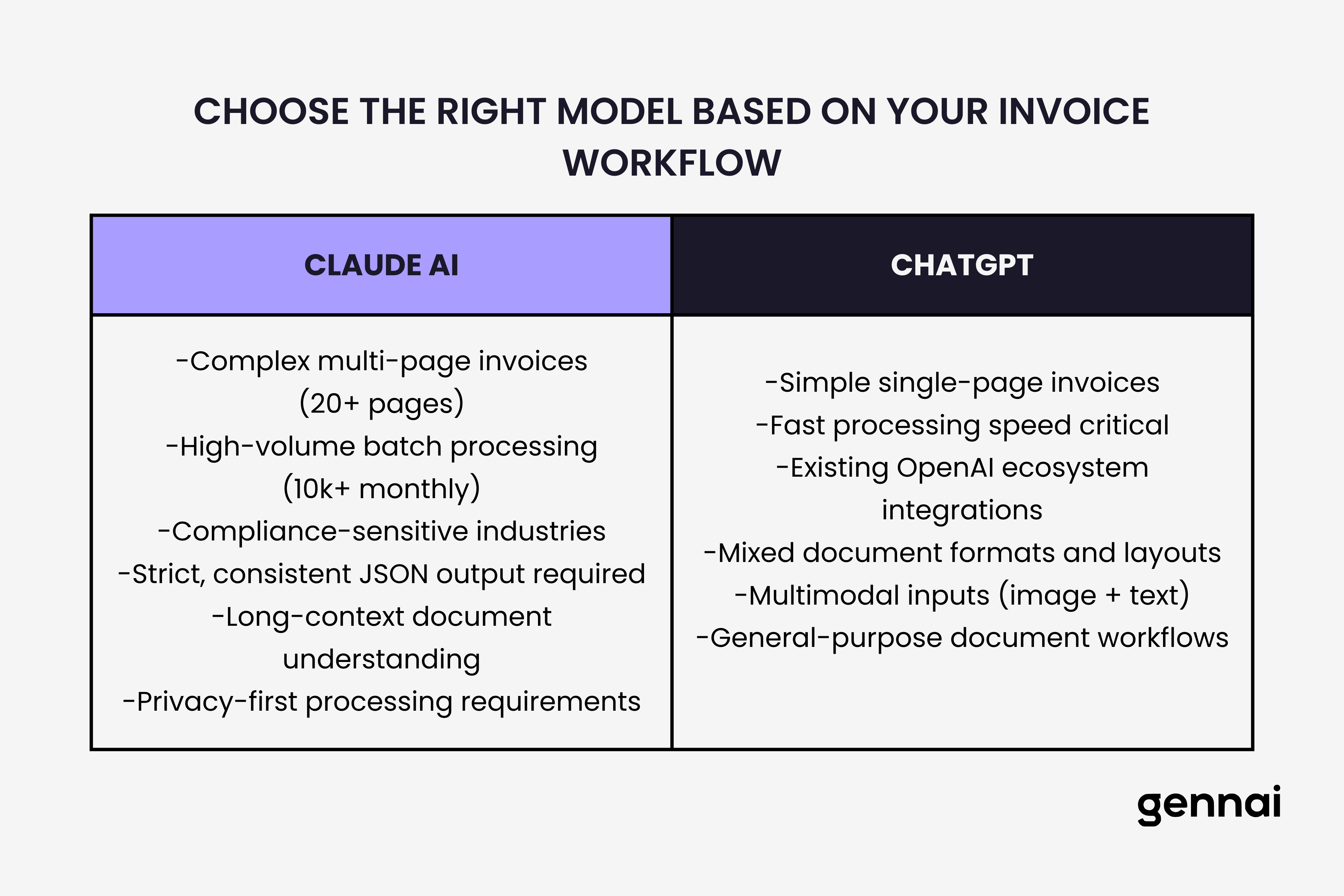
Choose Claude when processing complex, multi-page invoices with extensive line items. Its massive context window and strong reasoning capabilities handle documents that would overwhelm models with smaller context limits. Construction invoices, detailed service agreements, and complex project billing all benefit from Claude's ability to maintain context across dozens of pages.
Compliance-sensitive industries should favor Claude. Its Constitutional AI training makes it more reliable for handling sensitive financial data with appropriate safeguards. The model demonstrates fewer hallucinations and more conservative extraction practices, flagging uncertain fields rather than guessing incorrectly. This behavior reduces audit risk in regulated environments.
When output format consistency matters critically, Claude delivers more reliably. The model produces valid, properly structured JSON every time, eliminating the need for extensive post-processing validation. For systems where malformed outputs cause downstream failures, Claude's consistency provides significant operational benefits.
Businesses processing invoices in batch workflows benefit from Claude's long context window. You can send instructions, validation rules, and multiple invoices in a single API call, with Claude maintaining consistency across the entire batch. This approach reduces API calls and ensures uniform processing logic across all documents.
Organizations prioritizing data privacy and security find Claude's terms more favorable. Anthropic commits to not using customer data for model training, providing stronger guarantees than some alternatives. For companies processing sensitive financial documents, this privacy commitment carries significant weight.
When ChatGPT Is the Better Choice
ChatGPT excels in different invoice processing scenarios. Recognizing these strengths helps you leverage the right tool for your specific requirements.
Choose ChatGPT when processing speed takes priority over marginal accuracy improvements. The model's faster inference times and ability to process images without separate OCR can reduce total processing time by 40-50%. For businesses where invoice approval speed directly impacts working capital, these time savings matter significantly.
Companies processing primarily scanned or photographed invoices benefit from GPT-4o's integrated vision capabilities. Eliminating the separate OCR step simplifies architecture, reduces infrastructure complexity, and accelerates processing. Mobile invoice capture workflows particularly benefit from this streamlined approach.
Organizations already invested in the OpenAI ecosystem find ChatGPT integration more natural. If you're using GPT models for other business functions, maintaining a single vendor relationship simplifies management and potentially provides volume discounts. The extensive third-party integrations and broader developer community also offer implementation advantages.
Businesses requiring multimodal processing beyond just invoices favor ChatGPT's versatility. The model can handle related documents like purchase orders, receipts, and contracts without architecture changes. This flexibility becomes valuable for companies automating broader accounts payable workflows beyond invoice processing alone.
For startups and small businesses prioritizing rapid implementation, ChatGPT's larger community and more extensive documentation resources accelerate deployment. The abundance of code examples, tutorials, and community support reduces time-to-value compared to Claude's smaller but growing ecosystem.
Understanding the real cost of manual invoice processing makes clear that either AI option delivers massive improvements over manual methods. The choice between Claude and ChatGPT often matters less than the decision to implement AI automation in the first place.
The Hybrid Approach: Using Both
Many organizations discover optimal results come from using both models strategically. This hybrid approach leverages each model's strengths while mitigating weaknesses.
A common pattern routes simple, single-page invoices to ChatGPT for fast processing while directing complex, multi-page documents to Claude for thorough extraction. This routing logic maximizes processing speed for straightforward invoices while ensuring accuracy on complicated documents.
Another effective strategy uses ChatGPT for initial extraction and Claude for validation. ChatGPT's speed processes the bulk of invoices quickly, then Claude reviews flagged cases or high-value invoices requiring additional scrutiny. This two-tier approach balances speed and accuracy cost-effectively.
Some implementations employ both models concurrently for critical invoices, comparing outputs to identify discrepancies. When Claude and ChatGPT disagree on extracted values, the invoice flags for human review. This redundant processing catches errors that single-model approaches might miss, though it doubles processing costs.
For businesses serious about invoice automation, the choice between Claude and ChatGPT represents an optimization decision rather than a fundamental fork in the road. Both models deliver transformative improvements over manual processing, and many successful implementations use elements of both.
Making Your Decision
Choosing between Claude and ChatGPT for invoice processing ultimately depends on your specific requirements, existing infrastructure, and processing priorities.
Evaluate based on your invoice complexity. If you primarily process simple, standardized invoices from a few vendors, ChatGPT's speed and integrated vision capabilities likely provide better value. If you handle complex invoices with dozens of line items from diverse vendors, Claude's reasoning capabilities and consistency deliver superior results.
Consider your volume and cost sensitivity. At low volumes under 1,000 invoices monthly, model choice matters less than implementation quality. At enterprise scale processing 100,000+ monthly invoices, Claude's lower API costs and reduced error correction needs can generate meaningful savings despite slightly lower extraction accuracy percentages.
Factor in your technical capabilities and existing infrastructure. Organizations with strong OCR infrastructure already in place find Claude's separation of concerns cleaner and more maintainable. Companies starting fresh benefit from ChatGPT's integrated approach reducing architectural complexity.
Most importantly, test both models with your actual invoices before committing. Invoice characteristics vary dramatically across industries, vendors, and document types. Real-world testing with your specific document corpus provides more valuable insights than general benchmarks or comparisons.
Conclusion
Claude and ChatGPT both represent powerful solutions for AI invoice processing. Claude excels with complex documents, delivers more consistent output formatting, and provides stronger privacy guarantees. ChatGPT offers faster processing, integrated vision capabilities, and broader ecosystem integration.
The performance difference between 90% and 91% accuracy matters less than choosing the right model for your specific invoice characteristics and processing requirements. Both dramatically outperform manual processing and traditional OCR approaches.
For most businesses, the question isn't which AI is objectively better, but which one aligns best with your existing infrastructure, processing volume, and document complexity. Many successful implementations ultimately use both models strategically, routing different invoice types to the AI that handles them best.
Ready to implement AI invoice processing? Gennai uses advanced AI models with 95%+ accuracy to automatically extract and process invoices from your Gmail or Outlook inbox. Try it free and see how AI-powered automation works for your specific invoices.
TL;DR
- Claude Sonnet 3.5 achieves 90% accuracy with 100% output consistency; GPT-4 reaches 91% accuracy with 94% output consistency
- Claude excels at: complex multi-page invoices, batch processing, compliance-sensitive industries, and consistent JSON output
- ChatGPT excels at: fast processing (0.9-1.3s vs 1.2-1.5s), image/scan processing without separate OCR, and rapid implementation
- Cost comparison: Claude ~$1.50-$2.00 per 1,000 invoices; ChatGPT ~$1.80-$2.50 per 1,000 invoices
- Context windows: Claude 200,000 tokens vs ChatGPT 128,000 tokens
- Hybrid approach: Route simple invoices to ChatGPT for speed, complex invoices to Claude for accuracy
- Bottom line: Both dramatically outperform manual processing; choose based on your invoice complexity and infrastructure
Ready to automate your invoices?
Start extracting invoices from your email automatically with Gennai. Free plan available, no credit card required.
Start FreeRelated Articles
Accounts Payable Turnover Ratio Explained
The accounts payable turnover ratio shows how fast you pay suppliers. Get the formula, a worked example, benchmarks and what your number really means.
GuideNet 30 vs Net 60: What Payment Terms Really Mean for Your Cash
Net 30 vs net 60 explained for business owners: what each term means, when the clock really starts, and how the gap hits your cash on both sides.
GuideThe Accounts Payable Process, Step by Step (for Owners)
The accounts payable process has five steps: receive, verify, approve, pay, and record each invoice. Here is how each works and where owners lose money.