
Invoice Management Statistics 2026: Latest Data & Trends
Manual invoice processing costs $12.88-$19.83 per invoice, 39% contain errors, and 55%+ are paid late. Complete 2026 invoice management statistics with sources.

Manual invoice processing still costs the average business $12.88 to $19.83 per invoice. Nearly 39% of all invoices contain at least one error. And over half of all U.S. invoices are paid after their due date. These are not projections or best-case estimates. They are current benchmarks drawn from primary research published in 2024 and 2025 by institutions including Ardent Partners, QuickBooks, Parseur, DocuClipper, and Grand View Research. This article compiles the most relevant invoice management statistics for 2026: covering costs, error rates, automation adoption, market growth, payment delays, and AI performance. If you manage accounts payable or finance operations, these numbers directly affect your team's time, budget, and vendor relationships.
1. The State of Invoice Processing in 2026
Before diving into the specific numbers, it helps to understand where the industry actually stands. Invoice processing has been a target for automation for over a decade, but adoption remains lower than most forecasts predicted. As of 2026, the gap between what technology can deliver and what most businesses have implemented remains striking.
- 8% of finance teams are fully automated in 2026 (Rillion / Parseur)
- 68% of AP teams still manually key invoices into ERP (DocuClipper)
- 60-64% of finance teams are partially or significantly dependent on manual tasks (Rillion)
The numbers make clear that manual invoice processing is not a legacy problem that has been solved. For every finance team running a fully automated workflow, roughly nine others are still relying on spreadsheets, email inboxes, and manual data entry for a significant portion of their invoicing work. Only 32% of surveyed businesses have any automated process at all for invoice capture, according to DocuClipper research.
Why this matters: Despite years of innovation in AI and automation, the majority of finance teams worldwide still touch invoices manually at some point in the process. The gap between what tools can do and what most businesses have adopted represents a significant efficiency opportunity for any team willing to act first.
2. Invoice Processing Cost Statistics
Processing cost is often the most cited reason to pursue automation, and for good reason. The difference between manual and automated processing cost per invoice is substantial, and it compounds across every invoice your team handles each month.
Cost per invoice: manual vs. automated
| Metric | Manual Processing | AI-Automated Processing | Source |
|---|---|---|---|
| Cost per invoice (average) | $12.88 - $19.83 | $2.36 - $2.78 | Parseur / Ardent Partners 2025 |
| Cost per invoice (best-in-class) | $12.88 | $2.78 | Ardent Partners 2025 |
| Potential cost reduction | - | Up to 80% | Zipdo / Parseur |
| Error correction cost | ~$53 per mistake | Near zero | Industry data |
This connects directly to what the real cost of manual invoice processing analysis covers in detail: most businesses underestimate their processing costs because they only account for visible labor, ignoring error correction, late payment penalties, and approval bottlenecks.
3. Invoice Error Rate Statistics
Errors in invoice processing are far more common than most finance teams realize when they rely on manual workflows. And each error has a cascading cost: delayed payment, strained vendor relationships, and time spent on resolution instead of higher-value work.
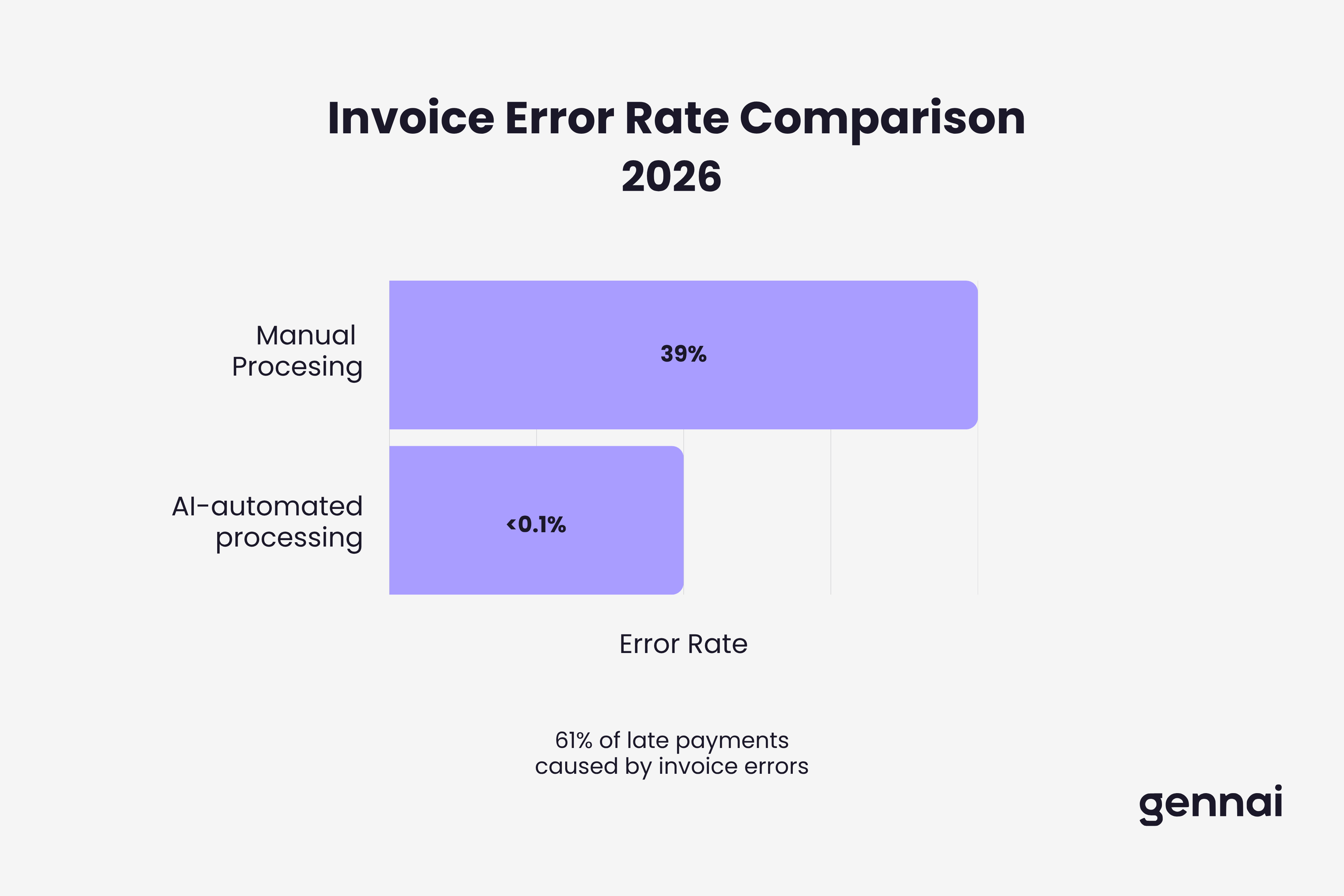
- 39% of manually processed invoices contain at least one error (DocuClipper)
- 61% of late payments in the U.S. result directly from invoice errors (Amalto)
- <0.1% error rate for AI-automated invoice processing (Industry benchmark)
The industry standard for an acceptable invoice error rate is 5% or below, according to Medius benchmarking data. Best-in-class AP teams target below 1%, with top performers reaching error rates as low as 0.8%. AI-powered systems lower this further, with automated processing achieving error rates below 0.1% through digital data capture and validation rules.
Invoice errors do not only create immediate rework. According to Resolvepay research, errors can raise processing costs by up to 20% and rework may add another 5-10% to total project costs. For companies processing thousands of invoices each month, even a modest reduction in error rate translates to meaningful cost savings.
Quick calculation: 39% of manually processed invoices contain errors. At a correction cost of roughly $53 per mistake, a team handling 1,000 invoices per month could be spending over $20,000 per month on error-related rework if their manual error rate tracks the industry average.
4. Invoice Processing Time Statistics
Speed matters in accounts payable. Slow processing cycles mean missed early payment discounts, strained supplier relationships, and cash flow problems that compound over time. The time gap between manual and automated processing is as stark as the cost gap.
| Processing Metric | Manual | Best-in-Class (Automated) |
|---|---|---|
| Average days to process one invoice | 14.6 days | 3.1 days |
| Time per invoice (task) | 10 - 30 minutes | 1 - 2 seconds (AI) |
| Invoices processed per hour (FTE) | 5 invoices | 30 invoices |
| Invoices per year (one FTE) | 6,082 | 23,333 |
| Approvals requiring 6+ sign-offs | 29% of enterprises | Configurable routing |
Approval bottlenecks are a major contributor to slow processing. According to DocuClipper, 29% of enterprises require six or more approvals for invoice processing, extending approval times to three weeks or more. Understanding how to automate invoice processing from end to end, including the approval stage, addresses this bottleneck directly.
5. Late Payment Statistics
Getting invoices processed on time is one problem. Getting them paid on time is another. Late payment rates remain high across most markets, and the consequences reach well beyond cash flow.
- 55%+ of U.S. invoices are paid after the due date (DocuClipper / Atradius)
- $17.5K average outstanding invoice balance per U.S. small business (QuickBooks 2025)
- 47% of small businesses had invoices overdue by 30+ days (QuickBooks 2025)
Research by Atradius indicates that only 36% of invoices in the U.S. are paid on time, while 9% are eventually written off as uncollectible. For small businesses specifically, the 2025 QuickBooks Small Business Late Payments Report found that over half (56%) of respondents were owed money from unpaid invoices, with the average balance reaching $17,500 per business.
The impact of late payments extends beyond cash flow. The same QuickBooks report found that small businesses with overdue invoices are 1.3 times more likely to face challenges hiring skilled workers, and 1.6 times more likely when payment terms exceed standard windows. Late payments also correlate with higher reliance on credit: affected businesses reported 21% higher loan usage and 31% higher use of lines of credit compared to those receiving timely payments.
| Late Payment Fact | Statistic | Source |
|---|---|---|
| Invoices paid on time in the U.S. | 36% | Atradius |
| Invoices written off as bad debt | 9% | Atradius |
| Average days past due (U.S. SMBs) | 8 days | Small Business Insight |
| SMEs expecting late payment | 54% | Industry survey |
| Invoices overdue by 2+ weeks | 20% | Industry survey |
| Late payments caused by invoice errors | 61% | Amalto |
| Manual invoices paid within 30 days | 6% | Industry study |
6. Automation Adoption Statistics
The gap between what businesses know they should do and what they have actually implemented is one of the defining characteristics of invoice management in 2026. Automation adoption is growing, but the pace is slower than most vendors or analysts predicted five years ago.
Current state of AP automation adoption:
- 20% of AP teams are now fully automated (DocuClipper)
- 41% plan to automate payables processes within the next 12 months
- 42% expect full AP automation to take 1 to 3 years
- 17% anticipate reaching full automation within 6 to 12 months
- 25% invoice management is the most commonly automated AP process
- 68% still manually key invoice data into ERP or accounting software
The primary obstacles to faster adoption are consistent across surveys. Budget limitations affect 29% of organizations considering AI-based invoice processing. Integration challenges with legacy ERP systems affect 28%. And a shortage of skilled talent to manage implementation affects 15%, according to Rillion research cited by Parseur.
For teams evaluating when and how to move forward, understanding how to choose invoice management software based on actual business needs rather than vendor claims is the practical starting point. The right solution depends on invoice volume, existing tech stack, and how invoices currently arrive, not on feature lists.
7. AI Invoice Processing Performance Benchmarks
The performance gap between AI-powered and traditional invoice processing is now well documented. These are not projected improvements but measured benchmarks from organizations that have implemented modern AP automation.
- 95-99% accuracy rate for AI-powered invoice data extraction (Parseur / Industry)
- 89% touchless invoice processing achievable with AI (Deloitte / Basware)
- 80% cost reduction possible when moving to AI processing (Zipdo / Parseur)
To understand what these numbers mean in practice: Deloitte's partnership with Basware demonstrated that enterprises can reach up to 89% touchless invoice processing, meaning nearly 9 in 10 invoices go from receipt to payment approval without any manual touchpoint. Best-in-class AP teams using AI tools process invoices at a cost of $2.78 per invoice with a 3.1-day cycle time, compared to $12.88 and 17.4 days for average teams still relying heavily on manual methods.
The accuracy improvement from AI is especially important when you consider the downstream effects. Moving from 85% accuracy (typical for older OCR systems) to 98-99% accuracy (modern AI) does not just cut the number of corrections needed. It eliminates the approval delays, vendor disputes, and duplicate payment risks that stem from incorrect extraction. The technical guide to AI invoice processing covers how these accuracy gains are achieved and what distinguishes genuine AI systems from basic OCR wrapped in an AI label.
How AI gets there: Machine learning models trained on large datasets can achieve accuracy rates above 95% on varied invoice formats, including PDFs from different vendors, scanned documents, and images captured by mobile devices. This is the same technology that powers automated invoice extraction directly from Gmail and Outlook inboxes.
8. Market Size and Growth Statistics
The invoice management and AP automation market is large and growing. These figures provide context for understanding the scale of investment happening in this space and why the competitive pressure to automate is increasing.
| Market Segment | Value / Projection | CAGR | Source |
|---|---|---|---|
| Invoice Processing Software Market (2023) | $2.78 billion | 14.2% | SkyQuest |
| Invoice Processing Software Market (2032 proj.) | $9.18 billion | 14.2% | SkyQuest |
| AP Automation Market (2023) | $3.08 billion | 12.8% | Grand View Research |
| AP Automation Market (2030 proj.) | Significant growth | 12.8% | Grand View Research |
| AP Invoice Automation Software (2026) | ~$1.75 billion | 14% | DocuClipper |
| Global E-Invoicing Market (2030 proj.) | $16.68 billion | N/A | Research.com |
9. E-Invoicing and Digital Adoption Statistics
The shift from paper to electronic invoice delivery has accelerated considerably. E-invoicing is no longer just a preference for large enterprises but increasingly a regulatory requirement in many markets.
- 60%+ of B2B invoices are now delivered electronically, with email as the primary channel (Industry data)
- 57% of invoice data from paper invoices is still entered manually into systems (DocuClipper)
- 66% of businesses still use Excel spreadsheets for AP tracking (DocuClipper)
More than 60% of B2B invoices are now delivered electronically, with email as the primary channel for the majority of small and mid-size businesses, according to industry data. Yet digital delivery does not automatically mean digital processing. Even among businesses receiving invoices by email, 57% still enter that data manually into their ERP or accounting system.
This is precisely where tools focused on automating invoice processing from email inboxes address the core problem. Receiving an invoice as a PDF attachment does not eliminate manual data entry unless you have a tool that reads, extracts, and exports that data automatically. Only 21% of U.S. small and mid-sized firms have connected their accounting system with payments and invoicing tools, according to a Viewpost survey cited by LLCBuddy.
Manual tasks take up 84% of the average AP practitioner's time, according to IOFM data. Despite the availability of automation tools, the working reality for most accounts payable professionals in 2026 is that they spend the majority of their time on tasks that technology could handle in seconds.
10. Key Takeaways: What These Statistics Mean for Your Business
The data points in this article tell a consistent story. Manual invoice processing is expensive, error-prone, and slow. Automation adoption is growing but remains the exception rather than the rule. And the performance gap between businesses that have automated and those that have not is widening each year.
| If your situation is... | What the data says |
|---|---|
| Error rate above 5% | You are in the majority, but that majority is losing money. At 39% average error rates and $53 per correction, the cost adds up fast. |
| Cost per invoice above $10 | Industry benchmarks show best-in-class teams process at $2.78. The gap between your current cost and that number is your automation ROI floor. |
| Cycle time above 10 days | The best-in-class benchmark is 3.1 days. Every day longer increases payment delay risk and reduces your ability to capture early payment discounts. |
| Still manually entering data from email PDFs | You are among the 57% still doing this. The tools to eliminate it exist, work reliably, and pay back their cost quickly. |
| Have not connected inbox to accounting system | Only 21% of U.S. SMBs have done this. It is one of the highest-ROI changes available to most finance teams. |
Looking at the Numbers Honestly
These statistics are not an argument for spending money on software. They are a measurement of the gap between where most finance teams operate and what their peers who have automated are achieving. That gap has a real dollar value specific to every business: multiply your monthly invoice volume by the difference between your current cost per invoice and the automated benchmark. That number is your starting point for any honest ROI conversation.
For teams that receive most of their invoices through Gmail or Outlook and export data to Xero or QuickBooks, the practical path forward is shorter than most assume. The infrastructure is already in place. What is missing is the connection layer that reads the invoice, extracts the data, and pushes it to the right place without anyone touching a keyboard. That is the problem Gennai was built to solve, and the statistics above explain exactly why it matters.
Explore how AI invoice processing works technically, see what the data says about accounts payable automation implementation, or review how invoice OCR converts scanned documents into structured data to understand what the technology actually does before committing to any tool.
Data Sources & References
- Parseur. "Global Trends in AI Invoice Processing." December 2025. parseur.com
- Parseur. "AI Invoice Processing Benchmarks 2026." November 2025. parseur.com
- DocuClipper. "59 Accounts Payable Statistics for 2025." March 2025. docuclipper.com
- QuickBooks / Intuit. "2025 US Small Business Late Payments Report." May 2025. quickbooks.intuit.com
- Medius. "Benchmarking AP Accuracy." October 2025. medius.com
- Resolvepay. "17 Statistics Showing the Hidden Cost of Invoice Errors." June 2025. resolvepay.com
- SkyQuest. "Global Invoice Processing Software Market." skyquestt.com
- Grand View Research. "Global Accounts Payable Automation Market." grandviewresearch.com
- Research.com. "17 Best Invoicing Software for 2026." January 2026. research.com
- InvoPilot. "50+ Late Invoice Statistics." April 2025. invopilot.com
- Rillion (via Parseur). AP Automation Challenges Survey. 2026.
- IOFM. AP Practitioner Time Study. iofm.com
- Amalto. Late Payment Causation Study. amalto.com
- LLCBuddy. "Invoice Management Statistics." September 2024. llcbuddy.com
- Atradius. U.S. Invoice Payment Research. atradius.com
- Ardent Partners / Zipdo. AP Benchmark Data. 2025.
Ready to automate your invoices?
Start extracting invoices from your email automatically with Gennai. Free plan available, no credit card required.
Start FreeRelated Articles
Accounts Payable Turnover Ratio Explained
The accounts payable turnover ratio shows how fast you pay suppliers. Get the formula, a worked example, benchmarks and what your number really means.
GuideNet 30 vs Net 60: What Payment Terms Really Mean for Your Cash
Net 30 vs net 60 explained for business owners: what each term means, when the clock really starts, and how the gap hits your cash on both sides.
GuideThe Accounts Payable Process, Step by Step (for Owners)
The accounts payable process has five steps: receive, verify, approve, pay, and record each invoice. Here is how each works and where owners lose money.