
Invoice Automation 2026: Benchmarks, Costs & Trends
The 2026 state of invoice automation: adoption data, cost per invoice benchmarks, e-invoicing mandates, and the trends shaping AP teams this year.

Invoice automation crossed a meaningful threshold in 2026. For the first time, the majority of AP departments globally report using some form of AI or automation in their invoice workflows. Yet only 8% of finance teams have reached full automation, and 68% still manually key invoice data into their accounting systems. The market is growing at 14.2% annually. New e-invoicing mandates went live across Europe and the Middle East in Q1 2026. Agentic AI is moving from vendor roadmaps to production deployments.
This report synthesizes the most current data from Ardent Partners, Parseur, Medius, Forrester, Rossum's DAT26 research, Grand View Research, and Gartner into a single view of where invoice automation stands, what is changing, and what the data signals about what comes next.
Chapter 1: The Adoption Paradox
Progress and Stagnation Side by Side
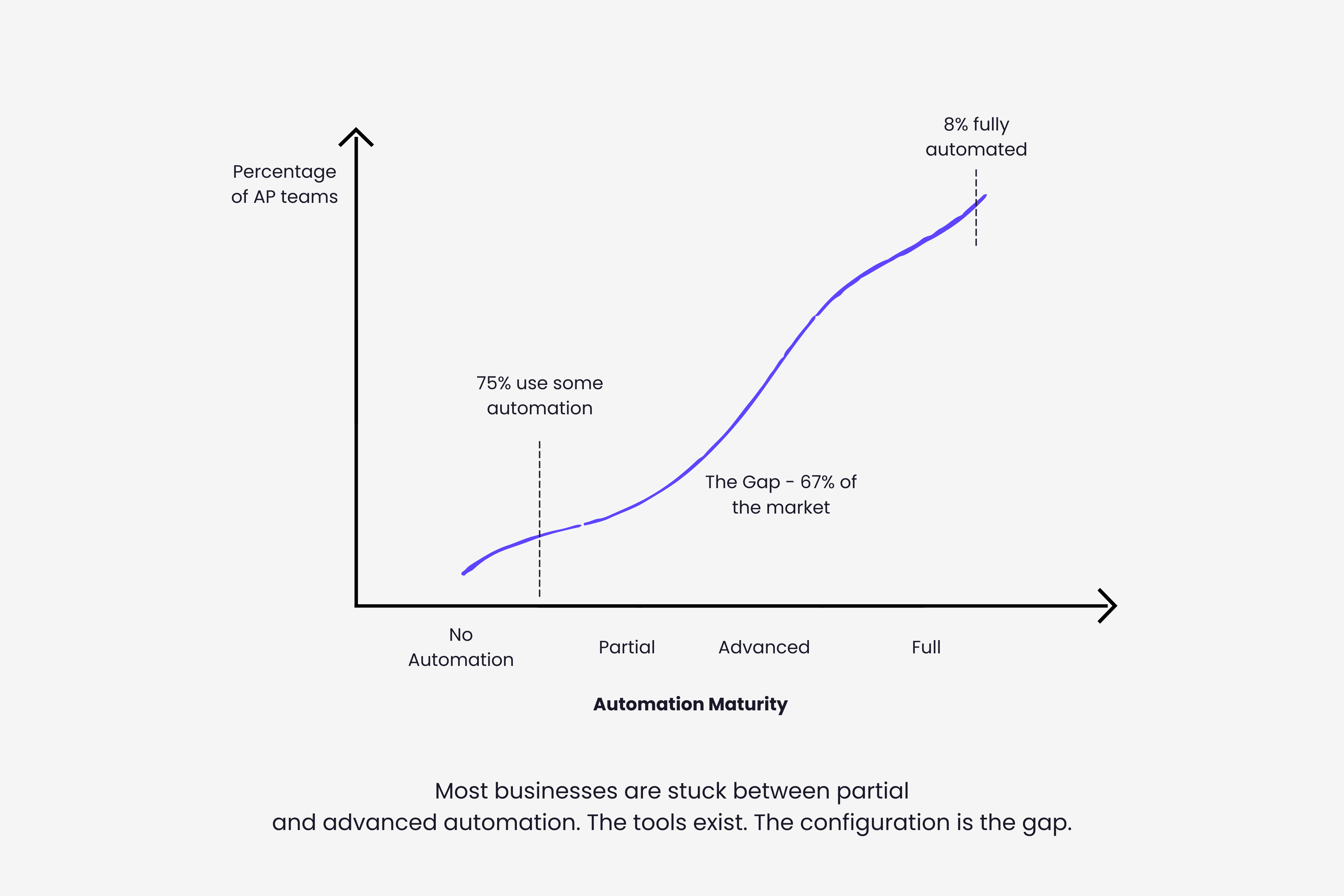
The headline number is deceptively optimistic. Medius reports that 75% of AP departments now use some form of AI or automation in their invoice workflows. But the definition of automation varies enormously in that figure. A team that uses a PDF reader to extract text and a Zapier workflow to move it to a spreadsheet technically uses automation. A team with fully touchless invoice processing from email to payment is also counted. The gap between those two realities is the adoption paradox of 2026.
| Metric | Figure | Source |
|---|---|---|
| AP departments using some form of automation | 75% | Medius 2025 |
| Finance teams that are fully automated | 8% | Rillion / Parseur 2026 |
| Teams still manually keying invoice data into ERP | 68% | DocuClipper 2025 |
| AP practitioner time spent on manual tasks | 84% | IOFM |
Signal: The experimentation phase is over. Finance leaders evaluating AP tools in 2026 are no longer asking whether automation works. They are asking whether it works at their specific invoice volume, with their vendor mix, and proves its value in measurable KPIs within a defined timeframe. Vendors that cannot demonstrate quantifiable ROI in the first 90 days are losing evaluations.
Chapter 2: The Performance Gap
What Best-in-Class Actually Looks Like
Ardent Partners tracks AP performance across thousands of organizations annually. The 2025 data shows a performance gap between best-in-class and average teams that has widened since 2022. The gap is not primarily explained by technology differences. Most teams have access to capable tools. It is explained by configuration depth: best-in-class teams have built complete automation across capture, validation, approval, and integration. Average teams have automated one or two stages and left the rest manual.
| KPI | Best-in-Class (Ardent Partners 2025) | Average | Manual / No Automation |
|---|---|---|---|
| Cost per invoice | $2.78 | $12.88 | $19.83+ |
| Cycle time (days) | 3.1 days | 17.4 days | 14.6 days avg |
| Exception rate | 9% | 22% | 39% error rate |
| Touchless processing | Up to 89% (Deloitte/Basware) | 60-80% high performers | 0% |
| Invoices/FTE/year | 23,333 | N/A | 6,082 |
| Error rate | Below 1% | 5% (acceptable) | 39% |
The full context for these benchmarks, including how to calculate your own cost per invoice, is covered in the 2026 invoice management statistics and the manual processing cost calculator.
Chapter 3: Market Size and Growth
A $9 Billion Market Growing at 14% Annually
The invoice processing software market was valued at $2.78 billion in 2023 and is projected to reach $9.18 billion by 2032, growing at a 14.2% CAGR according to SkyQuest. The broader AP automation market tracked by Grand View Research was valued at $3.08 billion in 2023 and is growing at 12.8% through 2030. E-invoicing specifically is on a faster trajectory: the global e-invoicing market is projected to surpass $16.68 billion by 2030, reflecting the compound effect of both technology adoption and regulatory mandates.
| Market Segment | 2023 Value | Projection | CAGR | Source |
|---|---|---|---|---|
| Invoice Processing Software | $2.78B | $9.18B by 2032 | 14.2% | SkyQuest |
| AP Automation Market | $3.08B | Significant growth by 2030 | 12.8% | Grand View Research |
| AP Invoice Automation Software | ~$925M (2021) | ~$1.75B by 2026 | 14% | DocuClipper |
| Global E-Invoicing Market | $5.87B (2020) | $16.68B by 2030 | ~11% | Research.com |
| AP Automation Market (broad) | $1.22B (2023) | $2.79B by 2032 | 8.83% | DocuClipper |
Chapter 4: E-Invoicing — The Regulatory Inflection Point
Mandates Move from Policy to Operational Reality
The most consequential development in Q1 2026 for invoice management teams with European or Middle Eastern supplier relationships is not a technology change. It is a regulatory one. Three major mandates went live between January and February 2026, with France's September 2026 deadline approaching for all large and mid-sized companies.
| Country | Mandate Status | Format / Network | Impact on AP teams |
|---|---|---|---|
| Belgium | LIVE — Jan 1, 2026 | Peppol / EN 16931 | All B2B invoices must be structured e-invoices. PDF invoices no longer compliant for domestic B2B |
| Poland | LIVE — Feb 1, 2026 (large taxpayers) | KSeF national platform | Tax authority validates invoices before delivery. Real-time clearance model |
| France | Sept 2026 (large/mid-sized) | PPF/PDP certified platforms | All businesses must be able to receive e-invoices. Large/mid-sized must also issue them |
| UAE | Voluntary Jul 2026, Mandatory Jan 2027+ | Peppol 5-corner model | Large taxpayers (AED 50M+ turnover) first. Phased expansion through 2027 |
| Germany | LIVE — receive (from 2025) | ZUGFeRD / XRechnung | Must be able to receive structured e-invoices. EDI permitted until 2028 |
Chapter 5: Five Trends Defining 2026
What the Data Points to Next
1. Agentic AI enters the AP workflow
The shift from AI-as-extraction-engine to AI-as-workflow-agent is the most significant technology development in AP automation in 2026. Traditional automation waits for input. Agentic systems initiate action: flagging an exception, sending a vendor inquiry, routing an approval, and following up on an overdue response, without a human triggering each step. Forrester's 2026 analysis noted that vendors are now deploying agentic capabilities for exception handling, fraud detection, and supplier management. Gartner forecasts that 40% of enterprise applications will embed task-specific AI agents by the end of 2026, up from less than 5% in 2025. For AP teams, this means the next generation of tools will manage exceptions rather than just flag them.
2. The performance measurement bar is rising
Rossum's DAT26 research found that 34.2% of finance leaders now track automation success through operational KPIs: cost per invoice, error rates, cycle time, and exception rates. The experimentation phase, where automation was measured loosely by team satisfaction or invoice volume processed, is giving way to quantitative ROI accountability. CFOs are requiring automation to prove its value in hard numbers within defined timeframes. This shift favors tools with built-in reporting dashboards and vendors who provide clear benchmark data.
3. Hyperautomation extends beyond AP
Thirty-three percent of finance leaders surveyed by Rossum in 2026 are pursuing hyperautomation: connecting invoice processing with procurement, customer success, and supply chain in unified automated workflows. UiPath's research shows that organizations applying hyperautomation achieved 42% faster process execution and 25% productivity gains. For invoice management, this means extraction tools are increasingly expected to be one node in a larger automated network, not a standalone product. Integration depth has become a primary evaluation criterion.
4. Explainable AI becomes a trust requirement
Rossum's DAT26 survey found that 35.8% of finance leaders consider a system trustworthy only when it can reliably flag exceptions while allowing standard invoices to pass through. The parallel finding: blackbox AI that cannot explain why it approved or rejected an invoice is increasingly seen as a liability rather than an advantage. Finance teams processing regulated financial documents need auditable decision trails, not opaque automation. Vendors who cannot provide explainable exception handling are losing enterprise evaluations to those who can.
5. Fraud prevention becomes standard, not premium
With 0.8% to 2% of invoices paid twice in organizations without robust duplicate controls, and vendor fraud increasingly sophisticated (spoofed invoices, redirected bank details, shell vendor schemes), fraud detection capabilities are moving from enterprise-tier add-ons to baseline product requirements. Forrester's 2026 AP trends analysis highlighted anomaly detection and supplier-risk scoring as capabilities vendors are actively developing across market segments. For buyers: evaluate whether fraud controls are included in the base product or licensed separately.
Chapter 6: Where Teams Still Get Stuck
The Gap Between Partial and Full Automation
The data is consistent across every survey cited in this report: most teams that have started automating have not finished. The three most commonly cited barriers in 2026 are budget constraints (29%), legacy ERP integration complexity (28%), and a shortage of skills to implement and manage automation tools (15%), according to Rillion research. But a fourth barrier goes largely unmeasured: configuration incompleteness. Many teams have deployed automation tools and then stopped at the first working stage, leaving approval workflows manual, GL coding unautomated, or file storage disconnected.
| Gap | Description |
|---|---|
| Capture without extraction | The tool detects invoice emails but does not extract structured data. The team still reads PDFs and types data manually. This describes roughly a third of 'automated' setups. |
| Extraction without integration | Data is extracted correctly but exported to a spreadsheet rather than synced directly to the accounting system. Manual import step remains. This is the most common mid-stage gap. |
| Integration without two-way sync | Invoices flow from extraction to accounting, but approval status and GL coding do not flow back. Two separate records diverge over time, creating reconciliation problems at month end. |
| Automation without measurement | The system is running but nobody tracks cost per invoice, exception rates, or cycle time. No feedback loop means no optimization. This affects the majority of SMB implementations according to the Rossum DAT26 survey, which found fewer than 35% of teams track formal automation KPIs. |
Observation: The most valuable thing most AP teams can do in 2026 is not adopt a new tool. It is complete the configuration of the tool they already have. Most implementations stop at 60-70% of what the platform supports. The remaining 30-40% of configuration is where most of the cost savings live.
Chapter 7: What Comes Next
The 2026-2028 Invoice Automation Outlook
The directional signals from market data, regulatory timelines, and technology adoption curves point toward three developments that will shape invoice management over the next two years.
1. E-invoicing coverage expands significantly
France's September 2026 deadline will bring structured e-invoice requirements to one of Europe's largest economies. Ireland's November 2028 rollout, Slovenia's June 2026 mandate, and the UAE's January 2027 large-taxpayer requirement all represent additional market coverage for structured invoicing. By 2028, the European Commission's ViDA framework will require most EU member states to have mandatory B2B e-invoicing. AP tools that handle only PDF attachments will face growing coverage gaps as these mandates expand supplier-side adoption.
2. Agentic capabilities become standard product features
Gartner predicts 40% of enterprise applications will embed task-specific AI agents by the end of 2026, up from less than 5% in 2025. For AP tools, this transition means exception handling, approval escalation, and vendor communication will progressively shift from notification-based (the tool tells a human to act) to action-based (the tool acts and notifies a human of the outcome). Teams evaluating tools in 2026 and 2027 should ask vendors specifically what their agentic roadmap looks like, not just what their current feature set includes.
3. Small teams close the gap with enterprise performance
The performance gap between enterprise AP teams and SMBs has historically been explained by budget: large companies could afford sophisticated tools, small ones could not. Email-first tools with transparent, flat pricing have disrupted this dynamic. A business processing 250 invoices per month can now reach best-in-class extraction accuracy and direct accounting integration for $29 per month. The technology barrier to closing the performance gap is lower in 2026 than it has ever been. The remaining barrier is awareness and configuration discipline, not cost.
The Report in a Sentence
Invoice automation in 2026 is past the adoption question and into the execution quality question. The majority of teams have started. Most have not finished. The tools exist to close the gap at every market segment. The data shows clearly what finished looks like: $2.78 per invoice, a 3.1-day cycle, and an exception rate under 10%. Everything between where most teams are today and those numbers is solvable with the right configuration, not with a more expensive tool.
The full suite of resources referenced in this report is available across the Gennai blog: the best practices guide for 2026 covers the twelve practices that close the gap, the 52-item automation checklist provides a configuration audit framework, and the 12-tool comparison helps identify where the right tool fits in the market.
Data Sources and References
- Ardent Partners. State of ePayables 2025
- Medius. AP Benchmark Report 2025
- Parseur. Global Trends in AI Invoice Processing. December 2025
- Parseur. AI Invoice Processing Benchmarks 2026. November 2025
- Rossum. Document Automation Trends 2026 (DAT26). January 2026
- Forrester. What's New for AP Invoice Automation in 2026. January 2026
- Gartner. Predicts 2026: The New Era of Agentic Automation Begins
- Gartner. 40% of Enterprise Apps Will Feature AI Agents by 2026. August 2025
- SkyQuest. Global Invoice Processing Software Market
- Grand View Research. Global AP Automation Market
- DocuClipper. 59 Accounts Payable Statistics for 2025. March 2025
- Rillion (via Parseur). AP Automation Challenges Survey. 2026
- Vertex Inc. Navigating Urgent Global E-Invoicing Mandates. February 2026
- Klippa. 2026 E-Invoicing Regulations in the EU and UK. January 2026
- IOFM. AP Practitioner Time Study
- UiPath. Automation Trends Report 2025
- Deloitte / Basware. Enterprise Touchless Processing Data
- QuickBooks / Intuit. 2025 US Small Business Late Payments Report. May 2025
TL;DR
- 75% of AP departments use some automation, but only 8% are fully automated — the gap is configuration, not technology
- Best-in-class teams process invoices at $2.78 each vs $12.88 average — a 78% cost gap that compounds with volume
- The invoice processing software market is valued at $3.17B and growing at 14.2% annually toward $9.18B by 2032
- E-invoicing mandates went live in Belgium and Poland in Q1 2026, with France (Sept 2026) and UAE (Jan 2027) approaching
- Agentic AI is the biggest technology shift: tools that act on exceptions rather than just flagging them
- The biggest barrier is not adopting a tool — it is finishing the configuration of the tool you already have
- The data points to one conclusion: execution quality, not tool selection, separates best-in-class from average
Ready to automate your invoices?
Start extracting invoices from your email automatically with Gennai. Free plan available, no credit card required.
Start FreeRelated Articles
12 Invoice Automation Tools Compared (2026 Guide)
12 invoice automation tools compared for 2026: email capture, AI extraction, and AP suites, with pricing, pros and cons, and the best fit for each.
GuideHow to Choose Invoice Management Software
How to choose the right invoice management software. Decision framework covering features, ROI, integrations, and scalability for any business size.
GuideInvoice Software: Complete Buyer's Guide 2026
Choose the right invoice management software for your business. Compare features, pricing, and types. Real advice from finance professionals. 2026 guide.