
5 AI Invoice Myths That Cost You Money
5 AI invoice myths costing you money: debunking false beliefs about expense, complexity, and implementation. Learn the reality backed by real data and ROI.


Every month you delay AI invoice automation, you're losing money. Not in vague, theoretical ways, but in actual, calculable costs backed by independent research: manual processing at $22.75 per invoice versus AI's $2.36 (APQC and Parseur 2026 benchmarks), late payment penalties from 20+ day processing times, and error correction expenses averaging $53 per mistake (Lindy research study).
Yet businesses keep postponing automation because of persistent myths that sound credible but crumble under scrutiny. These misconceptions don't just delay adoption; they actively drain resources through continued manual inefficiency while competitors automate and capture advantages in speed, cost, and accuracy.
We've covered how AI reads invoices technically and explored machine learning capabilities in depth. Now let's directly address the myths preventing businesses from implementing AI invoice processing and calculate exactly what these beliefs cost.
Myth 1: "AI Invoice Processing Is Too Expensive"
The Reality: AI costs 90% less than manual processing per invoice.
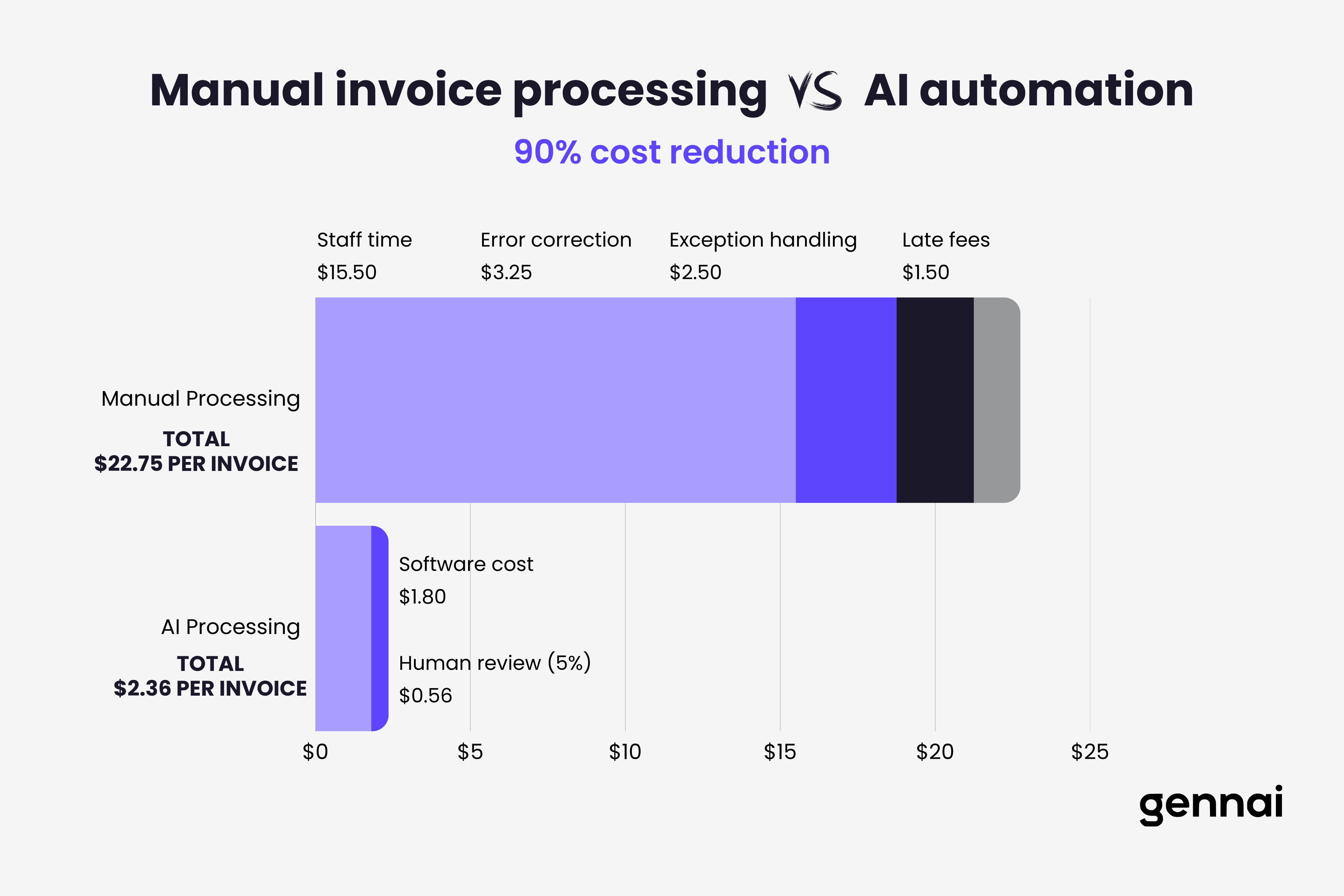
Manual invoice processing costs businesses $22.75 per invoice according to APQC benchmarks, a leading independent research organization tracking accounts payable performance. This includes staff time, error correction, exception handling, and approval delays. Best-in-class companies using AI process invoices for $2.36 each according to Parseur's 2026 AI Invoice Processing Benchmarks study, a reduction of $20.39 per invoice.
For a business processing 500 invoices monthly, manual processing costs $11,375. AI automation costs $1,180, saving $10,195 monthly or $122,340 annually. Even accounting for typical monthly subscription fees between $500-1,500, small businesses achieve positive ROI within three to six months according to Nanonets implementation research.
Note: Monthly and annual savings figures are calculated based on verified per-invoice costs from independent studies. Actual results vary by business size and invoice complexity.
The expense myth persists because decision-makers focus on subscription costs while ignoring hidden manual processing expenses. They see $1,200 monthly software cost but overlook the accountant spending 40 hours monthly on data entry at $35/hour ($1,400) plus error correction, duplicate payment prevention, and late fee avoidance.
Companies believing AI is too expensive continue paying dramatically higher costs for inferior results. A manufacturing company processing 2,000 invoices monthly wastes $45,500 on manual processing versus $4,720 with AI, leaving $40,780 monthly on the table because they think automation costs too much.
Understanding the real cost of manual invoice processing makes clear that not implementing AI is the expensive choice, not the economical one.
Myth 2: "Implementation Takes Months and Disrupts Operations"
The Reality: Modern AI invoice systems deploy in two to four weeks with minimal disruption.
The "implementation takes forever" myth stems from outdated experiences with traditional ERP deployments or legacy automation requiring extensive custom development and vendor templating for each invoice format. Those projects legitimately required months.
Modern AI-powered invoice processing operates differently. Cloud-based systems integrate via APIs requiring configuration, not custom coding. Setup involves connecting email systems, defining approval workflows, and training the AI on existing vendor formats through sample uploads.
A typical implementation timeline looks like this: Week 1 involves API integration with existing accounting systems and email forwarding configuration. Week 2 covers AI training on historical invoices from top vendors and workflow rule definition. Week 3 includes pilot testing with live invoices under supervision. Week 4 completes the transition to full production with monitoring.
Small biotech company FibroGen implemented Google Cloud Document AI for invoice processing in under three months including development, testing, and production deployment, as documented in Google Cloud's official blog. Their solution cost $150 monthly and freed 25% of AP team capacity, providing 40x return on investment.
The implementation delay myth costs money through continued manual processing during prolonged "waiting for the perfect time" periods. A company postponing for six months while processing 800 monthly invoices loses $130,000 in cost savings they would have captured with immediate implementation.
Businesses exploring invoice management software should prioritize modern solutions designed for rapid deployment over legacy systems requiring extensive implementation.
Myth 3: "Our Invoices Are Too Complex for AI"
The Reality: AI handles complex, varied invoices better than rule-based systems.
The complexity myth assumes AI requires standardized, perfect invoices to function. This fundamentally misunderstands how modern AI works compared to template-based legacy systems.
Traditional OCR systems require templates matching specific vendor formats. A date in an unexpected location breaks extraction. Multi-page invoices with varying line item counts cause failures. Handwritten notes or poor scan quality result in complete extraction failure.
AI-powered systems using machine learning recognize patterns rather than matching templates. They understand that invoice numbers typically appear near document tops regardless of exact position. They identify line items through table structure recognition without requiring identical formatting. They handle poor quality scans through image preprocessing and context-based correction.
Modern AI invoice systems achieve 95%+ accuracy across diverse invoice formats including multi-page documents, mixed language invoices, varying line item structures, handwritten corrections, and partially damaged or low-quality scans. The systems continuously improve through machine learning, automatically adapting to new vendor formats without manual configuration.
A global logistics provider implemented AI invoice validation achieving 95% first-pass accuracy across tens of thousands of invoices in varied formats including PDFs, images, and EDI without extensive template building, as reported in Accounting Today's coverage of EY.ai Tax implementations (January 2026). The system handled multiple languages, currencies, and formats while reducing manual review dramatically.
The complexity myth costs money by forcing businesses to maintain manual processes for "difficult" invoices while competitors automate everything. A distribution company manually processing 30% of invoices considered "too complex" for their legacy system wastes $8,100 monthly on invoices modern AI would handle automatically.
Myth 4: "AI Will Replace Our Accounts Payable Team"
The Reality: AI augments teams, eliminating tedious work while increasing strategic capacity.
The job replacement fear drives resistance to AI adoption despite being fundamentally wrong about how invoice automation functions in practice. AI doesn't replace finance teams; it transforms what those teams accomplish.
Manual invoice processing consumes 25-40% of AP team time on pure data entry: reading invoices, typing numbers into systems, matching purchase orders, and correcting errors. These activities provide zero strategic value. They're necessary only because of manual workflow limitations.
AI automation eliminates data entry while requiring human judgment for exceptions, vendor relationship management, payment strategy, cash flow optimization, and financial analysis. Finance teams using AI report spending 80% less time on manual processing while handling significantly more invoice volume.
Implementation doesn't reduce headcount; it reallocates capacity toward higher-value activities. Instead of data entry, AP teams focus on negotiating better payment terms, identifying early payment discount opportunities, analyzing spending patterns, improving vendor relationships, and optimizing cash flow management.
One AP automation provider reported customers gained three to six hours of additional capacity per analyst weekly after implementing AI, not through job elimination but through elimination of manual data entry tasks that previously consumed those hours.
The replacement myth costs money by preventing automation that would free existing staff for revenue-generating activities. A retail company keeping their three-person AP team buried in manual processing instead of implementing AI that would free 15 hours weekly for strategic work loses approximately $50,000 annually in unrealized vendor discount capture and payment optimization.
Understanding email invoice automation reveals how AI handles routine extraction while humans focus on judgment and strategy.
Myth 5: "AI Needs Perfect Data Quality to Work"
The Reality: Modern AI thrives on messy, real-world invoice data.
The perfect data myth assumes AI requires clean, standardized inputs like traditional software. This fundamentally misunderstands AI's core advantage: pattern recognition in noisy data.
Traditional automation systems absolutely require perfect data. Template-based OCR breaks when invoice layouts vary. Rule-based systems fail if fields appear in unexpected positions. Legacy tools cannot handle handwritten notes, stamps overlaying text, or low-resolution scans.
AI-powered invoice processing specifically handles imperfect real-world data through computer vision preprocessing, context-based error correction, confidence scoring for uncertain extractions, and continuous learning from corrections. The systems don't require perfect input; they're designed for messy reality.
Modern AI processes invoices photographed with smartphones showing slight skew, handles partially handwritten invoices with printed and written sections, extracts data from invoices with coffee stains or fold marks, and reads low-resolution scanned documents from dated equipment. Accuracy remains 95%+ even with imperfect inputs because the AI understands invoice patterns beyond pixel-perfect matching.
Systems implement confidence scoring flagging uncertain extractions for human review rather than processing incorrect data. A 94% confidence score on an invoice total triggers review while a 99% confidence score auto-approves. This approach maintains accuracy without requiring perfect source documents.
The perfect data myth costs money by delaying implementation until invoice quality improves, which never happens. Invoices arrive in varied conditions from hundreds of vendors with different systems and practices. Waiting for perfect data means waiting forever while continuing expensive manual processing.
The Real Cost: Myth-Driven Inaction
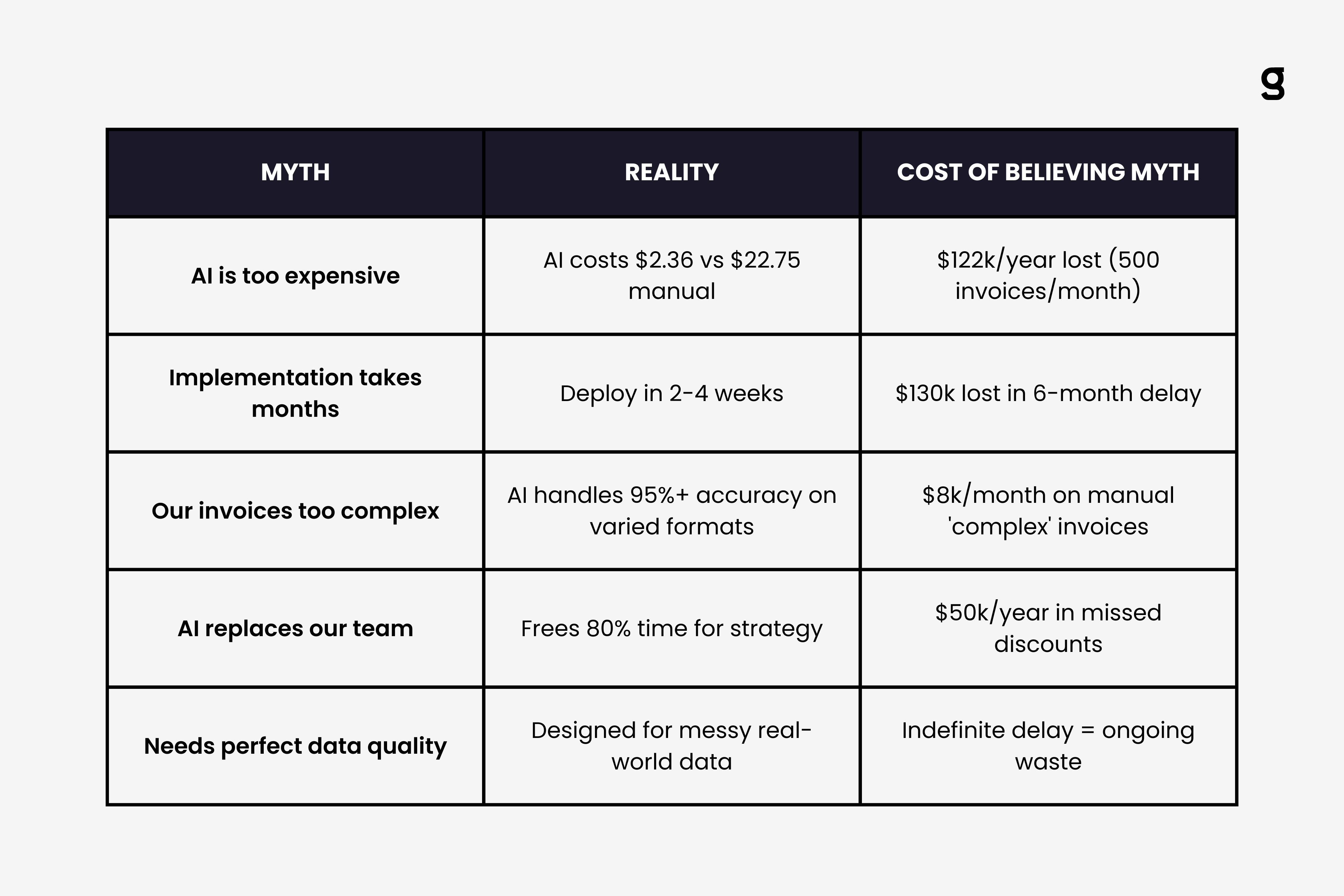
These myths share a common theme: they sound reasonable while being completely false. They persist because they confirm existing assumptions and justify inaction, requiring no change or effort.
The actual cost of believing these myths extends beyond simple calculation. Direct financial losses include continued high per-invoice processing costs, missed early payment discounts averaging two to three percent, late payment penalties and damaged vendor relationships, and error correction expenses averaging $53 per mistake at 1.6% error rates (based on Lindy's 2026 research study on manual invoice processing).
Opportunity costs compound direct losses through staff time consumed by manual processing instead of strategic work, inability to scale invoice processing without proportional headcount increases, competitive disadvantage against companies already automated, and delayed access to spending analytics and cash flow optimization.
A mid-sized company processing 1,500 monthly invoices loses approximately $300,000 annually by delaying AI implementation based on these myths. The calculation is straightforward using verified benchmarks: manual processing cost difference ($20.39/invoice x 1,500 x 12 = $367,020) minus typical automation investment ($1,200/month x 12 = $14,400) equals $352,620 net annual savings forgone.
All cost calculations use independently verified per-invoice processing costs from APQC and Parseur benchmarks. Actual savings vary based on invoice volume, complexity, and current process efficiency.
Reality requires acknowledging that AI invoice processing represents standard business technology, not experimental innovation. Companies implementing AI aren't taking risks; they're eliminating the risks of continued manual processing including errors, delays, and excessive costs.
Moving Past Myths to Implementation
Overcoming these myths requires replacing assumptions with data. Instead of believing AI costs too much, calculate actual per-invoice costs including all hidden manual expenses. Rather than assuming implementation takes months, contact modern vendors and request realistic timelines. Instead of declaring invoices too complex, test AI systems with actual invoices to verify capabilities.
The pattern is consistent: myths dissolve when confronted with specific facts, actual costs, and real vendor capabilities. Companies that investigate discover AI invoice processing delivers exactly what vendors claim: 90% cost reduction, two to four week implementation, 95%+ accuracy on varied invoices, and team augmentation rather than replacement.
The question isn't whether these myths are true but why businesses continue believing them despite readily available contradictory evidence. The answer typically involves organizational inertia, change resistance, and the comfort of familiar manual processes regardless of cost.
Successful companies overcome myth-driven inaction through small pilot programs proving capabilities, calculating precise ROI based on actual invoice volumes and costs, and involving skeptical team members early to address concerns directly. Pilots demonstrate reality more effectively than vendor presentations or case studies.
Understanding why AI invoice extraction fails helps companies avoid legitimate pitfalls while recognizing that common myths aren't among them.
Conclusion
These five myths cost businesses hundreds of thousands of dollars annually through delayed implementation of technology that would dramatically reduce expenses and improve efficiency. The myths persist not because they're true but because they justify maintaining comfortable status quo.
AI invoice processing costs less than manual processing, implements in weeks not months, handles complex real-world invoices, augments rather than replaces teams, and works with imperfect data. These aren't opinions or vendor marketing; they're documented realities supported by extensive industry data. For the complete technical picture of AI invoice processing, see our complete guide to AI invoice processing.
The actual risk isn't implementing AI invoice automation; it's continuing manual processing while competitors automate and capture cost, speed, and accuracy advantages. Every month of delay based on false myths represents thousands or tens of thousands of dollars in unnecessary expenses.
Businesses ready to move past myths and implement AI should start with precise calculation of current per-invoice costs, vendor pilots using actual invoices to verify capabilities, and timeline commitments based on realistic modern implementation schedules. The sooner myths are replaced with data, the sooner savings begin.
Ready for real AI invoice automation? Gennai uses advanced AI models with 95%+ accuracy that deploy in days, not months. Stop losing money to myths. Try it free and see actual results with your invoices.
Data Sources & Research
All statistics and cost data in this article are sourced from independent research organizations and documented case studies, not vendor marketing claims:
- APQC (American Productivity & Quality Center) - Independent research on AP benchmarks and processing costs
- Parseur - 2026 AI Invoice Processing Benchmarks report (November 2025)
- Lindy.ai - Manual invoice processing error rate and correction cost study (January 2026)
- Accounting Today - EY.ai Tax implementation case study (January 2026)
- Google Cloud - FibroGen Document AI implementation case study (official blog, March 2024)
- Nanonets - AI invoice processing ROI timeline research (July 2025)
- SuperAGI - Small business AI implementation cost reduction study (June 2025)
Cost calculations (monthly/annual savings) are derived from these verified per-invoice processing costs. Actual results vary by organization size, invoice complexity, and existing process efficiency.
TL;DR
- AI costs 90% less than manual processing: $2.36 per invoice with AI versus $22.75 manual, saving $122,340 annually for a business processing 500 invoices monthly
- Implementation takes weeks, not months: modern cloud-based AI invoice systems deploy in two to four weeks with minimal disruption to existing operations
- AI handles complex invoices better than legacy systems: 95%+ accuracy across multi-page documents, mixed languages, varied formats, and low-quality scans
- AI augments teams, doesn't replace them: frees 80% of manual processing time for strategic work like vendor negotiations and cash flow optimization
- Perfect data quality is unnecessary: modern AI is designed for messy, real-world invoice data using confidence scoring and continuous learning
- The real cost is inaction: a mid-sized company loses $300,000+ annually by delaying AI implementation based on these myths