
Will AI replace bookkeepers? A task-by-task answer
AI will absorb the keying and matching in bookkeeping, not the accountability. See which tasks run on their own, which need review and which stay human.

AI will replace a large share of what bookkeepers do each month, and it is unlikely to replace the bookkeeper. The tasks that go first are made of keying, reading and matching: typing invoice data, applying coding you have applied a hundred times before, matching bank lines to documents that already exist. The tasks that stay are the ones where someone has to decide, explain or answer for the result: how to treat a new supplier, whether to release a payment run, what to do about a document that never arrived, whether the period is right.
So the useful question is not whether the job survives. It is which of your tasks are on which side of that line, and how fast the line is moving. This article answers it task by task.
What the labor data says, and what it does not
The US Bureau of Labor Statistics projects that employment of bookkeeping, accounting and auditing clerks will fall 6% between 2025 and 2035, from about 1.53 million jobs to about 1.45 million. BLS attributes the decline to software automating many of these clerks' tasks, so the same work needs fewer people, and expects the remaining workers to move toward analysis and advisory work.
For accountants and auditors, the same projection period shows growth of 5%. BLS expects AI and other technology to automate some routine work and raise efficiency, without reducing overall demand, and to make advisory and analytical work more central.
Two cautions before reading too much into this. These are projections for US occupational categories, not forecasts about AI specifically. And the clerk category describes people employed to record and check transactions, which will not match every bookkeeper, least of all one who runs an independent practice and already spends part of the week advising clients.
Still, the pattern is informative. The keying-heavy occupation is projected to shrink and the judgment-heavy one to grow. That is what you would expect if the work is being unbundled rather than eliminated, and unbundling is the right way to look at it.
"Replace" is the wrong unit
A bookkeeper is a bundle of tasks, and software does not take bundles. It takes tasks one at a time, starting with the ones that are cheapest and safest to hand over. The five levels of accounting autonomy give a way to describe where each task sits: level 0 is fully manual, level 1 is assisted (software suggests, you confirm each item), level 2 is supervised automation (software executes under rules, you review batches), level 3 is exception-based autonomy (software executes inside policy, you work the queue of what falls outside it) and level 4 adds resolution of most exceptions with evidence, with a person owning the outcome.
The jump that changes a bookkeeper's week is from level 2 to level 3. Below it, you still look at every item, even if only to click OK. Above it, you look at what the system could not resolve.
Four questions that predict whether a task gets automated
Whether a task reaches level 3 depends less on how clever the AI is than on four properties of the task itself:
- Is the input complete and structured? A PDF invoice in hand is. An invoice that never arrived is not.
- Does a rule or your own history determine the answer? A supplier you have paid twenty times has a settled coding. A supplier you have never paid does not.
- Can a mistake be undone cheaply? A miscoded line can be recoded. A released payment cannot be recalled.
- Does someone's legal accountability attach to the result? A coded line carries little. A filed return or a signed-off period carries a lot.
If the first three answers are yes and the fourth is no, software can run the task and you handle the exceptions. A no on any of the first three means software can prepare the work but a person decides. A yes on the fourth means a person signs regardless of how good the software gets.
The bookkeeper's month, task by task
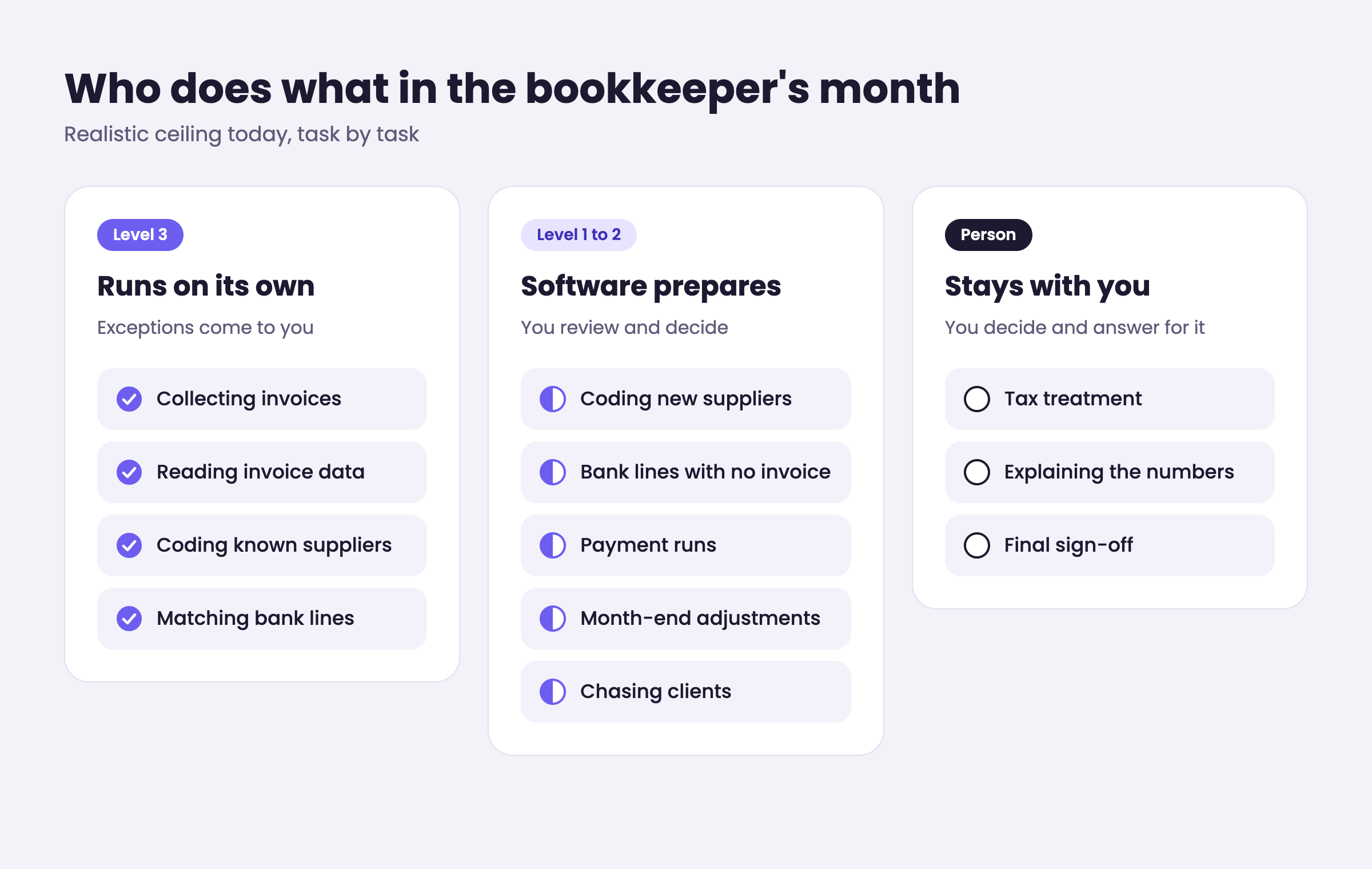
| Task | Realistic ceiling today | What software can carry | What stays with a person |
|---|---|---|---|
| Collecting supplier invoices and receipts | Level 3 | Pulling documents from inboxes and messaging channels, reading them, flagging duplicates | Deciding which sources are in scope; chasing documents that live in a supplier portal or a client's drawer |
| Entering invoice data | Level 3 | Extracting supplier, dates, totals, tax and line items; keeping the original beside the data | Reviewing what the system flags as unreadable or inconsistent |
| Coding known suppliers | Level 3 | Applying the coding you used last time, based on your own history | Spot checks; changing the rule when the business changes |
| Coding new suppliers and unusual items | Level 1 to 2 | Suggesting an account and tax treatment | The decision: expense or asset, reverse charge or not, business or client cost |
| Matching bank lines to documents | Level 3 for matching | Matching amounts, dates and references, including split and partial payments | Reviewing the match rules; signing off that the bank activity is explained |
| Resolving bank lines with no document | Level 2 | Showing which supplier and which month is missing | Finding the document, or deciding what to do when there is none. Creating an entry without evidence is not a task to automate |
| Supplier payment runs | Level 2, by design | Preparing the run and flagging anything unusual | Releasing the funds, and checking any change of supplier bank details out of band |
| Month-end adjustments and accruals | Level 2 for mechanics | Recurring journals, flags for invoices dated in the period but received late | Accruals that depend on facts only you know, such as a dispute or a service delivered but not yet invoiced |
| Tax treatment and filings | Person | Preparing the figures | Judgment on treatment; accountability for what is filed |
| Chasing clients for what is missing | Level 1 to 2 | Detecting the gap and drafting the request | The relationship, and knowing which client will answer only to a phone call |
| Explaining the numbers and advising | Level 0 to 1 | Drafting summaries and surfacing patterns | Everything the client actually pays for: what the numbers mean and what to do |
A few rows deserve a comment, because they run against what people expect.
Capture is closer to autonomy than coding. The obstacle is rarely the AI reading a document. It is coverage: a system can only handle the documents it can see, and in most small businesses they are spread across a founder's personal inbox, a shared mailbox, a messaging thread with a contractor and a few supplier portals. The bookkeeper's old job of knowing where the paperwork hides becomes the job of deciding which sources the system should watch.
Reconciliation splits in two. Matching a bank line to a document that exists is mechanical. A bank line with no document behind it is a capture problem that reconciliation discovered late, and the human work is finding the document or deciding what its absence means.
Payments stay human on purpose. Preparing a payment run is easy to automate. The reason to keep a person at release is that payments are irreversible and are the usual target of fake invoices and supplier impersonation, and the control that stops those is a person making a call to a known number. The approval is the product, not an obstacle to it.
Coding learns from you. For known suppliers, coding that learns from your own accounting history is a reasonable level 3 task. Every exception you resolve should shrink the queue next month, which is also what makes the queue a place where your judgment compounds instead of repeating.
Where the hours go
The hours do not vanish. They move in three directions.
From entry to the exception queue. Once capture, coding and matching run at level 3, the work that reaches you is only what the system could not resolve. Owning that queue is a real job: deciding what counts as an exception, resolving it, and noticing when the same exception keeps coming back because a rule is missing. The failure mode is treating the queue as optional. An unworked queue is just a backlog with better branding.
From per transaction to per policy. Instead of confirming each line, you write down the policy the system follows: which suppliers are in scope, what threshold triggers review, when something is capitalized, who releases payments. A policy decision made once replaces a thousand per-line decisions, and mistakes in it are also made once. It takes more judgment per hour, not less.
From the close week to continuous work. When documents arrive and match continuously, the close becomes a confirmation of work that already happened, rather than a batch event in the first week of the month. That changes how you schedule your own work across clients.
The uncomfortable part is pricing. If your fee is built from hours of keying and matching, those hours are the ones being absorbed, and the fee goes with them. Fees tied to the client, the outcome or the review and advice you provide hold up better because they follow the work that remains.
A one-month self-audit
Take last month's timesheet, or reconstruct a typical week. Label each block of time with a level from 0 to 4, using the four questions above. Time spent at levels 0 to 2 on tasks that pass the first three questions is the time most exposed. Time spent on tasks that fail those questions, or that carry accountability, is the part of your work that gets more valuable as the rest is automated. The goal is not to predict your job. It is to see how much of your week sits in each group and to choose, deliberately, where to move first.
If you are the business owner
The mirror-image risk applies to you. Because software handles more, it is tempting to assume that nobody needs to look at anything. Autonomy of this kind moves responsibility from each transaction to the policy and the exceptions; it does not remove it. When a vendor says it automates bookkeeping, ask which step, under which policy, with what route for exceptions and who approves anything that moves money. A vendor who can answer that step by step is describing a real system. Agentic tools in accounts payable and the broader AI bookkeeping guide cover where those claims tend to be strongest and weakest.
Where Gennai fits
Gennai is building toward autonomous accounting for small businesses, and it is designed to complement your accounting software and your accountant or bookkeeper, not to replace them. Today it works on the upstream steps in the table: it captures supplier invoices from connected inboxes, forwarding, uploads and messaging channels, extracts the accounting-relevant data including line items, categorizes invoices based on your own accounting history, reconciles uploaded bank statements against captured invoices to update payment status and surface missing documents, and exports the records to Xero, QuickBooks Online and Holded. Review and correction stay with you. Gennai does not connect to your bank, move money or close your books.
If you want to see how that looks for the capture-to-export part of the workflow, how Gennai works walks through it, and you can try it free on your own invoices.